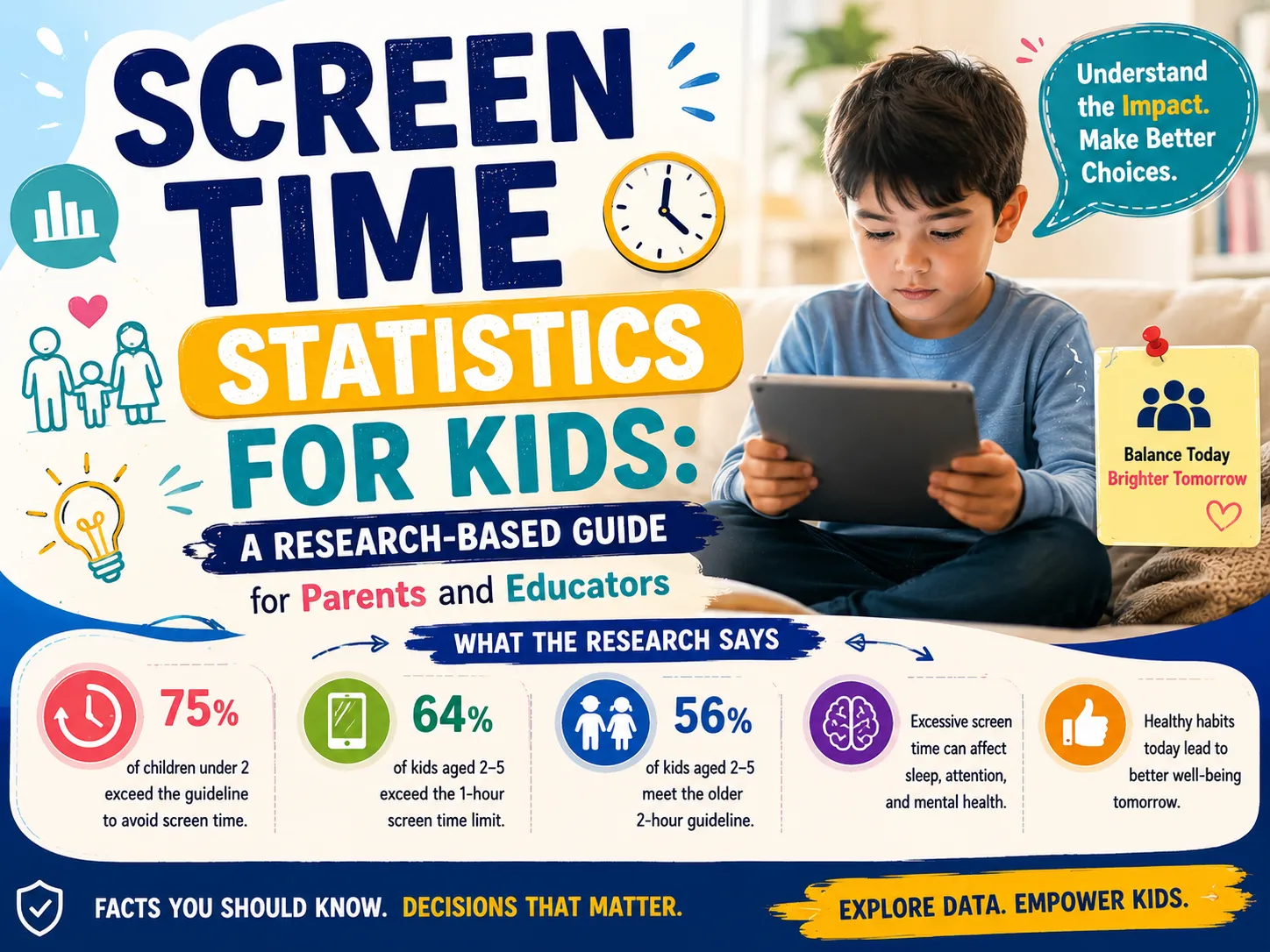
Screen time has become a normal part of childhood, but the numbers show that many children still exceed health-based guidelines, especially in the early years. In a large meta-analysis of 95 samples covering 89,163 children, only 24.7% of children younger than 2 years met the “no screen time” guideline, and only 35.6% of children aged 2 to 5 years met the “no more than 1 hour a day” guideline.
This matters because screen exposure affects more than entertainment habits; it can influence sleep, physical activity, learning, and family routines. The World Health Organization advises limiting screen-based sedentary time for children under 5, while the American Academy of Pediatrics emphasizes quality, context, and family media habits rather than only time counts.
Table of Contents
Key Screen Time Statistics
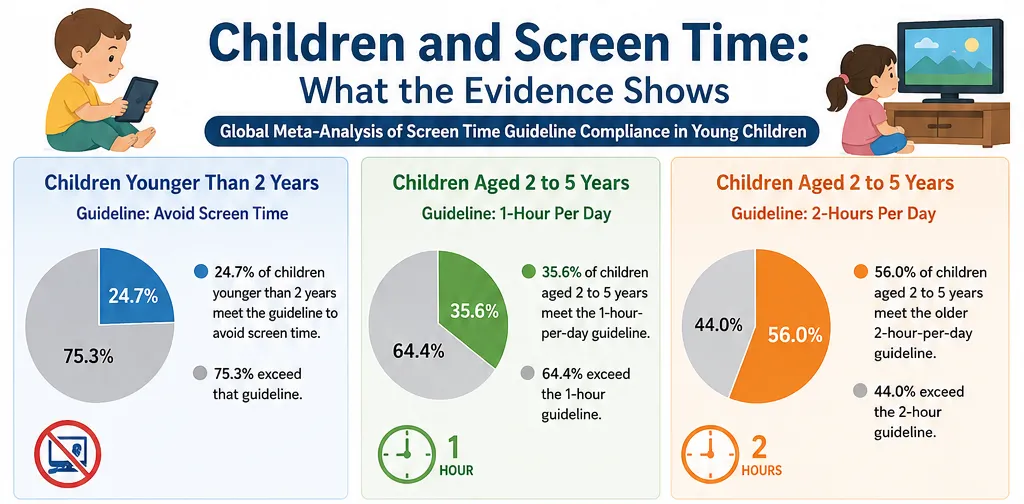
- 24.7% of children younger than 2 years meet the guideline to avoid screen time
- 75.3% of children younger than 2 years exceed that guideline.
- 35.6% of children aged 2 to 5 years meet the 1-hour-per-day guideline.
- 64.4% of children aged 2 to 5 years exceed the 1-hour guideline.
- 56.0% of children aged 2 to 5 years meet the older 2-hour-per-day guideline.
- 44.0% of children aged 2 to 5 years exceed the 2-hour guideline.
- 63 studies and 95 nonoverlapping samples were included in the meta-analysis.
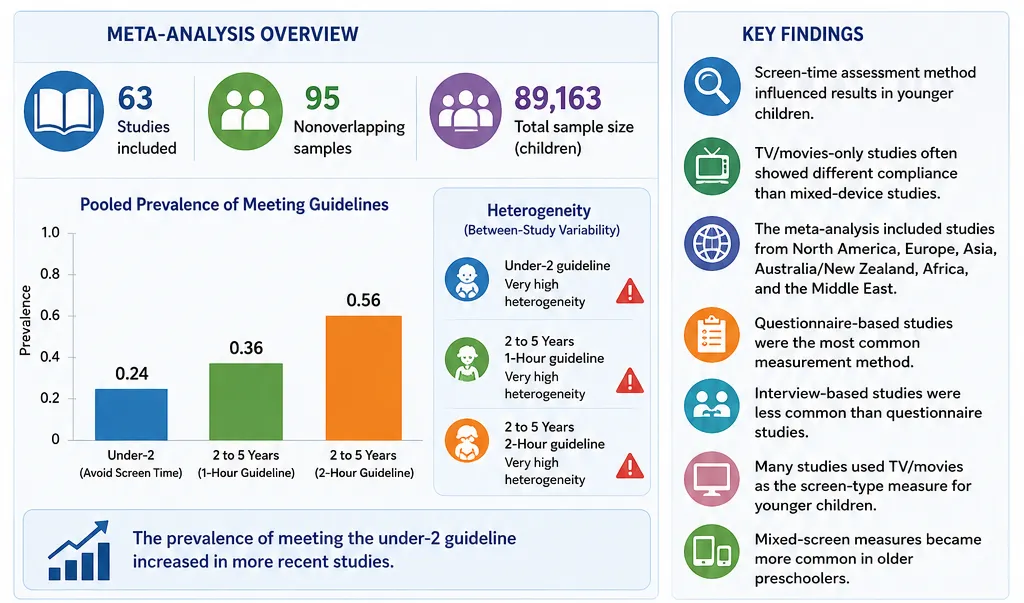
- The total sample size was 89,163 children.
- The pooled prevalence of meeting the under-2 screen-time guideline was 0.24.
- The pooled prevalence of meeting the 2-to-5-year 1-hour guideline was 0.36.
- The pooled prevalence of meeting the 2-to-5-year 2-hour guideline was 0.56.
- The prevalence of meeting the under-2 guideline increased in more recent studies.
- Screen-time assessment method influenced results in younger children.
- TV/movies-only studies often showed different compliance than mixed-device studies.
- The under-2 estimate showed very high between-study heterogeneity.
- The 2-to-5-year 1-hour estimate also showed very high heterogeneity.
- The 2-to-5-year 2-hour estimate showed very high heterogeneity.
- The meta-analysis included studies from North America, Europe, Asia, Australia/New Zealand, Africa, and the Middle East.
- Questionnaire-based studies were the most common measurement method.
- Interview-based studies were less common than questionnaire studies.
- Many studies used TV/movies as the screen-type measure for younger children.
- Mixed-screen measures became more common in older preschoolers.
- The WHO under-5 guideline package covers activity, sedentary behavior, sleep, and screen-based sedentary activities in one 24-hour framework.
- The AAP now prioritizes quality, context, and conversation over strict minute limits for many ages.
- The AAP still advises no screens before 18 months, except video chatting.
- The AAP still recommends about 1 hour of high-quality content daily for ages 2 to 5.
- AAP guidance emphasizes device-free bedrooms and mealtimes.
- The WHO guidelines are built on evidence, expert consensus, feasibility, and equity.
Screen Time by Age
Screen time patterns differ sharply by age, with the youngest children being the most sensitive to overuse. The strongest evidence base for strict limits is in children under 5, where guidelines focus on protecting sleep, movement, and direct human interaction.who+1
For children younger than 2 years, the key recommendation is to avoid screen time outside of video chatting. For ages 2 to 5 years, the main threshold is no more than 1 hour a day of high-quality content, though some older AAP material and some studies still reference 2 hours as a less strict benchmark.who+2
Device Ownership Statistics
Device ownership is rising, which makes screen exposure harder to manage in households with children. Contemporary research notes that children’s access to tablets, smartphones, streaming video, and mobile devices has expanded rapidly, changing both how often and how long they are exposed to screens.
The key trend is not just ownership but portability: phones and tablets are easier for children to use outside the living room, so monitoring becomes more difficult. That shift also makes bedroom use, car use, and unsupervised app access increasingly important to track in family media plans.choc+1
Daily Screen Time
Daily screen time in early childhood is often higher than recommended, especially when television, streaming, tablets, and phones are combined. The meta-analysis found that a majority of children under 5 did not meet the recommended limits, showing that daily exposure is widespread rather than exceptional.
One important finding is that how researchers measure screen time changes the numbers. Studies using questionnaires often reported higher compliance than interviews, which suggests that parent recall and social desirability can affect estimates of daily exposure.
Educational vs Entertainment Screen Time
Not all screen time behaves the same way, and that is one reason modern pediatric guidance focuses on context and content. Educational, interactive, and co-viewed screen use may have very different effects from passive entertainment, especially when adults talk with the child about what they are watching or using. +1
Still, the major concern is displacement: screen use becomes risky when it replaces sleep, free play, reading, movement, or face-to-face interaction. That is why many experts recommend asking not only “how much screen time?” but also “what is it replacing?” +1
Sleep & Screen Time
Sleep is one of the clearest areas where screen habits matter. Pediatric guidance commonly advises keeping screens out of bedrooms and stopping screen use before bedtime because blue light, stimulation, and content arousal can delay sleep and reduce sleep quality.choc+1
The WHO’s under-5 guidance explicitly links sedentary screen time with a 24-hour health framework that also includes sleep and movement. In practical terms, a child who spends long evenings on screens may be losing both sleep time and the settling routine that helps them rest well.who+1
Mental Health Statistics
Research on mental health and screen time is more mixed than sleep research, but the risk pattern is consistent: heavy, passive, or unsupervised use is more concerning than limited, purposeful use. The strongest concerns involve mood problems, attention difficulties, irritability, and reduced emotional regulation when screens crowd out offline life.
The AAP’s newer approach reflects this complexity by emphasizing family context, content quality, and interaction rather than rigid universal limits. That shift matters because the same amount of screen time can have very different effects depending on what the child is doing and whether an adult is involved.
Physical Health Statistics
Physical health effects often show up indirectly through reduced movement, poorer sleep, and more sedentary time. WHO guidance for children under 5 is built around the idea that screen time is part of a broader daily health pattern, not an isolated behavior.who+1
For young children, the main concern is that screen time competes with active play, outdoor movement, and motor development. The evidence base therefore supports reducing passive screen use while preserving time for physical activity and unstructured play.
Academic Performance Statistics
Academic effects depend heavily on age, content, and whether screens interfere with reading, homework, and attention. For younger children, excessive screen time can reduce the time available for language-rich interaction, book reading, and early learning through play.
For school-age children, the issue is often less about screens themselves and more about overuse, multitasking, and bedtime use. When devices cut into sleep or study time, academic performance is more likely to suffer. +1
Social Media Statistics
Social media is not the main screen-time concern for toddlers and preschoolers, but it becomes increasingly relevant as children get older and begin using connected devices. AAP guidance for older children and adolescents focuses on safe, age-appropriate digital participation rather than a one-size-fits-all minute cap.
The key parental issue is supervision: as children gain access to social platforms, the risks shift toward comparison, overstimulation, algorithmic feeds, and exposure to inappropriate content. For this reason, media planning should evolve with age rather than remain fixed.choc+1
Global Screen Time Statistics
Screen-time habits vary across countries, but the global pattern is consistent: many children under 5 exceed recommended limits. The meta-analysis included studies from multiple world regions and found that adherence is far from universal, especially when more realistic mixed-device measures are used.
The prevalence of meeting guidelines also differed by geography and measurement method, showing that cultural routines, household structures, and access to devices all influence results. That makes local context important when writing about screen time for a global audience.
Parental Control Statistics
Parental control is one of the most important moderators of child screen habits, especially for younger ages. The AAP recommends family media plans, co-viewing, common-area use, and device-free bedrooms and mealtimes as practical controls that reduce harm without relying only on punishment or strict time policing.choc+1
The evidence suggests that controls work best when they are consistent and developmentally realistic. In other words, the goal is not perfect restriction but a healthy digital environment that protects sleep, learning, movement, and conversation. +1
Expert Recommendations
The WHO recommends healthy daily movement, adequate sleep, limited sedentary behavior, and restricted screen-based sedentary time for children under 5. Its guidelines are explicitly designed for the full 24-hour day, not just screen minutes.who+1
The AAP’s current direction is more nuanced than older “two hours a day” messaging. It still supports no screens before 18 months except video chatting, around 1 hour of high-quality content daily for ages 2 to 5, and strong attention to context, co-use, and family routines for older children.choc+1
Frequently Asked Questions
1. Is all screen time bad for kids?
No. Quality, context, and purpose matter, and interactive or educational use may differ from passive entertainment.
2. What is the safest screen-time limit for toddlers?
For children under 18 months, the AAP advises no screen time except video chatting, and for ages 2 to 5, about 1 hour of high-quality content is the common benchmark.
3. Why do some studies use 2 hours and others 1 hour?
Older guidance and some studies still use 2 hours as a benchmark, but more recent pediatric recommendations emphasize stricter limits for young children. +1
4. Does screen time affect sleep?
Yes, especially when screens are used in the evening or in bedrooms.choc+1
5. What matters more: time or content?
Both matter, but current pediatric advice gives more weight to content quality, timing, and whether the screen use replaces sleep or play.
References
- McArthur BA, Volkova V, Tomopoulos S, Madigan S. Global Prevalence of Meeting Screen Time Guidelines Among Children 5 Years and Younger. JAMA Pediatrics. 2022.trytimeout
- World Health Organization. Guidelines on physical activity, sedentary behaviour and sleep for children under 5 years of age. 2019.trytimeout
- American Academy of Pediatrics. Digital Ecosystems, Children, and Adolescents: Policy guidance. 2026.publications.aap
- American Academy of Pediatrics. Updated screen time recommendations for parents. 2026.choc