
Akbar–Birbal moral stories in English are a wonderful way to teach life lessons to children in a simple and enjoyable manner. These stories are short, interesting, and full of wisdom, which makes them easy for kids to understand and remember.
How to explain this moral to kids:
After reading the story, talk to the child in simple words. Ask them what Birbal did and why it was right. Connect the moral to daily life, such as telling the truth, thinking calmly, or being patient. Use examples from school or home so the lesson feels real and practical.
When to tell this story:
These stories are best told during bedtime, story time in class, moral science periods, or when a child makes a mistake and needs gentle guidance. They also work well during family discussions or school assemblies.
What habit it helps build:
Akbar–Birbal stories help children develop habits like honest thinking, problem-solving, patience, respect for others, and confidence. They also encourage children to think before acting and to choose intelligence over anger or fear.
35 Akbar Birbal Moral Stories in English for Kids 2026
Table of Contents
Birbal and the Clever Answer

One day, Emperor Akbar asked a tricky question in his court. He said, “How many crows are there in my kingdom?” Everyone became silent. They did not know the answer. Birbal smiled and said, “Your Majesty, there are exactly one lakh crows.”
Akbar was surprised and asked, “What if there are more?”
Birbal replied, “Then they must be visiting their relatives from other kingdoms.”
Akbar laughed and asked again, “What if there are fewer?”
Birbal answered calmly, “Then some crows have gone to visit their relatives.”
The whole court laughed, and Akbar praised Birbal for his smart and clever answer.
Moral of the story
A clever mind and calm thinking can solve even difficult questions.
What Kids Can Learn
- Think calmly before answering
- Use intelligence instead of fear
- A smart reply can save you from trouble
Question for the Child to Think
What would you say if someone asked you a question with no clear answer?
Birbal’s Wisdom Saves the Day

One day, Emperor Akbar was very upset. Two farmers came to the court, both claiming that a piece of land belonged to them. They argued loudly and blamed each other. Akbar listened carefully but could not decide who was telling the truth. He asked Birbal to solve the problem.
Birbal went to the land and looked at it closely. He noticed a well in the middle of the field. Birbal asked both farmers, “Who built this well?”
The first farmer quickly said, “I did.”
The second farmer replied, “No, I built it.”
Birbal smiled and said, “Let us ask the well itself.” Everyone was surprised. Birbal told the guards to dig a little around the well. Soon, they found old tools buried near it. One farmer became nervous and admitted that he had lied. The other farmer was the real owner.
Akbar was happy and praised Birbal for his wisdom. Justice was done, and the innocent farmer got his land back.
Moral of the story
Truth always comes out when wisdom is used wisely.
What Kids Can Learn
- Always speak the truth
- Stay calm while solving problems
- Wisdom is stronger than arguments
Question for the Child to Think
Why do you think lying made the problem worse for the dishonest farmer?
Akbar Tests Birbal’s Intelligence

One day, Emperor Akbar decided to test Birbal’s intelligence. He ordered his ministers to bring a heavy wooden stick to the court. Akbar said, “Birbal, I want you to measure this stick, but you cannot use any ruler, scale, or rope.”
All the courtiers laughed and thought Birbal would fail. Birbal thought quietly for a moment. Then he placed the stick on the floor and made a mark at both ends using a piece of chalk. After that, he took a small stick and measured the distance between the two marks step by step.
Birbal then said, “Your Majesty, this stick is exactly twelve small-stick lengths long.”
Akbar smiled and asked, “But how is this correct without a ruler?”
Birbal replied, “A ruler is only a tool. Intelligence is more important. Any object can be used for measurement if we think wisely.”
Akbar was very pleased. He praised Birbal and told the court that intelligence and presence of mind are greater than expensive tools. The courtiers learned an important lesson that day.
Moral of the Story
Intelligence and smart thinking are more powerful than tools.
What Kids Can Learn
- Think creatively to solve problems
- Do not panic in difficult situations
- Intelligence matters more than resources
Question for the Child to Think
Can you think of a problem where you can use common things to find a solution?
Birbal and the Case of the Missing Ring

One day, Emperor Akbar lost his precious ring in the court. He was very worried because the ring was a gift from his father. Akbar called Birbal and asked him to find the ring. Birbal thought for a while and said, “Your Majesty, the ring is inside the court, and the thief is also here.”
All the courtiers became nervous. Birbal gave each courtier a small stick and said, “The thief’s stick will grow longer by tomorrow morning.” Everyone was surprised, but they followed Birbal’s order.
The next day, Birbal checked all the sticks. One stick was shorter than the others. Birbal smiled and said, “The thief cut his stick because he was afraid it would grow.” The courtier accepted his mistake and returned the ring to Akbar.
Akbar was very happy and praised Birbal for his intelligence. The innocent courtiers were relieved, and the thief learned an important lesson.
Moral of the Story
Fear of truth always exposes a wrongdoer.
What Kids Can Learn:
- Lying creates more problems
- Intelligence is better than force
- Wrong actions are always caught
Question for the Child to Think
Why did the thief cut his stick instead of telling the truth?
Birbal’s Smart Way to Find the Thief

One day, a rich merchant came to Emperor Akbar’s court. He complained that someone had stolen his bag of gold while he was resting in the palace garden. Akbar asked Birbal to find the thief. Birbal looked at all the servants standing there and said, “The thief is one of you, but there is no need to be afraid.”
Birbal gave each servant a piece of white cloth and said, “Hold this cloth tightly. The cloth of the thief will turn black by tomorrow morning.” The servants went home, feeling nervous.
The next day, Birbal checked the cloths. All were clean and white except one. One servant had washed his cloth again and again, but it looked old and weak. Birbal smiled and said, “This is the thief. His fear made him wash the cloth too much.”
The servant accepted his mistake and returned the gold. Akbar praised Birbal for his smart thinking. Everyone understood that fear always shows who is guilty.
Moral (One Sentence):
Fear and guilt always reveal the truth.
What Kids Can Learn:
- Wrong deeds create fear
- Smart thinking can solve problems
- Honesty keeps us confident
Question for the Child to Think:
What made the thief act differently from the other servants?
Birbal and the Honest Farmer

One day, a poor farmer came to Emperor Akbar’s court. He bowed respectfully and said that he had found a gold coin while working in his field. He wanted to return it because it did not belong to him. Akbar was pleased with the farmer’s honesty and asked Birbal to reward him.
Just then, a rich man stepped forward and claimed that the gold coin was his. He said he had lost it near the farmer’s field. Birbal listened carefully and asked the rich man, “How many gold coins did you lose?”
The rich man replied, “I lost one hundred gold coins.”
Birbal smiled and said, “This farmer found only one coin, not one hundred. So this coin cannot be yours.” The rich man became silent. Akbar understood the truth and punished the rich man for lying.
Akbar praised the farmer for his honesty and rewarded him with gold coins. The farmer went home happy, and everyone in the court learned the value of truth.
Moral of the Story
Honesty is always rewarded.
What Kids Can Learn
- Always tell the truth
- Do not be greedy
- Honest actions bring respect
Question for the Child to Think:
Why do you think Akbar rewarded the farmer even though he was poor?
Birbal Teaches a Lesson to the Proud Man

One day, a proud man came to Emperor Akbar’s court. He said, “I am the smartest person in this kingdom. No one is as intelligent as me.” Akbar smiled and asked Birbal to test the man.
Birbal gave the man a simple task. He showed him a bowl filled with water and said, “Take this bowl around the court and do not spill even one drop.” The proud man laughed and said the task was very easy.
As he started walking, Birbal quietly told the guards to beat drums loudly. The noise scared the man, and he became nervous. His hands shook, and water spilled from the bowl. Birbal then said, “You failed because you were not calm.”
The proud man felt ashamed. Birbal explained, “True intelligence is not about showing off. It is about staying calm and humble in every situation.” Emperor Akbar praised Birbal’s wisdom, and the proud man learned an important lesson.
Moral of the Story
Pride leads to failure, but humility leads to success.
What Kids Can Learn:
- Do not be proud of your knowledge
- Stay calm in difficult situations
- Respect others and be humble
Question for the Child to Think:
Why did the proud man fail even though the task looked easy?
Birbal and the Greedy Merchant

One day, a greedy merchant came to Emperor Akbar’s court. He complained that Birbal had taken a bag of gold from him and had not returned it. Birbal calmly said that the merchant was lying. Akbar asked Birbal to prove the truth.
Birbal requested the merchant to bring the bag of gold to the court the next day. When the merchant brought the bag, Birbal said, “This bag does not belong to you. The real bag is much heavier.”
The merchant quickly replied, “No, this is the same bag. It only feels light because some gold is missing.”
Hearing this, Birbal smiled. He turned to Akbar and said, “Your Majesty, the merchant has exposed himself. If this were truly his bag, he would not know that gold was missing.” The merchant realized his mistake and bowed his head in shame.
Akbar punished the merchant for his greed and praised Birbal for his sharp thinking. The court learned that greed often leads people to tell lies and lose respect.
Moral of the Story
Greed makes people careless and dishonest.
What Kids Can Learn:
- Do not be greedy
- Think before you speak
- Honesty earns respect
Question for the Child to Think:
How did the merchant’s greed help Birbal catch him?
Birbal’s Clever Judgment in Court

One day, two women came to Emperor Akbar’s court with a baby. Both women claimed that the baby was theirs. They argued loudly and started crying. Akbar was confused and asked Birbal to give the judgment.
Birbal listened carefully and then said, “I will cut the baby into two parts and give one part to each woman.” Everyone in the court was shocked. One woman agreed to the decision, but the other woman cried and begged Birbal to give the baby to the other woman instead of harming the child.
Birbal immediately stopped and said, “This woman is the real mother.” He explained that a true mother would never want her child to be hurt, even if it meant losing the child.
Akbar praised Birbal for his wise judgment. The real mother got her baby back, and the false woman was punished. The court learned that wisdom and understanding human feelings are very important in giving justice.
Moral of the Story
True love and care always reveal the truth.
What Kids Can Learn
- Think wisely before making decisions
- True feelings cannot be hidden
- Justice needs understanding, not anger
Question for the Child to Think
Why did Birbal pretend to harm the baby to find the real mother?
Birbal and the Clever Question

One day, Emperor Akbar asked a strange question in his court. He said, “Birbal, tell me how many stars are there in the sky.” Everyone laughed because they thought the question was impossible to answer. Birbal thought for a moment and then smiled.
Birbal said, “Your Majesty, there are exactly as many stars in the sky as there are hairs on the tail of your horse.” Akbar was surprised and asked, “How can you be so sure?”
Birbal replied calmly, “If you do not believe me, you may count the hairs on the horse’s tail. If the number is different, I will accept my mistake.” The courtiers laughed, and Akbar smiled, understanding Birbal’s clever reply.
Akbar praised Birbal for his intelligence and presence of mind. The court learned that sometimes questions are asked not to find an exact answer, but to test how wisely a person thinks.
Moral of the Story
A clever reply can solve even impossible questions.
What Kids Can Learn
- Think smartly instead of panicking
- Use logic while answering questions
- Stay calm under pressure
Question for the Child to Think
What other clever answer could Birbal have given to such a question?
Birbal Outsmarts the Cheaters

One day, Emperor Akbar heard complaints about two traders who were cheating people by using false weights in the market. Akbar called them to the court and asked Birbal to find the truth.
Birbal asked the traders to bring their weighing stones. He then asked the palace cook and a poor shopkeeper to bring their weighing stones as well. Birbal put all the stones in water one by one. The stones used by the honest people sank evenly, but the traders’ stones floated a little because they were hollow inside.
Birbal showed this to Akbar and said, “Your Majesty, these traders are cheating. Their stones are not solid, so customers get less goods.” The traders became frightened and accepted their mistake.
Akbar punished the traders and warned everyone in the market to be honest. The people praised Birbal for his smart thinking and fairness. The market became a better place after that day.
Moral of the Story
Dishonesty is always caught sooner or later.
What Kids Can Learn:
- Cheating never brings success
- Truth can be found with smart thinking
- Honest work earns trust
Question for the Child to Think:
Why do you think Birbal used water to test the weighing stones?
Birbal and the Talking Pot

One day, a clever but dishonest man came to Emperor Akbar’s court. He complained that Birbal had borrowed a cooking pot from him and returned it broken. The man said, “The pot broke on its own and spoke before breaking.” Everyone laughed at the strange story.
Birbal calmly said, “Your Majesty, this man is telling the truth.” The court was surprised. Birbal continued, “If a pot can speak, then it can also give birth to a small pot.”
The next day, Birbal returned the pot to the man along with a small pot. The man happily accepted both. A few days later, Birbal told the man that the big pot had died. The man shouted, “How can a pot die?”
Birbal smiled and said, “If a pot can speak and give birth, it can also die.”
The man understood his mistake and accepted that he had lied earlier. Akbar praised Birbal for teaching a lesson in a clever way.
Moral of the Story
Lies often trap the liar.
What Kids Can Learn
- Lying leads to embarrassment
- Think before believing strange stories
- Clever thinking can expose lies
Question for the Child to Think:
Why did Birbal agree with the man at first instead of arguing with him?
Birbal’s Wise Advice to Akbar

One day, Emperor Akbar was feeling very angry. A small mistake by a servant had spoiled his mood. Akbar ordered that the servant should be punished immediately. The servant became frightened and started crying.
Birbal noticed Akbar’s anger and stepped forward politely. He said, “Your Majesty, may I tell you a short story before you decide?” Akbar agreed. Birbal told him about a king who punished people in anger and later felt sorry when he understood the truth.
After listening, Akbar became calm. He asked the servant what had happened. The servant explained that the mistake was not done on purpose. Akbar realized that anger had blinded him. He forgave the servant and thanked Birbal for stopping him from making a wrong decision.
Akbar then announced in the court that anger should never control judgment. Everyone praised Birbal for his wisdom and courage to speak the truth at the right time.
Moral of the Story
Decisions made in anger often lead to regret.
What Kids Can Learn:
- Stay calm before taking action
- Listen to others before judging
- Wise advice can prevent mistakes
Question for the Child to Think:
What could have happened if Akbar had punished the servant without listening?
Birbal and the Foolish Courtier

One day, a foolish courtier in Emperor Akbar’s court wanted to prove that he was very intelligent. He often made fun of others and spoke without thinking. One day, he told Akbar, “I can answer any question in the world.”
Akbar smiled and asked Birbal to test him. Birbal asked the courtier a simple question, “Which is heavier one kilogram of cotton or one kilogram of iron?”
The courtier laughed and said, “Iron is heavier, of course!”
Birbal gently smiled and said, “Both are equal in weight. One kilogram is one kilogram, no matter what the object is.” The whole court laughed. The courtier felt ashamed and understood his mistake.
Birbal then said, “True wisdom is not about speaking loudly or showing off. It is about understanding facts and thinking clearly.” Akbar praised Birbal and advised everyone in the court to speak wisely and humbly.
Moral of the Story
Speaking without thinking can make us look foolish.
What Kids Can Learn:
- Think before you speak
- Do not show off your knowledge
- Real intelligence is quiet and calm
Question for the Child to Think:
Why do you think the courtier felt embarrassed after Birbal’s explanation?
Birbal and the Test of Honesty

One day, Emperor Akbar decided to test the honesty of the people in his court. He announced that a bag of gold coins would be kept in the palace hall for one night. Anyone who touched it would be caught. The bag was placed in the hall, and guards watched silently.
The next morning, Akbar called everyone to the court. He noticed that one man looked very nervous. Birbal stepped forward and said, “Your Majesty, let us check everyone’s hands.” When the courtiers showed their hands, one man’s hands were stained with oil.
Birbal explained, “Last night, the floor was covered with oil. Anyone who went near the bag would get oil on their hands.” The man with oily hands accepted his mistake and returned the stolen coins.
Akbar praised Birbal for his sharp thinking and rewarded the honest people. The dishonest man learned that honesty is the best way to live.
Moral of the Story
Dishonesty can never be hidden for long.
What Kids Can Learn:
- Always be honest
- Wrong actions leave clues
- Truth protects us from fear
Question for the Child to Think:
Why did the dishonest man feel nervous in front of everyone?
Birbal Solves the Difficult Puzzle
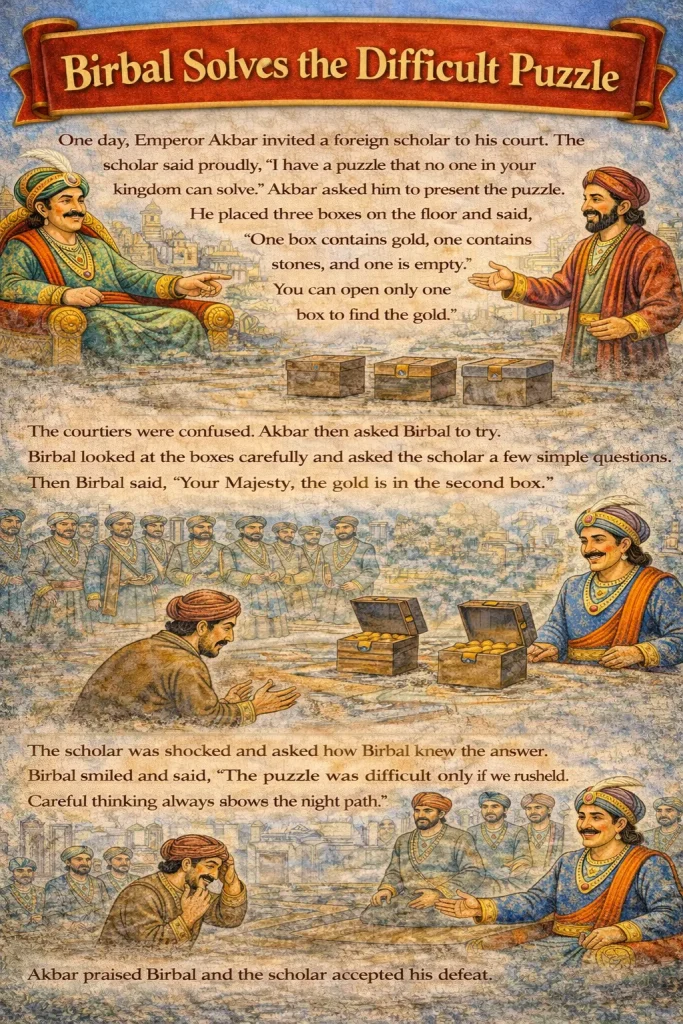
One day, Emperor Akbar invited a foreign scholar to his court. The scholar said proudly, “I have a puzzle that no one in your kingdom can solve.” Akbar asked him to present the puzzle. He placed three boxes on the floor and said, “One box contains gold, one contains stones, and one is empty. You can open only one box to find the gold.”
The courtiers were confused. Akbar then asked Birbal to try. Birbal looked at the boxes carefully and asked the scholar a few simple questions. Then Birbal said, “Your Majesty, the gold is in the second box.” When the box was opened, gold was found inside.
The scholar was shocked and asked how Birbal knew the answer. Birbal smiled and said, “The puzzle was difficult only if we rushed. Careful thinking always shows the right path.” Akbar praised Birbal, and the scholar accepted his defeat.
Moral of the Story
Calm thinking can solve even the hardest problems.
What Kids Can Learn:
- Do not hurry while solving problems
- Think carefully before answering
- Confidence comes from understanding
Question for the Child to Think:
Why is it important to stay calm while solving a difficult puzzle?
Birbal and the Value of Truth

One day, Emperor Akbar announced that anyone who spoke the truth in his court would be rewarded. A man came forward and said that his neighbour had stolen his cow. The neighbour denied the claim and said he was innocent. Both men argued strongly.
Akbar asked Birbal to find the truth. Birbal called both men early the next morning and said, “The cow will be brought here and will bow to its real owner.” The guilty man became worried, but the honest man remained calm.
When the cow was brought, nothing happened. Birbal then noticed that one man was shaking with fear. Birbal said, “The cow cannot speak, but fear can.” The frightened man admitted that he had lied and tried to blame his neighbour.
Akbar punished the liar and rewarded the honest man. Everyone in the court understood that truth gives confidence, while lies create fear.
Moral of the Story
Truth gives courage, but lies create fear.
What Kids Can Learn:
- Always speak the truth
- Lies make people nervous
- Honesty brings confidence
Question for the Child to Think:
Why did the honest man stay calm while the liar was afraid?
Birbal and the Well of Justice

One day, a poor man came to Emperor Akbar’s court with a complaint. He said that a rich landlord had taken his well and was not allowing him to use water. The landlord claimed that he owned the well, but the poor man was allowed to take water only if he paid money.
Akbar asked Birbal to give justice. Birbal thought carefully and said, “The well belongs to the poor man, but the water inside the well belongs to the landlord.” Everyone looked confused. Birbal continued, “So the landlord must remove his water from the poor man’s well immediately.”
The landlord was shocked. He understood that it was impossible to remove water from a well. Feeling ashamed, he admitted his mistake and returned the well to the poor man without asking for money.
Akbar praised Birbal for his fair and clever judgment. The poor man thanked Birbal, and the court learned that justice should always protect the weak from the powerful.
Moral of Story
True justice always supports what is right.
What Kids Can Learn:
- Justice should be fair to everyone
- Clever thinking can stop wrongdoing
- Power should never be misused
Question for the Child to Think:
Why did Birbal’s decision force the landlord to admit his mistake?
Birbal’s Lesson on Common Sense
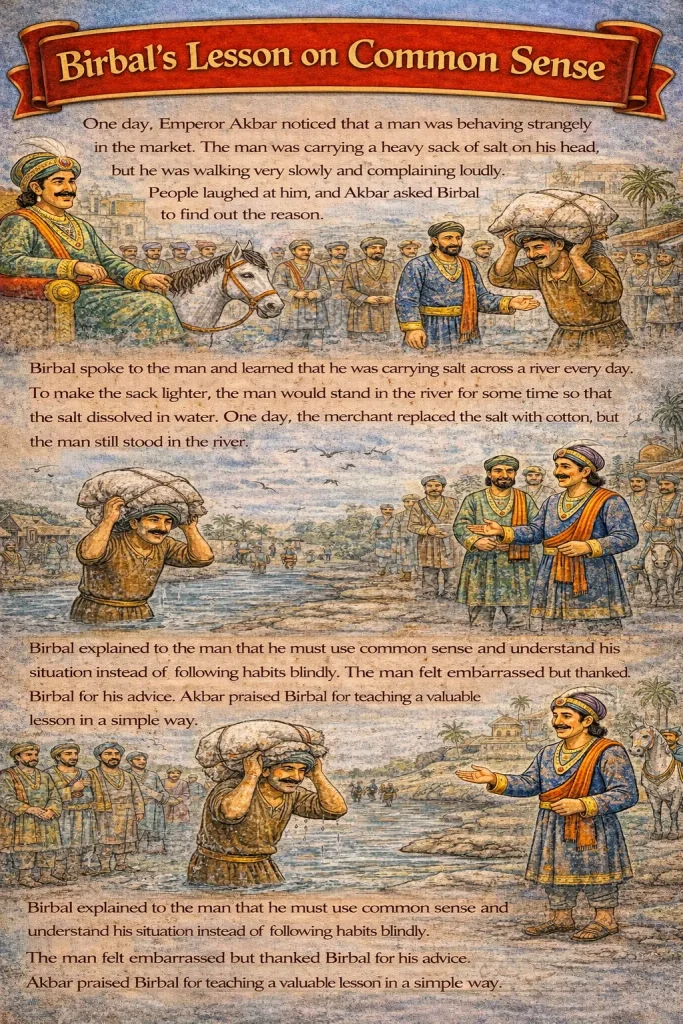
One day, Emperor Akbar noticed that a man was behaving strangely in the market. The man was carrying a heavy sack of salt on his head, but he was walking very slowly and complaining loudly. People laughed at him, and Akbar asked Birbal to find out the reason.
Birbal spoke to the man and learned that he was carrying salt across a river every day. To make the sack lighter, the man would stand in the river for some time so that the salt dissolved in water. One day, the merchant replaced the salt with cotton, but the man still stood in the river. The cotton absorbed water and became heavier, making the load even more difficult to carry.
Birbal explained to the man that he must use common sense and understand his situation instead of following habits blindly. The man felt embarrassed but thanked Birbal for his advice. Akbar praised Birbal for teaching a valuable lesson in a simple way.
Moral of Story
Common sense is more important than blind habits.
What Kids Can Learn:
- Understand situations before acting
- Do not follow habits without thinking
- Learn from mistakes
Question for the Child to Think:
What should the man have done differently when the load changed from salt to cotton?
Birbal and the Clever Use of Time

One day, Emperor Akbar noticed that many people in his court complained about not having enough time to finish their work. Akbar asked Birbal why this happened. Birbal requested permission to teach everyone a small lesson.
Birbal gave a simple task to the courtiers. He asked them to write their names on a paper while talking to each other. Many people made mistakes and took a long time. Then Birbal asked them to write their names again, this time in silence and with full attention. Everyone finished quickly and neatly.
Birbal explained, “Time is not short. We waste it by doing many things at the same time.” Akbar agreed and praised Birbal for his wisdom. The courtiers understood that focus and planning help save time.
From that day, Akbar encouraged everyone in the court to work with concentration and discipline. Work became smoother, and fewer mistakes were made.
Moral of the Story
Time is used best when we focus on one task at a time.
What Kids Can Learn:
- Focus improves work quality
- Avoid distractions while studying
- Good time use reduces stress
Question for the Child to Think:
How can focusing on one task help you in your daily studies?
Birbal and the Proud Scholar

One day, a famous scholar came to Emperor Akbar’s court. He said proudly, “I have read many books and know everything. No one here can defeat me in knowledge.” The courtiers felt uncomfortable, but Akbar remained calm and asked Birbal to speak with him.
Birbal welcomed the scholar kindly and asked him a simple question, “Can you tell us how many leaves fall from a tree in one year?” The scholar became silent. He tried to think but could not give an answer.
Birbal then smiled and said, “Knowledge is important, but wisdom is knowing what can and cannot be answered.” He explained that true learning also includes humility and understanding limits.
The scholar felt ashamed and bowed his head. He thanked Birbal for teaching him a valuable lesson. Akbar praised Birbal and reminded everyone that learning should make a person humble, not proud.
Moral of the Story
True knowledge makes a person humble, not proud.
What Kids Can Learn:
- Do not be proud of knowledge
- Accept that no one knows everything
- Respect others’ wisdom
Question for the Child to Think:
Why is it important to stay humble even when you know a lot?
Birbal Finds the Real Culprit

One day, Emperor Akbar’s royal necklace went missing from the palace. The guards searched everywhere but could not find it. Akbar became worried and asked Birbal to solve the case.
Birbal called all the servants and guards to the court. He looked at their faces carefully and then said, “The necklace is hidden inside this room, and the person who stole it is also standing here.” Everyone became nervous.
Birbal then placed a bowl of water in front of them and said, “Wash your hands in this water. The water will change color if the thief touches it.” The innocent people calmly washed their hands, but one servant refused to come forward.
Birbal pointed at him and said, “Your fear has revealed you.” The servant bowed his head and took out the necklace from his clothes. Akbar praised Birbal for his intelligence and thanked him for finding the truth without harming anyone.
Moral of the Story
Fear always exposes the guilty person.
What Kids Can Learn:
- Wrong actions create fear
- Intelligence can solve problems peacefully
- Truth gives confidence
Question for the Child to Think:
Why did the guilty servant refuse to wash his hands?
Birbal and the Lazy Man

One day, a lazy man came to Emperor Akbar’s court. He complained that he was very poor and asked for money without doing any work. Akbar felt confused and asked Birbal what should be done.
Birbal gave the man a bag of coins and said, “Take this bag and count the coins carefully. Come back tomorrow and tell me the exact number.” The lazy man became happy and left.
The next day, the man returned and said, “I could not count the coins because I felt tired.” Birbal smiled and said, “If you are too lazy to count coins, you do not deserve them.” He then gave the coins to a hardworking man who was waiting outside the court.
Akbar praised Birbal and explained that help should be given to those who are willing to work. The lazy man felt ashamed and understood that hard work is necessary to earn respect and money.
Moral of the Story
Laziness never leads to success.
What Kids Can Learn:
- Hard work is important
- Do not expect rewards without effort
- Responsibility brings respect
Question for the Child to Think:
Why did Birbal give the coins to the hardworking man instead?
Birbal Teaches a Lesson on Patience

One day, a young man came to Emperor Akbar’s court with a complaint. He said that he wanted quick success and was angry because his plans were not working. Akbar asked Birbal to guide him.
Birbal gave the young man a seed and said, “Plant this seed today and come back tomorrow expecting fruit.” The young man laughed and said, “That is impossible.” Birbal smiled and replied, “Success is like this seed. It needs time, care, and patience.”
Birbal then showed him a tree in the palace garden. He explained that the tree had taken many years to grow and give shade and fruits. The young man understood his mistake and realized that he was being impatient.
Akbar praised Birbal for teaching an important lesson in a simple way. The young man promised to work patiently and not give up too soon.
Moral of the Story
Patience is the key to true success.
What Kids Can Learn:
- Good things take time
- Do not rush for quick results
- Patience helps in learning and growth
Question for the Child to Think:
Why is patience important when learning something new?
Birbal Teaches a Lesson on Patience
One day, a merchant came to Emperor Akbar’s court. He complained that his business was not growing and said, “I work hard every day, but I want success quickly.” Akbar asked Birbal to help him understand the problem.
Birbal took the merchant to the palace garden and showed him a small plant. He said, “Pull this plant and make it grow taller today.” The merchant tried but failed. Birbal then showed him a big tree and asked, “Do you know how long this tree took to grow?” The merchant shook his head.
Birbal explained, “This tree grew slowly, day by day. It needed water, sunlight, and time. If it had been pulled to grow faster, it would have broken.” The merchant understood that success cannot be rushed.
Akbar smiled and praised Birbal for his wise lesson. The merchant thanked Birbal and promised to work with patience and faith. From that day, he stopped worrying about quick results and focused on steady effort.
Moral of the Story
Patience and hard work lead to lasting success.
What Kids Can Learn:
- Success takes time
- Rushing can spoil good efforts
- Patience makes us stronger
Question for the Child to Think:
Can you think of something in your life that needs patience to grow?
Birbal and the Greedy Landlord

One day, a poor farmer came to Emperor Akbar’s court. He said that a greedy landlord had taken half of his crops every year and still asked for more. The farmer was tired and asked for justice. Akbar asked Birbal to handle the case.
Birbal called the landlord and the farmer. He listened to both sides carefully. Then Birbal said, “Let us divide the crops fairly today.” He asked the guards to bring two baskets. Birbal put the farmer’s crops in one basket and stones in the other. He told the landlord, “You may choose one basket.”
The landlord quickly chose the basket that looked heavier. When he opened it, he found only stones. The basket with crops was lighter but useful. Birbal smiled and said, “Greed made you choose weight, not value.”
The landlord felt ashamed and accepted his mistake. Akbar ordered him to return the extra crops and treat the farmer fairly. The farmer thanked Birbal for his wisdom.
Moral of the Story
Greed makes people choose wrongly.
What Kids Can Learn:
- Do not be greedy
- Think about value, not just gain
- Fairness brings peace
Question for the Child to Think:
Why did the landlord choose the wrong basket even when it looked heavier?
Birbal’s Sharp Mind in Action

One day, Emperor Akbar noticed that food grains were disappearing from the royal storehouse. The guards said they were honest, but the grains kept reducing every day. Akbar became worried and asked Birbal to find the truth.
Birbal visited the storehouse at night and carefully observed everything. The next morning, he called all the guards and asked them to bring their shoes to the court. Everyone was confused, but they obeyed.
Birbal looked at the shoes and noticed that one guard’s shoes were covered with grain dust. He said, “This guard has been entering the storehouse secretly at night.” The guard became frightened and admitted that he had been stealing small amounts every day, thinking no one would notice.
Akbar punished the guard and praised Birbal for his sharp observation. The court learned that intelligence and careful thinking can solve problems without force or anger.
Moral of the Story
A sharp mind notices even small details.
What Kids Can Learn:
- Pay attention to details
- Wrong actions always leave signs
- Intelligence is stronger than strength
Question for the Child to Think:
What small detail helped Birbal find the thief?
Birbal and the Weight of Lies

One day, Emperor Akbar received complaints that a trader was cheating people by lying about the weight of goods. The trader claimed he was honest. Akbar asked Birbal to test him.
Birbal asked the trader to bring his weighing scale and weights to the court. He then asked the trader to weigh a bag of rice. The trader did it confidently. After that, Birbal asked him to weigh the same bag again but using a different set of weights borrowed from the palace kitchen.
This time, the weight was different. Birbal smiled and said, “Your Majesty, the trader’s lies are heavier than the rice.” He explained that the trader was using false weights to cheat customers.
The trader became ashamed and accepted his mistake. Akbar punished him and warned everyone to be honest in business. The people praised Birbal for his smart thinking.
Moral of the Story
Lies may look light, but they become heavy in the end.
What Kids Can Learn:
- Cheating never works for long
- Honesty builds trust
- Lies always get exposed
Question for the Child to Think:
Why did Birbal use different weights to catch the trader?
Birbal’s Smart Trick to Catch the Thief

One night, some valuable jewels were stolen from the palace. Emperor Akbar was very upset and asked Birbal to find the thief without hurting anyone. Birbal asked all the palace servants to come to the court.
Birbal gave each servant a piece of thread and said, “Tie this thread around your wrist and sleep with it tonight. The thread of the thief will become shorter by morning.” The servants were confused but followed the order.
The next day, Birbal checked all the threads. One servant’s thread was shorter than the others. Birbal smiled and said, “This is the thief.” The servant admitted that he had cut the thread because he was afraid it would shrink.
Akbar praised Birbal for his clever idea. The jewels were returned, and the servant learned a lesson about honesty. Everyone understood that fear makes guilty people act differently.
Moral of the Story
Fear exposes the person who does wrong.
What Kids Can Learn:
- Guilt creates fear
- Smart thinking solves problems
- Honesty brings peace of mind
Question for the Child to Think:
Why did the thief cut the thread instead of leaving it as it was?
Birbal and the Importance of Thinking

One day, Emperor Akbar noticed that many people in his kingdom were copying others without understanding. He asked Birbal to teach them a lesson. Birbal invited a group of young men to the court and gave them a simple task.
He placed a locked box on the table and said, “Open this box without breaking it.” Some men started pulling it hard, while others tried to break the lock. Birbal stopped them and asked, “Did anyone try to think first?”
Birbal then showed them a small key hidden under the table. He opened the box easily and said, “Strength without thinking leads to failure.” Inside the box was a note that said, Think before you act.
Akbar praised Birbal for his wise lesson. The people understood that using the mind is more important than copying others or acting without thought.
Moral of the Story
Thinking before acting saves time and effort.
What Kids Can Learn:
- Use your brain before taking action
- Do not blindly copy others
- Smart thinking makes work easier
Question for the Child to Think:
How can thinking first help you solve problems in school?
Birbal Solves the Mystery

One morning, Emperor Akbar found that an important message had gone missing from his table. The message was very important for the safety of the kingdom. Akbar was worried and asked Birbal to solve the mystery quickly.
Birbal carefully looked around the room. He noticed that nothing else was disturbed. He then called the palace messengers and asked them one simple question, “Who entered the room after the message was kept here?” Everyone answered, but one messenger looked confused and nervous.
Birbal gave all the messengers a piece of paper and asked them to write the same sentence. When Birbal checked the papers, he noticed that one person made spelling mistakes. Birbal smiled and said, “The message was written clearly. Only someone who did not read it properly could make these mistakes.”
The messenger accepted his mistake and returned the message. Akbar praised Birbal for solving the mystery without shouting or punishment.
Moral of the Story
Careful observation helps solve even hidden problems.
What Kids Can Learn:
- Pay attention to small details
- Stay calm while solving problems
- Observation is a powerful skill
Question for the Child to Think:
What small clue helped Birbal find the person who took the message?
Birbal and the Value of Wisdom Over Strength

One day, a strong wrestler came to Emperor Akbar’s court. He said proudly, “I am the strongest man in the kingdom. No one can defeat me.” Akbar smiled and asked Birbal to test him.
Birbal did not challenge the wrestler to a fight. Instead, he gave him a heavy stone and said, “Lift this stone and keep it in the air for one hour.” The wrestler lifted it proudly, but after a few minutes, his arms became tired, and he dropped the stone.
Then Birbal picked up a small stone and placed it gently in his pocket. He said, “I can carry this stone all day without pain.” The court laughed, and the wrestler understood the lesson.
Birbal explained, “Strength works for a short time, but wisdom helps us choose the right way.” Akbar praised Birbal and told everyone that intelligence is more useful than physical power.
Moral of the Story
Wisdom is stronger than physical strength.
What Kids Can Learn:
- Use your brain, not just muscles
- Smart choices make tasks easier
- Strength without thinking can fail
Question for the Child to Think:
Why was Birbal able to carry his stone easily while the wrestler failed?
Birbal and the Clever Reply

One day, Emperor Akbar wanted to test Birbal’s presence of mind. He suddenly asked, “Birbal, why do people sleep at night and not during the day?” The courtiers laughed, thinking it was a strange question.
Birbal smiled and replied, “Your Majesty, people sleep at night because the body needs rest after working all day. At night, the world becomes quiet, which helps us sleep peacefully.” Akbar then asked, “But some people sleep during the day too.”
Birbal answered, “Yes, Your Majesty. They are either sick, tired, or did not sleep well at night. Rest is needed whenever the body asks for it.” Akbar was pleased with the clear and thoughtful reply.
The courtiers understood that a clever reply does not need complicated words. It only needs clear thinking and confidence. Akbar praised Birbal for his calm and wise answer.
Moral of the Story
Clear thinking leads to smart answers.
What Kids Can Learn:
- Think calmly before replying
- Simple answers can be the best
- Confidence comes from understanding
Question for the Child to Think:
Why is it important to understand a question before answering it?
Birbal and the False Witness

One day, a man came to Emperor Akbar’s court and accused his neighbor of stealing his money. He brought a witness who said he had seen the theft at night. The neighbor said he was innocent. Akbar asked Birbal to find the truth.
Birbal looked at the witness and asked, “How far away was the house where the theft happened?” The witness replied, “Very far, near the village border.” Birbal then asked, “How could you see the theft clearly at night from such a distance?”
The witness quickly said, “There was a bright lamp in the house.” Birbal smiled and asked, “If the lamp was so bright, why was the village path outside dark?” The witness had no answer and became nervous.
Birbal explained that the witness was lying because his story did not match. The man admitted that the witness was false and that he had made the accusation out of anger. Akbar punished the liar and praised Birbal for his sharp questioning.
Moral of the Story
False statements cannot stand against truth.
What Kids Can Learn:
- Lies get exposed easily
- Truth is strong and clear
- Think carefully before accusing others
Question for the Child to Think:
Which question helped Birbal catch the false witness?
Birbal’s Lesson on Fair Judgment
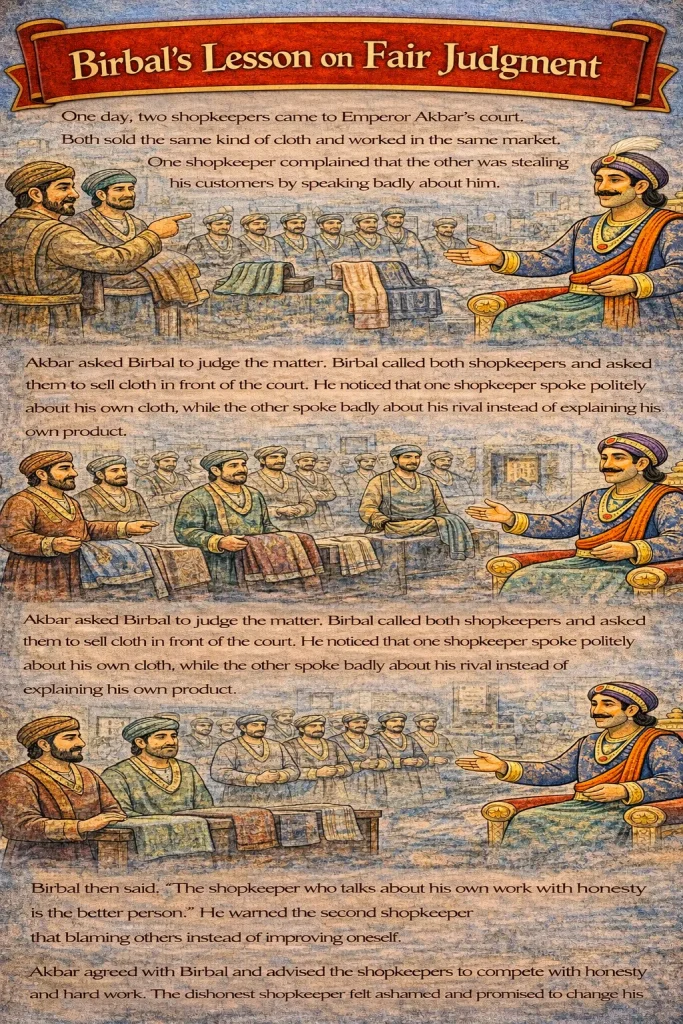
One day, two shopkeepers came to Emperor Akbar’s court. Both sold the same kind of cloth and worked in the same market. One shopkeeper complained that the other was stealing his customers by speaking badly about him.
Akbar asked Birbal to judge the matter. Birbal called both shopkeepers and asked them to sell cloth in front of the court. He noticed that one shopkeeper spoke politely about his own cloth, while the other spoke badly about his rival instead of explaining his own product.
Birbal then said, “The shopkeeper who talks about his own work with honesty is the better person.” He warned the second shopkeeper that blaming others instead of improving oneself is unfair.
Akbar agreed with Birbal and advised the shopkeepers to compete with honesty and hard work. The dishonest shopkeeper felt ashamed and promised to change his behavior.
Moral of the Story
Fair judgment comes from understanding actions, not words.
What Kids Can Learn:
- Do not blame others for your failure
- Improve yourself instead of complaining
- Fairness builds trust
Question for the Child to Think:
Why did Birbal judge the shopkeeper by his actions and not his words?
Birbal and the Power of Intelligence

One day, Emperor Akbar wanted to show the importance of intelligence to his courtiers. He asked them a question, “What is more powerful—strength or intelligence?” Many people answered, “Strength.”
Akbar then asked Birbal to give an example. Birbal invited a strong soldier to the court and gave him a thick wooden door to break. The soldier tried hard but could not break it. Then Birbal took a small key and opened the door easily.
Birbal said, “This key is small and weak, but it works because it is used in the right way.” The courtiers understood that intelligence helps us find easy solutions to difficult problems.
Akbar praised Birbal and reminded everyone that intelligence should guide strength. From that day, the court respected wisdom more than power.
Moral of the Story
Intelligence can achieve what strength cannot.
What Kids Can Learn:
- Think before using force
- Smart solutions save effort
- Intelligence makes work easier
Question for the Child to Think:
Can you think of a situation where thinking helped more than force?