Goddess Durga is one of the most widely worshipped forms of the Divine Mother in Hindu traditions. She is known as a powerful protector, a loving mother, and a warrior goddess who defeats forces that threaten divine and cosmic order.
The most famous story associated with Maa Durga is her battle with Mahishasura, the buffalo demon. But the complete story of Durga is much larger than the battle with Mahishasura.
One of the most important sources for the Goddess’s stories is the Devi Mahatmya, a Sanskrit text traditionally included in chapters 81–93 of the Markandeya Purana. It contains 13 chapters and three major narrative sections, usually called the three Charitas. These tell of the Goddess’s victories over Madhu and Kaitabha, Mahishasura, and Shumbha and Nishumbha.
The story also connects with the ideas of Shakti, Navratri, Durga Puja, the Navadurga, Kali, Chamunda, and the worship of the Goddess across different parts of India.
So, if you want to understand the complete Maa Durga story, it is important to look at both the ancient textual traditions and the living traditions that developed around them.
Who Is Maa Durga?
Maa Durga is a major form of the Hindu Goddess, especially important in Shakta traditions, where the Goddess or Devi is understood as the supreme divine power.
The word Shakti is often used for this divine power or energy.
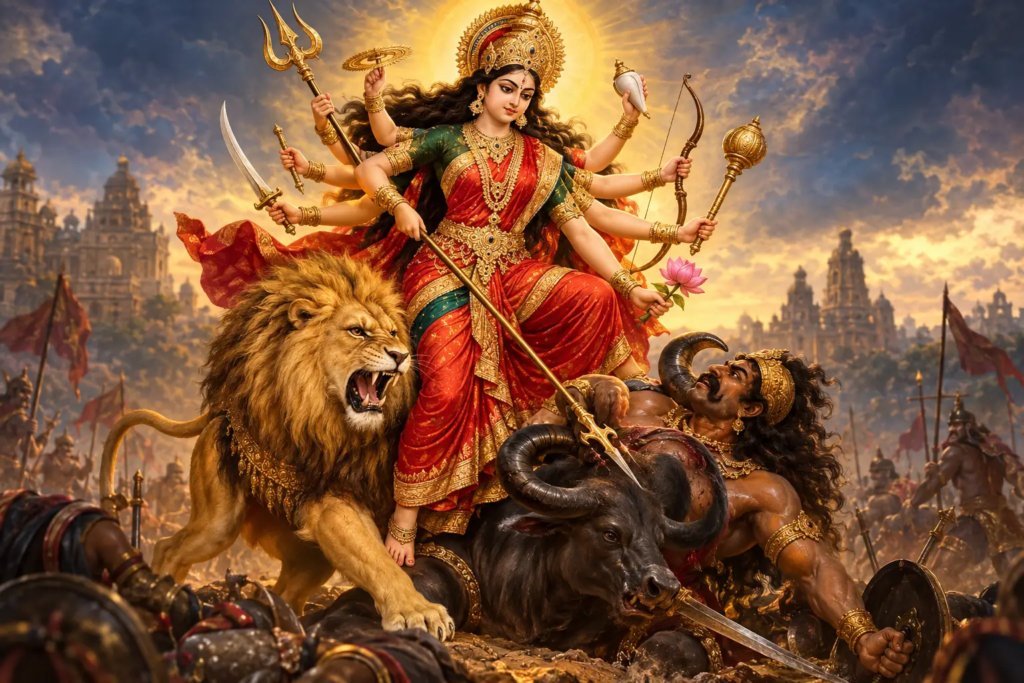
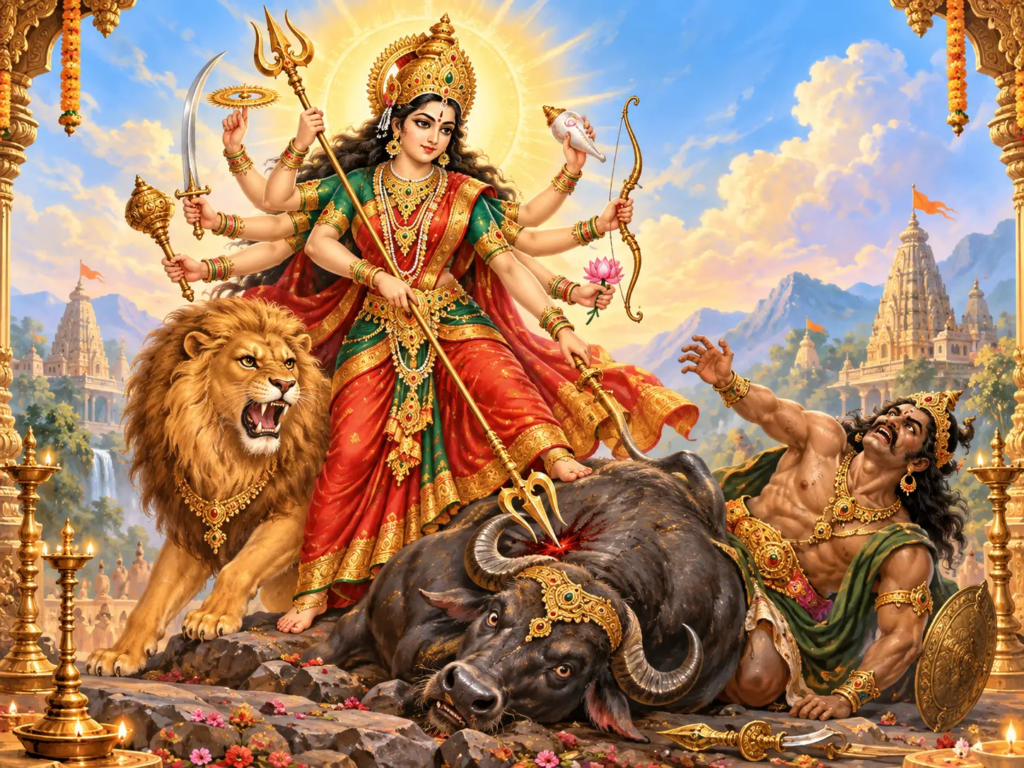
Durga is shown in many ways, but one of the best-known images shows her riding a lion or tiger, carrying several weapons and fighting Mahishasura.
She can represent several qualities at the same time:
- Strength
- Protection
- Courage
- Motherhood
- Compassion
- Divine power
- Victory over destructive forces
- Protection of cosmic order
This combination is important. Durga is not presented only as a warrior. She is also Maa, the mother who protects her children.
The Devi Mahatmya goes even further by presenting the Goddess as a divine power that can appear in different forms according to the needs of the world.
What Does the Name Durga Mean?
The Sanskrit name Durgā has been interpreted in several related ways.
The word is associated with ideas such as difficulty, danger, a difficult-to-cross place, or a fortified place. Traditional interpretations therefore connect Durga with the Goddess who protects devotees from difficulties and dangers.
The name should not be reduced to only one English translation.
In devotional traditions, Durga is often understood as the Mother who helps people cross difficult situations.
This is why the name fits her role as a protector.
Where Does the Story of Maa Durga Come From?
There is no single Hindu book containing every story ever told about Durga.
Different texts and regional traditions contain different accounts of the Goddess.
One of the most important sources is the Devi Mahatmya, also called:
- Durga Saptashati
- Devi Mahatmyam
- Chandi
- Chandi Path
It is traditionally included as chapters 81–93 of the Markandeya Purana.
The text contains 13 chapters and is built around three major stories or Charitas:
- Madhu and Kaitabha
- Mahishasura
- Shumbha and Nishumbha
The Mahishasura episode is probably the most famous part today, but it is only one part of the larger work.
The text is also important because it presents the Goddess not merely as a helper of the male gods but as a powerful divine reality in her own right.
The Story Begins With King Suratha and Merchant Samadhi
Interestingly, the Devi Mahatmya does not begin with Durga fighting Mahishasura.
It begins with two troubled people.
The first is King Suratha.
He has lost his kingdom and has been forced away from his power. Even after losing everything, he continues to think about his kingdom, his people, and the things he once controlled.
The second is a wealthy merchant named Samadhi.
Samadhi has been rejected by his own family. Yet he continues to worry about the very people who have treated him badly.
The two men meet in a forest and are surprised by their own feelings.
They ask a simple but deep question:
Why are we still attached to people and things that have caused us pain?
They go to the sage Medhas for an answer.
The sage explains the power of the Goddess and tells them stories of Devi.
This framing is important because the Durga tradition is not only about defeating an external demon. It also asks questions about the human mind:
- Why do we become attached?
- Why do we struggle to let go?
- Why does desire control us?
- Where can we find protection when life becomes difficult?
This makes the story meaningful even before the famous battle begins.
The Three Great Stories of Maa Durga
The Devi Mahatmya contains three major narrative sections.
They are traditionally associated with different manifestations of the Goddess.
1. The Story of Madhu and Kaitabha
The first story involves the demons Madhu and Kaitabha.
Vishnu is resting in cosmic sleep. The Goddess is associated with this divine sleep, often called Yoganidra.
When the demons threaten the cosmic order, the Goddess’s power becomes important in allowing Vishnu to confront them.
The story establishes a major idea that continues through the rest of the text:
Divine power can appear in different forms when the world needs protection.
2. The Story of Mahishasura
This is the most famous Durga story.
Mahishasura becomes extraordinarily powerful after receiving a boon that makes him extremely difficult for the gods to defeat.
He uses his strength to challenge the gods and takes control of their heavenly realm.
The gods become helpless.
They turn toward the divine power of the Goddess.
This is when the famous warrior form of Durga emerges.
3. The Story of Shumbha and Nishumbha
The third major story is even larger than the Mahishasura episode.
It involves:
- Shumbha
- Nishumbha
- Dhumralochana
- Chanda
- Munda
- Raktabija
- Kali
- Chamunda
- the Matrikas
- and finally the defeat of Shumbha and Nishumbha
This part of the story is extremely important because it shows that Mahishasura is not the only enemy defeated by the Goddess.
Who Was Mahishasura?
Mahishasura is traditionally described as a powerful demon associated with the buffalo.
His name itself is connected with mahisha, the Sanskrit word for buffalo.
Different traditions tell the story of his origin in somewhat different ways. Therefore, it is better not to present one later retelling as the only version.
In one widely known tradition, Mahishasura is associated with a buffalo mother and the asura Rambha. Other traditions give different details.
The important part of the story is that Mahishasura performs severe austerities and receives a powerful boon.
The boon makes him extremely difficult for the gods and male beings to defeat.
His power grows so great that he attacks the gods and takes control of their realm.
The gods then seek help from the Goddess.
Why Could Only a Woman Defeat Mahishasura?
This is one of the most important parts of the story.
Mahishasura’s protection leaves a weakness: the gods and male beings cannot easily defeat him.
The Goddess therefore becomes the answer to a problem that the male gods cannot solve.
This is why Durga’s appearance is so important.
The story is not simply:
A stronger god defeats a demon.
Instead, it is:
A new form of divine power appears because the existing powers are unable to solve the crisis.
This is one of the central ideas behind the Goddess’s victory.
How Was Maa Durga Created?
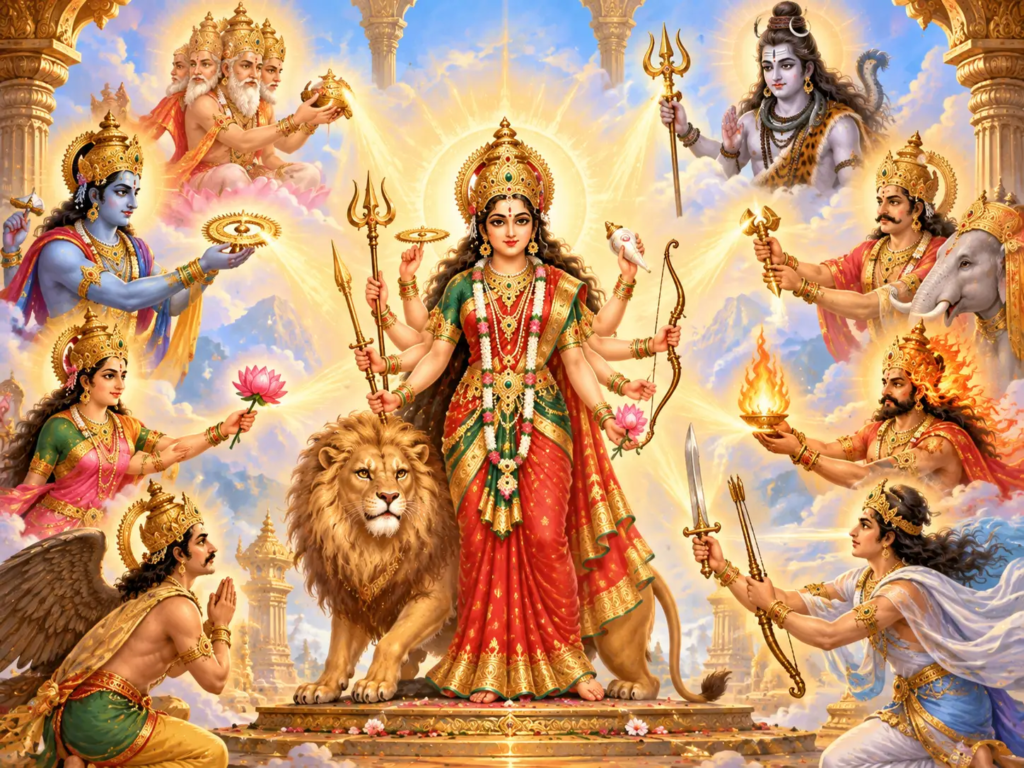
The Devi Mahatmya gives a detailed account of Durga’s emergence.
The gods are filled with divine energy. Their combined radiance comes together and takes the form of the Goddess.
Therefore, the text does not simply describe Durga as being made by only Brahma, Vishnu and Shiva.
She emerges from the combined divine energies of the gods.
This distinction is important because many modern retellings simplify the story.
The Goddess is then given weapons and ornaments by the gods and other divine beings.
The textual account describes many of these gifts in detail.
Who Gave Maa Durga Her Weapons?
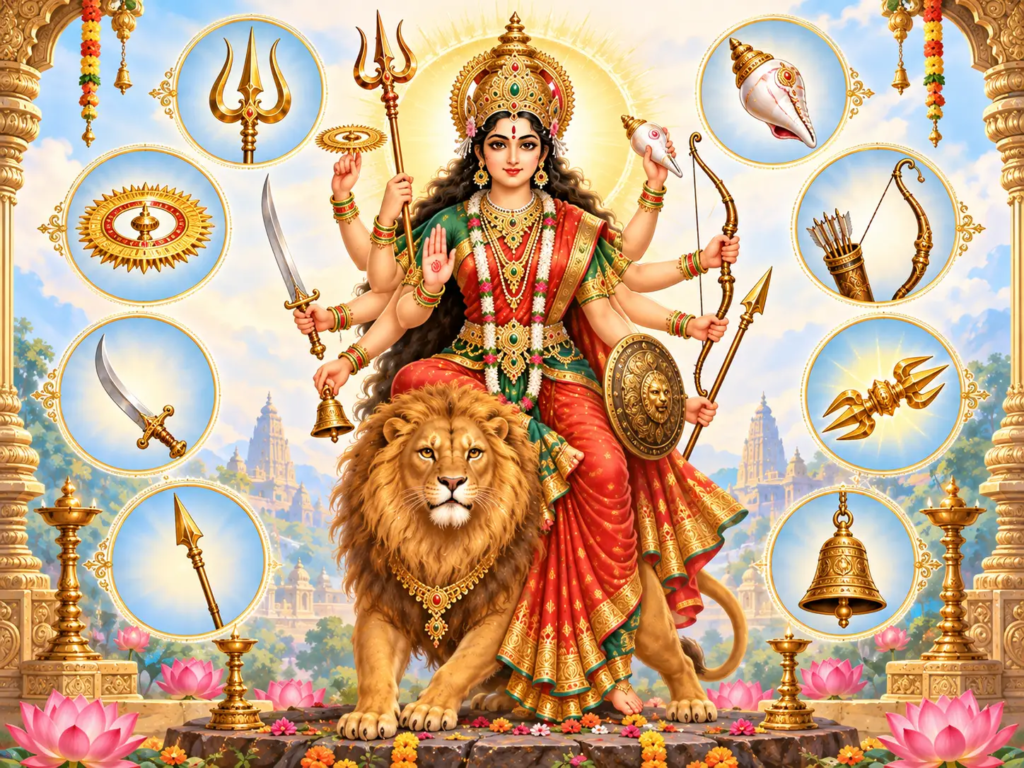
The Goddess receives weapons from different divine beings.
The Devi Mahatmya describes gifts including:
| Divine being | Gift to Durga |
|---|---|
| Shiva | Trident |
| Vishnu | Discus |
| Varuna | Conch |
| Agni | Spear |
| Maruts | Bow and arrows |
| Indra | Thunderbolt and bell |
| Yama | Staff |
| Varuna | Noose |
| Brahma | Water pot and rosary |
| Kala/Destiny | Sword and shield |
| Vishvakarma | Weapons, armour and ornaments |
| Himalaya | Lion and jewels |
| Ocean | Garments, pearls and lotus |
| Kubera | Drinking vessel |
| Shesha | Serpent necklace |
The exact list and wording can vary between translations, but the central idea is clear: the Goddess is armed with the powers of the divine world itself.
This is why the many weapons in her hands are more than decoration.
They show that she possesses many kinds of divine power.
Why Does Maa Durga Have So Many Arms?
Different artistic traditions show Durga with different numbers of arms.
Eight, ten, twelve and more arms can be found in different images.
The multiple arms allow artists to show the many weapons and divine attributes associated with her.
Symbolically, the image also communicates that Durga can perform many protective and destructive functions at the same time.
Rather than seeing the many arms as a literal physical description, they can be understood as part of religious iconography.
Why Does Maa Durga Ride a Lion?
The lion is one of the strongest symbols associated with Durga.
In popular interpretation, it represents:
- courage
- strength
- fearlessness
- royal power
- control over dangerous forces
But there is also a deeper historical dimension.
Research on early images of the Goddess connects the lion with warrior imagery and with ideas of political and royal power in early India.
Studies of early Durga iconography suggest that the lion was an important part of the development of the Goddess as a warrior and protector figure.
The Devi Mahatmya itself says that Himavat, the mountain deity, gave the Goddess a lion to ride.
The Great Battle Between Durga and Mahishasura
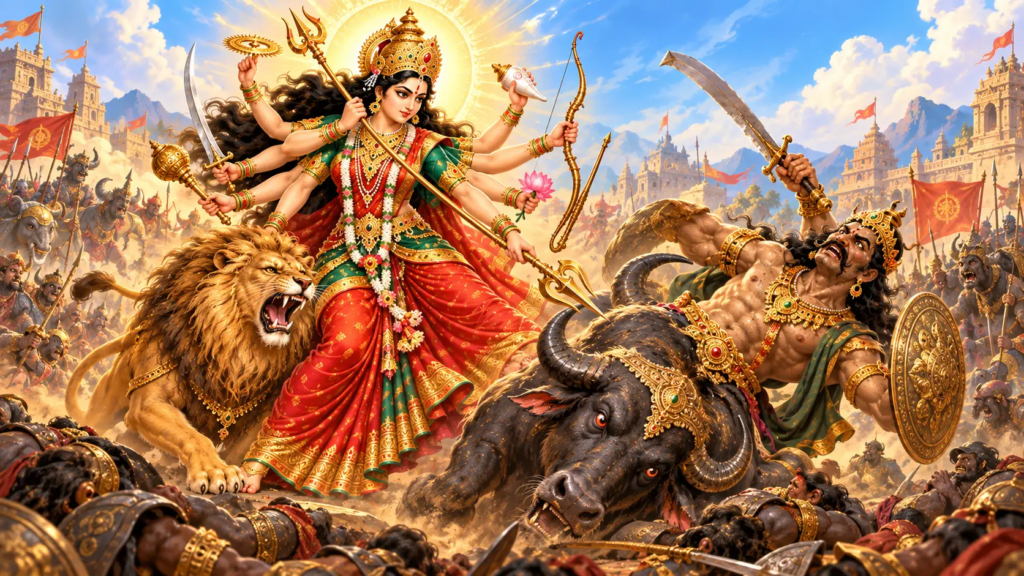
Once Durga is armed, she goes to battle.
Mahishasura sends enormous armies against her.
The Devi Mahatmya describes armies containing:
- elephants
- horses
- chariots
- soldiers
- weapons
- powerful demon warriors
Durga fights them with her divine weapons.
Her lion also joins the battle.
The text describes the Goddess destroying the weapons and armies sent against her.
She is not shown as struggling like an ordinary human warrior.
She is presented as a supernatural force capable of defeating enormous armies.
Mahishasura’s Shape-Shifting Battle
One of the most dramatic parts of the story is Mahishasura’s changing form.
He is associated with the buffalo form, but during the battle he takes different forms.
The buffalo form represents his enormous physical power.
The changing forms make the battle more difficult and give the story its famous visual quality.
This is why traditional images often show Durga standing or fighting over a buffalo while a human-like demon figure emerges from it.
The image is known as Mahishasuramardini, meaning the Goddess who destroys Mahishasura.
How Did Maa Durga Defeat Mahishasura?
Durga fights Mahishasura with several weapons.
The battle reaches its climax when Mahishasura continues changing forms.
Finally, Durga overcomes him and destroys him.
Different popular retellings sometimes describe the final weapon differently. Therefore, it is better not to reduce the entire battle to the claim that she killed him only with one particular weapon.
The important textual point is that Durga uses several divine weapons during the battle, and the Goddess ultimately defeats Mahishasura.
Her victory becomes one of the most important symbols of the triumph of divine order over destructive power.
What Does Mahishasura Represent?
The Devi Mahatmya presents Mahishasura as a demon and enemy of the gods.
Later spiritual and devotional interpretations have often used the story symbolically.
Mahishasura can be interpreted as representing qualities such as:
- uncontrolled power
- pride
- arrogance
- destructive desire
- disorder
However, it is important to separate later symbolic interpretation from what the original Sanskrit text explicitly says.
The scripture tells the story of a demon and his defeat. The psychological interpretation is a later way of finding meaning in that story.
What Happened After Mahishasura Was Defeated?
The story does not simply stop at the death of the demon.
The gods praise the Goddess.
They recognize her power and seek her protection.
This is important because the Goddess’s victory is not presented as an isolated act.
She restores confidence and protection to the divine world.
The Goddess then continues to remain available as a protector who can appear again when destructive forces threaten the world.
This leads into the larger theological idea of Shakti.
What Is Shakti?
Shakti means power, energy or divine force.
In Goddess-centered Hindu traditions, Shakti is much more than an abstract idea.
The Goddess can be understood as the power through which the universe functions.
This is one reason the Devi Mahatmya is so important.
The Goddess is not merely a female character helping male gods.
She can herself be understood as the supreme divine power.
This is one of the major developments represented by the text and later Shakta traditions.
The Story of Shumbha and Nishumbha
After the Mahishasura story, the Devi Mahatmya tells another major story.
The demons Shumbha and Nishumbha become extremely powerful.
They defeat the gods and take control of their possessions and powers.
The Goddess appears again.
Shumbha hears about her beauty and power and wants to possess her.
But the Goddess does not submit.
She refuses.
Her refusal becomes the beginning of another enormous conflict.
The demons send powerful warriors against her.
The Goddess and her different manifestations destroy them one after another.
The Story of Dhumralochana
One of Shumbha’s powerful commanders is Dhumralochana.
He is sent to capture the Goddess.
But the Goddess destroys him.
Her lion also plays an important role in the battle.
This is another example of the pattern found throughout the *Devi Mahatmya]:
When one form of evil appears, the Goddess manifests the necessary power to defeat it.
The Story of Chanda and Munda
Two other demon commanders are:
- Chanda
- Munda
During this battle, a fierce form of the Goddess emerges.
This form becomes associated with Kali and is called Chamunda after defeating Chanda and Munda.
The story is important because it shows the relationship between Durga’s peaceful and fierce forms.
The same divine power can appear as:
- mother
- protector
- warrior
- destroyer
depending on the situation.
The Story of Raktabīja
Raktabīja is one of the most unusual enemies in the Devi Mahatmya.
He has a special power.
Whenever his blood falls to the ground, another demon like him appears.
So the more he is wounded, the more difficult the battle becomes.
The Goddess therefore needs a different strategy.
A fierce form of the Goddess, associated with Kali, drinks or consumes the blood so that it does not fall onto the ground and create more demons.
This allows the Goddess to finally defeat Raktabīja.
The story is often interpreted as a lesson about problems that become larger when they are continually allowed to multiply.
Again, that symbolic interpretation should be understood as an interpretation rather than a literal statement in the ancient text.
The Final Battle With Nishumbha
Nishumbha continues the battle against the Goddess.
He is eventually defeated.
The Goddess then faces Shumbha.
Shumbha accuses her of depending on other goddesses and powers.
The Goddess responds by showing that the different manifestations are ultimately expressions of her own power.
The various forms return to her.
The battle then becomes a direct confrontation between Shumbha and the Goddess.
She finally defeats him.
The third great story therefore ends with another victory of the Goddess over forces that have disturbed cosmic order.
Is Durga the Same as Parvati?
This is a question with a complicated answer because Hindu traditions do not always use these names in exactly the same way.
In many traditions, Durga is closely connected with Parvati, the Goddess who is associated with Shiva.
In other theological traditions, Durga is treated as a manifestation of the supreme Goddess, while Parvati is another manifestation of the same ultimate divine power.
Therefore, it is better to say:
Durga and Parvati are closely connected in many Hindu traditions, but different texts and traditions describe their relationship in different ways.
Historical research also shows that the identity and role of Durga developed over time rather than appearing in exactly the same form throughout Indian history.
Durga and Kali: Are They the Same Goddess?
Durga and Kali are often closely connected.
In the Devi Mahatmya, fierce forms of the Goddess appear during battles.
Kali becomes particularly important during the stories of Chanda-Munda and Raktabīja.
In Shakta traditions, Kali and Durga can be understood as different manifestations of the same ultimate Goddess.
The important point is that there is not always a simple “Durga versus Kali” relationship.
They can be understood as different expressions of one divine Shakti.
What Are the Nine Forms of Durga?
The Navadurga, or nine forms of Durga, are traditionally:
- Shailaputri
- Brahmacharini
- Chandraghanta
- Kushmanda
- Skandamata
- Katyayani
- Kalaratri
- Mahagauri
- Siddhidatri
These nine names are especially important during Navratri.
However, an important clarification is needed.
The Navadurga framework should not simply be treated as the same thing as the three Charitas of the Devi Mahatmya.
The nine names are traditionally associated with the Goddess and are found in the Devi Kavacham tradition. Their organisation into one form for each of the nine nights is part of later and living Navratri practice.
So:
Navadurga ≠ the three major stories of Devi Mahatmya.
They are related parts of the much larger Goddess tradition.
The Nine Forms of Maa Durga
1. Shailaputri
Shailaputri means daughter of the mountain.
She is associated with the mountain and with the beginning of the Navadurga sequence.
2. Brahmacharini
Brahmacharini represents devotion, discipline and spiritual practice.
She is commonly shown walking with a rosary and water pot.
3. Chandraghanta
Chandraghanta is associated with courage and the warrior aspect of the Goddess.
Her name refers to the moon-shaped ornament associated with her.
4. Kushmanda
Kushmanda is associated in popular tradition with creative cosmic power and the generation of life.
5. Skandamata
Skandamata is the mother of Skanda, also known as Kartikeya.
This form emphasizes motherhood and protection.
6. Katyayani
Katyayani is a powerful warrior form.
She is strongly associated with the destruction of evil.
7. Kalaratri
Kalaratri is one of the fiercest forms of the Goddess.
She represents the destruction of fear and destructive forces.
8. Mahagauri
Mahagauri is associated with purity, peace and spiritual calm.
9. Siddhidatri
Siddhidatri is traditionally associated with spiritual accomplishments or siddhis.
The nine forms are widely worshipped during Navratri, although the exact customs, stories and rituals vary across regions.
Why Do We Celebrate Navratri?
Navratri means nine nights.
It is celebrated in different forms in different parts of India.
There are important regional variations in:
- rituals
- food
- music
- fasting
- forms of the Goddess
- stories
- dates and local customs
The autumn Navratri is especially important for Durga worship.
However, it is important not to say that the Devi Mahatmya itself simply gives a day-by-day diary saying:
Day 1: this happened
Day 2: this happened
Day 3: this happened…
The nine-night festival and the detailed textual stories have a more complicated historical and ritual relationship.
This distinction makes the explanation more accurate.
Why Is Vijayadashami Celebrated?
The tenth day after the nine nights is called Vijayadashami or Dussehra, depending on the regional tradition.
The word Vijaya is associated with victory.
In many traditions, the tenth day represents the victory of good or divine order over evil.
In Durga traditions, it is closely associated with the Goddess’s victory over Mahishasura.
But Dussehra also has other major stories and traditions, especially the victory of Rama over Ravana.
Therefore, the same festival season can carry different religious stories in different regions.
Durga Puja and Navratri: Are They the Same?
They are closely related but should not be treated as exactly identical.
Navratri
Navratri means nine nights and is celebrated across many parts of India.
Different forms of Devi are worshipped depending on the region.
Durga Puja
Durga Puja is especially prominent in Bengal and eastern India, although it is celebrated elsewhere too.
In Kolkata’s famous Durga Puja tradition, the festival includes:
- clay images
- artistic pandals
- music
- ritual worship
- community celebrations
- immersion of the images
UNESCO describes Kolkata’s Durga Puja as a major public celebration combining religion, art, craft, music and community participation.
Why Is Durga Puja Called Maa Durga’s Homecoming?
In Bengali tradition, Durga Puja is strongly connected with the idea of Maa Durga returning to her maternal home.
The festival therefore carries an emotional meaning beyond the battle with Mahishasura.
Durga is welcomed like a daughter returning home.
UNESCO describes this as a sense of “home-coming” or a seasonal return to one’s roots.
This is one reason the festival can feel both joyful and emotional.
How Is Durga Worshipped in Different Parts of India?
Durga worship takes many forms.
West Bengal
Durga Puja is celebrated with large public pandals, clay images, artistic installations, music and community gatherings.
Gujarat
Navratri is famous for Garba and Dandiya Raas.
People gather in large groups to dance during the nine nights.
Karnataka
The Mysuru Dasara tradition is strongly associated with royal history and the worship of Chamundeshwari.
Tamil Nadu
The Golu or Bommai Golu tradition displays dolls and religious figures during Navratri.
North India
Navratri often includes fasting, temple worship, recitation of devotional texts and worship of different forms of Durga.
Nepal
Goddess traditions are also deeply connected with Dashain, one of Nepal’s major festivals.
These traditions show that there is not one single way of celebrating the Goddess.
Why Are Young Girls Worshipped During Navratri?
In several Navratri traditions, young girls are worshipped as manifestations of the Goddess.
This practice is commonly called Kanya Puja or Kumari Puja, although the details vary between regions and traditions.
The practice reflects the idea that divine feminine power can be present in a young girl.
It also connects with the wider Hindu tradition of revering feminine power.
The exact age, number of girls and ritual procedure can differ according to local practice.
What Is Sandhi Puja?
In Bengali Durga Puja, Sandhi Puja marks the transition between Ashtami and Navami.
It has a special ritual importance because it represents the critical moment between two sacred days.
Traditional accounts connect this period with the fierce battle narratives of the Goddess.
The details of the ritual vary by community, so it is best understood as an important Bengali Durga Puja tradition, rather than something that is practiced identically throughout India.
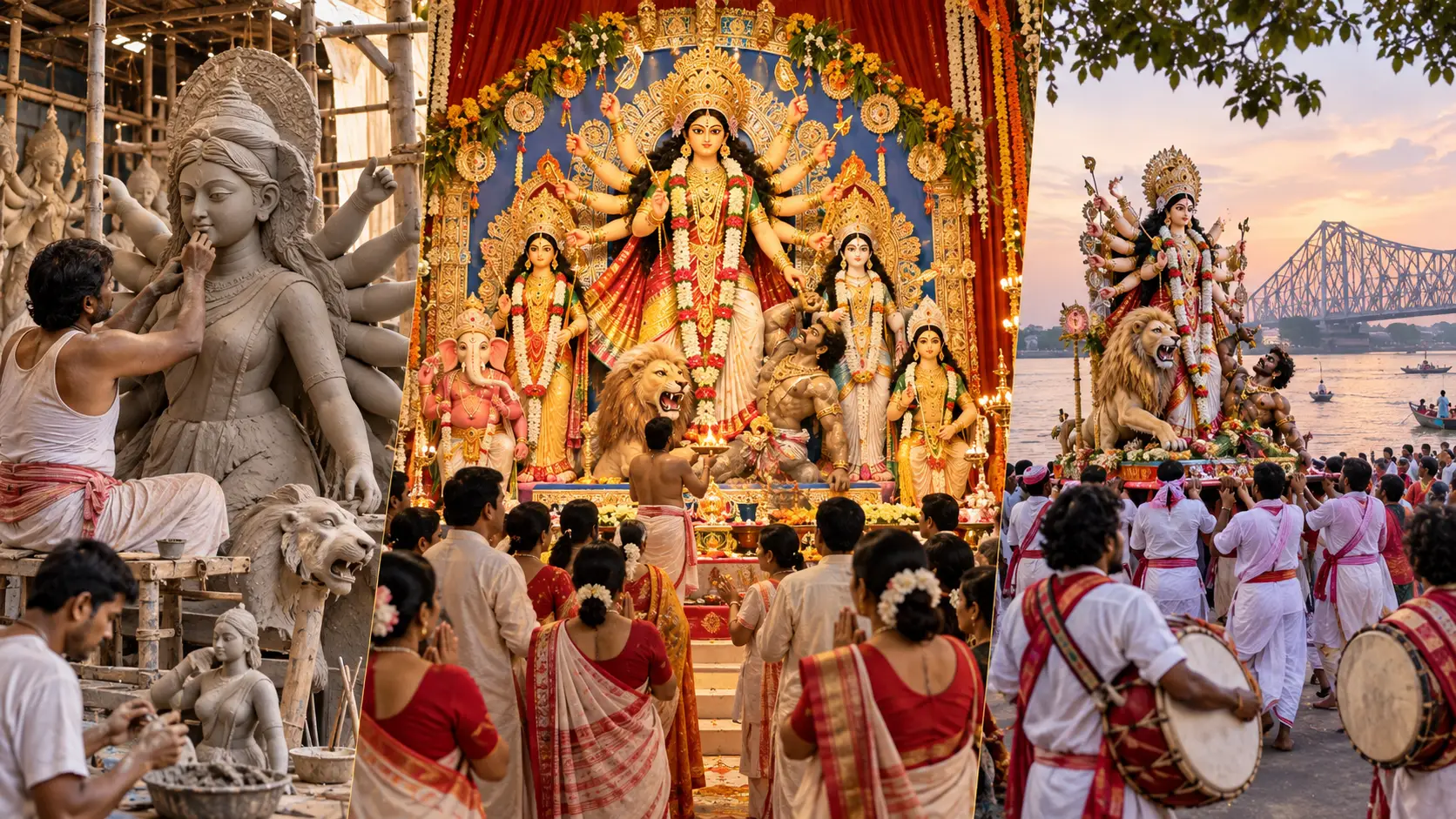
How Is a Durga Idol Made?
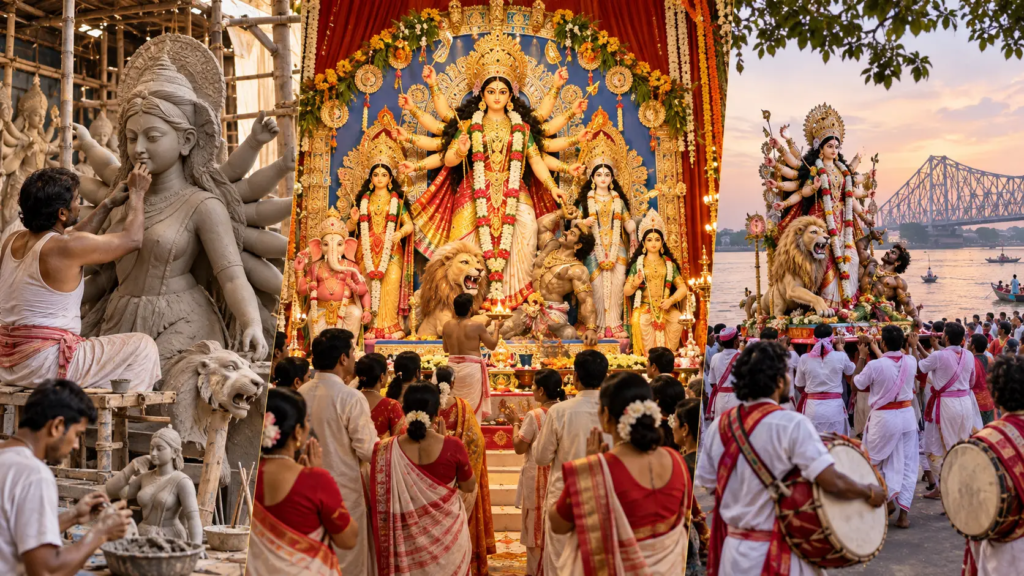
One of the most fascinating parts of Durga Puja is the creation of the clay image.
UNESCO’s documentation describes artisans creating images of Durga and her family from unfired clay, including clay associated with the Ganga River.
A simplified process is:
- A basic structure is prepared.
- Straw or another material is used to create the shape.
- Layers of clay are applied.
- The sculpture is dried.
- Details are added.
- The surface is prepared and painted.
- Clothing and ornaments are added.
- The eyes are painted as part of an important ritual tradition.
- The image is installed in the puja space.
- After the festival, it is taken for immersion.
This means a Durga idol is not simply a decorative statue.
It is the result of traditional craft, art, ritual and community work.
Why Is the Durga Idol Immersed in Water?
At the end of Durga Puja, the clay image is carried in a procession and immersed in water.
UNESCO notes the connection between the clay used to make the images and the water into which they are returned.
The process gives the festival a powerful sense of return and renewal.
The Goddess arrives, is worshipped, and then returns.
In Bengali tradition, this also connects strongly with the emotional idea of Maa Durga returning to her home.
UNESCO describes immersion as part of the festival’s meaning of “home-coming” and seasonal return.
Why Is Durga Puja in Kolkata Recognized by UNESCO?
In 2021, UNESCO added Durga Puja in Kolkata to the Representative List of the Intangible Cultural Heritage of Humanity.
UNESCO highlighted the festival’s combination of:
- religion
- art
- craft
- music
- community participation
- public installations
- traditional knowledge
- cultural transmission
The nomination also recognizes the important role of families, priests, drummers, artists, craftspeople and community organisations in keeping the tradition alive.
This is an important modern fact about Durga worship.
It shows that Durga Puja is not only a religious event. It is also a major living cultural tradition.
The Historical Story of Goddess Durga
The Durga known today did not appear suddenly in exactly the same form everywhere.
The history of the Goddess is complex.
Researchers studying early Indian religion and art have traced the development of Durga through:
- literary texts
- inscriptions
- sculpture
- coins
- temple traditions
- royal patronage
- regional goddess traditions
Research by historian Bihani Sarkar shows how Durga’s cult developed between approximately the 3rd and 12th centuries CE and became increasingly connected with political power, kingship and protection of kingdoms.
This does not mean that people suddenly “invented” Durga at one particular date.
Instead, the historical evidence suggests that different Goddess traditions gradually came together and developed into new forms of Durga worship.
Durga and the Gupta Period
The Gupta period is important in the history of Indian religion and art.
Research on Durga’s development suggests that the Goddess became increasingly visible during and after this period.
There is also ongoing scholarly debate about identifying some early female deity images and coins as Durga.
For example, a 2025 research paper re-examined Gupta coin evidence and argued that certain female figures associated with lions may represent an early form of Durga, while also acknowledging the identification debate.
This is a good example of why historical claims about Durga should be presented carefully.
Durga and Ancient Indian Kings
One of the most interesting parts of Durga’s history is her connection with kings.
Research by Bihani Sarkar argues that Durga became strongly connected with:
- kingship
- warfare
- protection
- political authority
- territorial power
- protection from communal dangers
As political structures changed after the Gupta period, Durga increasingly became a powerful symbol for emerging kingdoms.
She could represent both dangerous power and protective power.
This combination made her especially suitable as a warrior and royal goddess.
The research also shows how Durga’s traditions interacted with local goddesses and regional religious traditions.
How Did Durga Become the Warrior Goddess We Know Today?
Historical research suggests that the familiar image of Durga as a powerful warrior riding a lion developed through a long process.
Early forms of the Goddess had different identities and associations.
Over time, Durga became increasingly associated with:
- the lion
- weapons
- demons
- kingship
- protection
- warfare
- the destruction of dangerous forces
Her relationship with different religious traditions also changed.
Research describes a movement in which Durga was understood in different ways within Vaishnava and Shaiva settings before becoming increasingly central to Goddess-centered Shakta traditions.
So the modern image of Durga is the result of a long historical development.
Ancient Images of Mahishasuramardini
The famous image of Durga killing Mahishasura is called Mahishasuramardini.
This image became an important part of Indian temple art.
Artists have represented the Goddess in many different styles.
Some show her:
- standing on the buffalo
- attacking the buffalo
- pulling the demon from the buffalo body
- riding a lion
- surrounded by weapons
- accompanied by other divine figures
This diversity is important because religious art developed differently in different regions.
The image of Durga is therefore not only a religious symbol but also an important part of the history of Indian sculpture.
What Does the Buffalo Represent?
Mahishasura’s buffalo form is central to his identity.
In the story, the buffalo represents his immense physical power and his ability to take a frightening form.
In later interpretation, the buffalo demon has also been connected with ideas such as uncontrolled force and destructive power.
But, again, these symbolic interpretations should not be presented as though the original text itself gives a simple sentence saying:
“The buffalo means ego.”
The historical story and later symbolic interpretation should be kept separate.
What Do Durga’s Weapons Symbolize?
Different devotional traditions give symbolic meanings to the weapons.
For example:
Trident
Often associated with Shiva and with the destruction of harmful forces.
Discus
Associated with Vishnu and divine order.
Conch
Associated with sacred sound and divine proclamation.
Bow and arrows
Often associated with focus and the ability to act from a distance.
Sword
Associated with cutting through obstacles and ignorance in later spiritual interpretation.
Thunderbolt
Associated with Indra and powerful divine authority.
Bell
Connected with sacred sound and the battlefield imagery of the Goddess.
These meanings vary between traditions, so it is better to describe them as traditional interpretations, rather than claiming that every symbol has one universally fixed meaning.
Why Does Maa Durga Have a Third Eye?
Durga is often shown with a third eye, following a wider Hindu iconographic tradition.
The third eye is commonly associated with:
- higher knowledge
- spiritual vision
- awareness beyond ordinary perception
- divine power
This is also closely connected with the iconography of Shiva and the broader Hindu understanding of divine sight.
Why Is Durga Both a Mother and a Warrior?
At first this may seem like a contradiction.
How can the same Goddess be:
- gentle and loving,
- protective and maternal,
- fierce and destructive?
This contrast is actually central to Durga’s image.
A mother protects her child.
If a serious danger threatens the child, protection may require strength.
This is why Durga can be both:
Maa Durga — the loving mother
and
Mahishasuramardini — the destroyer of Mahishasura.
Her fierce form is not necessarily opposed to her motherly form.
Both are expressions of protection.
What Is the Difference Between Durga, Kali, Parvati and Mahadevi?
These names should not be treated as four completely unrelated goddesses.
In many Hindu traditions, they can be understood as different manifestations or aspects of the Divine Mother.
But different texts and traditions use the names differently.
Durga
Often associated with protection, warfare and the destruction of demons.
Kali
Often associated with fierce transformation, time, destruction and the defeat of powerful demons.
Parvati
Often associated with Shiva, family, motherhood and the Himalayan Goddess tradition.
Mahadevi
Literally means Great Goddess and can be used in theological traditions to describe the supreme Goddess.
The relationship between these forms changes according to the particular Hindu tradition being followed.
What Is the Connection Between Durga and Shakti?
Shakti is the idea of divine power.
In many Shakta traditions, the Goddess is not secondary to the male gods.
Instead, divine power itself is feminine.
This is why the Devi Mahatmya is so important.
The Goddess can give power to the gods, defeat the demons, protect the universe and appear in different forms.
This makes Durga one of the strongest expressions of divine feminine power in Hindu religious traditions.
What Does “Ya Devi Sarvabhuteshu” Mean?
One of the famous hymns connected with the Devi Mahatmya repeatedly praises the Goddess as being present in all beings in different forms.
The idea can be expressed simply as:
The Divine Mother is present in all living beings in different forms.
The hymn lists qualities such as:
- consciousness
- intelligence
- sleep
- hunger
- shadow
- power
- compassion
- memory
- peace
This gives the Goddess a much larger meaning than simply being a warrior who kills demons.
She can be understood as a divine presence within life itself.
What Happens After the Goddess Wins Her Battles?
The Devi Mahatmya does not end with a simple “good wins, evil loses” message.
The Goddess is praised by the gods.
She is asked for protection.
She promises to appear again when needed.
The text therefore presents the Goddess as a continuing source of protection.
Her victories become examples of what happens when divine order confronts destructive forces.
Does the Devi Mahatmya Say Durga Will Appear Again?
Yes, the concluding portions of the text describe future manifestations of the Goddess.
The Goddess tells the gods about forms she will take in future situations when the world needs her.
These include traditions associated with forms such as:
- Shakambhari
- Durga
- Bhima
- Bhramari
The exact theological interpretation of these manifestations varies between traditions.
The important idea is that the Goddess’s protective role continues beyond the Mahishasura story.
The Historical Evidence for the Devi Mahatmya
The dating of the Devi Mahatmya is a subject of scholarly discussion.
It is commonly dated to roughly the early centuries of the first millennium CE, with many scholars placing its composition around the 5th–6th centuries.
An inscription traditionally dated to 608 CE, associated with Dadhimati Mata in Rajasthan, has often been cited as evidence that a verse from the Devi Mahatmya was already known by that period.
However, this evidence needs a careful qualification.
Some later scholarship has questioned the reading of the inscription’s date and whether the quoted verse can definitively be identified with the Devi Mahatmya.
Therefore, the safest statement is:
The Dadhimati inscription has traditionally been used as important early evidence for the circulation of the Devi Mahatmya, but its dating and textual identification have been debated by scholars.
This is more accurate than presenting 608 CE as an absolutely settled date.
Why Did Ancient Kings Worship Durga?
The historical relationship between Durga and kingship is one of the most fascinating parts of her story.
Ancient and medieval rulers faced:
- war
- political competition
- drought
- disease
- natural disasters
- rival kingdoms
- social instability
A powerful warrior Goddess who could defeat demons and protect communities became a natural symbol of royal protection.
Research on Heroic Shaktism shows that Durga became deeply connected with political authority and the protection of kingdoms between the early centuries CE and the medieval period.
This helps explain why Durga images became so important in temples and royal traditions.
Why Are There Different Versions of Maa Durga’s Story?
Hindu mythology developed over many centuries and across many regions.
Therefore, it is normal to find differences in:
- Mahishasura’s birth
- Durga’s origin
- the number of weapons
- the identity of certain forms
- the relationship between Durga and Parvati
- the relationship between Durga and Kali
- the length and details of battles
- Navratri rituals
- Durga Puja customs
These differences do not automatically mean that one tradition is “wrong.”
They show how religious stories develop across different communities, languages and historical periods.
This is especially important when writing a general article for readers from different parts of India.
Maa Durga Story: Scripture vs Popular Retelling
| Topic | Common popular version | More careful explanation |
|---|---|---|
| Origin of Durga | Three major gods create her | She emerges from the combined divine energies of the gods |
| Main demon | Mahishasura is the whole story | Mahishasura is one of three major enemy narratives in Devi Mahatmya |
| Durga’s battles | One famous battle | Madhu-Kaitabha, Mahishasura, Shumbha-Nishumbha |
| Nine-day battle | Durga literally fights Mahishasura for nine days | The nine-night festival and textual narrative should not be treated as identical |
| Navadurga | All forms in Devi Mahatmya | A distinct nine-form tradition associated with Navratri |
| Weapons | Usually a few symbolic weapons | The text describes many divine gifts |
| Durga | Wife of Shiva | In many traditions she is connected with Parvati, but the Devi Mahatmya gives her an independent supreme identity |
| Mahishasura | One fixed origin story | Different traditions preserve different versions |
| Victory | Good defeats evil | The text also presents divine protection, cosmic order and continuing manifestations |
| Durga Puja | Only celebration of Mahishasura’s defeat | It also includes homecoming, community, art, ritual and regional traditions |
Durga Puja and the Living Culture of Bengal
Durga Puja is one of the best examples of how an ancient Goddess tradition continues to evolve.
In Kolkata, the festival combines:
- religious rituals
- sculpture
- painting
- architecture
- music
- lighting
- fashion
- food
- community participation
- public art
UNESCO describes it as a major public expression of religion and art and notes the participation of families, puja committees, priests, drummers, artists and craftspeople.
The festival is therefore not just something people read about in a religious story.
It is a living cultural tradition.
The Journey of a Durga Idol
The entire life of a Durga idol during Puja can be understood as a cycle:
Clay → Sculpture → Decoration → Worship → Celebration → Immersion → Return
This cycle is meaningful because the material image is temporary.
The Goddess is welcomed, worshipped and then returned to nature.
UNESCO specifically notes the use of unfired clay and the return of the image to the river at the end of the festival.
Maa Durga and the Idea of Homecoming
The homecoming theme is particularly powerful in Bengali Durga Puja.
Durga is imagined as returning to her maternal home.
Her arrival creates happiness.
Her departure creates sadness.
The immersion therefore does not simply represent the end of a festival.
It also represents:
- return
- change
- separation
- renewal
- hope for another year
This gives Durga Puja an emotional dimension that is different from simply celebrating the death of a demon.
What Are the Main Lessons From Maa Durga’s Story?
The story of Durga can be understood in many ways.
1. Courage is necessary in difficult times
The gods are helpless, but they do not give up.
2. Power can come from unity
Durga emerges through the combined divine energies of the gods.
3. Pride can destroy even the powerful
Mahishasura becomes so confident in his power that he challenges the divine order.
4. Evil can take different forms
The Goddess faces different enemies and different kinds of danger.
5. Protection sometimes requires strength
Durga’s fierce form exists because protection sometimes requires confrontation.
6. The Divine Feminine can be powerful
The story places a Goddess at the centre of the victory.
7. Problems require different solutions
The strategy used against Mahishasura is not the same as the strategy used against Raktabīja.
8. Hope can return after crisis
The Goddess appears when the gods have lost hope.
These are modern ways of drawing lessons from the story. They should not be confused with direct quotations from the ancient text.
A Simple Maa Durga Story for Kids
Once, a powerful demon named Mahishasura became so strong that he defeated the gods and created trouble in the three worlds.
The gods became worried and joined their divine powers.
From their combined energy appeared a powerful Goddess—Maa Durga.
The gods gave her many weapons and a lion to ride.
Durga went to fight Mahishasura.
The demon changed his forms and fought with great strength, but Durga did not become afraid.
After a great battle, Maa Durga defeated Mahishasura.
The gods celebrated her victory.
This story teaches us that courage, strength and goodness can overcome destructive power.
That is why Maa Durga is worshipped as a loving mother and a powerful protector.
Short Maa Durga Story
Maa Durga is a powerful form of the Divine Mother in Hindu traditions.
When the demon Mahishasura became too powerful for the gods to defeat, the divine energies of the gods came together and manifested as Durga.
The gods gave her powerful weapons, and she rode into battle on a lion.
After a great battle, Durga defeated Mahishasura and restored peace.
Her victory is remembered during Navratri and Durga Puja traditions.
Maa Durga represents strength, courage, protection and the victory of divine order over destructive forces.
Maa Durga Story Timeline
| Period/Event | Importance |
|---|---|
| Early Indian Goddess traditions | Foundations for later Goddess worship |
| Gupta period | Important stage in the development of Durga’s iconography |
| 5th–6th century CE | Common scholarly period associated with the composition of Devi Mahatmya |
| Early medieval period | Durga becomes increasingly connected with kingship and political protection |
| 6th–12th centuries | Expansion of Durga’s cult, temples and regional traditions |
| Medieval period | Regional Durga Puja and ritual traditions develop |
| Modern period | Large public Durga Puja becomes a major cultural festival |
| 2021 | Kolkata Durga Puja added to UNESCO’s Intangible Cultural Heritage list |
Research on the historical development of Durga particularly emphasizes the period from the Gupta era through the medieval period and the relationship between Goddess worship, regional kingdoms and political power.
Why Is Maa Durga Important Today?
Maa Durga remains important because her story continues to connect with people’s lives.
She is worshipped as:
- Mother
- Protector
- Warrior
- Source of Shakti
- Destroyer of destructive forces
- Symbol of courage
- Symbol of feminine power
Her festivals also bring communities together.
Durga Puja in Kolkata is a particularly strong example. UNESCO notes that the festival brings together religious practice, traditional craft, art, music and large public celebrations.
Frequently Asked Questions About Maa Durga
1. Who is Maa Durga?
Maa Durga is a major form of the Hindu Goddess, especially associated with protection, Shakti, courage and the destruction of harmful forces.
2. What is the most famous story of Durga?
The most famous story is her battle against Mahishasura, the buffalo demon.
3. Which book contains the story of Durga and Mahishasura?
The most important classical source is the Devi Mahatmya, traditionally included in the Markandeya Purana.
4. How many chapters are in the Devi Mahatmya?
The Devi Mahatmya contains 13 chapters.
5. What are the three main stories in Devi Mahatmya?
They concern Madhu and Kaitabha, Mahishasura, and Shumbha and Nishumbha.
6. Who was Mahishasura?
Mahishasura was a powerful demon associated with the buffalo and is the famous enemy defeated by Durga.
7. Why could Durga defeat Mahishasura?
His boon made him extremely difficult for male opponents to defeat, while the Goddess was able to confront and destroy him.
8. How was Maa Durga created?
In the Devi Mahatmya, she emerges from the combined divine energies of the gods.
9. Who gave Durga her weapons?
Different gods and divine beings gave her weapons and other objects, including Shiva’s trident, Vishnu’s discus, Indra’s thunderbolt and Himalaya’s lion.
10. Why does Durga ride a lion?
The lion represents strength and courage in popular interpretation and is also connected with the historical warrior and royal imagery of the Goddess.
11. Is Durga the same as Parvati?
They are closely connected in many Hindu traditions, but different texts and traditions explain their relationship differently.
12. Is Durga the same as Kali?
Durga and Kali can be understood as different manifestations of the same Divine Mother in many Shakta traditions.
13. What are the nine forms of Durga?
The Navadurga are Shailaputri, Brahmacharini, Chandraghanta, Kushmanda, Skandamata, Katyayani, Kalaratri, Mahagauri and Siddhidatri.
14. Why is Navratri celebrated?
Navratri is a nine-night festival dedicated to the Goddess in many Hindu traditions. The exact customs vary by region.
15. Why is Durga Puja celebrated?
Durga Puja celebrates and worships Goddess Durga and, in major traditions, is connected with her victory over Mahishasura. In Bengal it also strongly represents her homecoming.
16. Why is Durga Puja important in Bengal?
It is a major religious and cultural festival involving worship, sculpture, art, music, community celebrations and the traditional homecoming of Maa Durga.
17. Is Durga Puja recognized by UNESCO?
Yes. Durga Puja in Kolkata was added to UNESCO’s Representative List of the Intangible Cultural Heritage of Humanity in 2021.
18. Why are Durga idols immersed?
The clay image is traditionally returned to water at the end of the festival. UNESCO connects this practice with the festival’s theme of homecoming and return.
19. Who was Raktabīja?
Raktabīja was a demon whose blood was believed to produce more demons when it touched the ground. Kali’s intervention allowed the Goddess to defeat him.
20. Who are Shumbha and Nishumbha?
They are powerful demons defeated by the Goddess in the third major narrative of the Devi Mahatmya.
21. Who are Chanda and Munda?
They are demon commanders defeated by a fierce manifestation of the Goddess associated with Chamunda.
22. What does Shakti mean?
Shakti means divine power or energy. In Shakta traditions, the Goddess is understood as the supreme divine power.
23. Is the Mahishasura battle exactly nine days long?
Popular festival traditions connect the Goddess’s victory with the nine nights of Navratri, but the Devi Mahatmya should not be treated as a simple nine-day diary of the battle.
24. Is there only one version of the Maa Durga story?
No. Hindu texts and regional traditions preserve different versions and interpretations of Durga, Mahishasura and the Goddess’s forms.
25. What is the main message of Maa Durga’s story?
A common interpretation is that courage, divine power and righteous order can overcome destructive forces, while the Goddess represents protection and strength.
Conclusion: The Complete Meaning of Maa Durga’s Story
The story of Maa Durga is much more than the story of a Goddess defeating a buffalo demon.
At its heart, it is a story about divine power appearing when the world faces a crisis.
The Devi Mahatmya presents the Goddess through several great battles. She defeats Madhu and Kaitabha, Mahishasura, Shumbha, Nishumbha, Raktabīja and other destructive forces.
But the story also goes beyond battle.
It explores human attachment through King Suratha and merchant Samadhi. It presents the Goddess as Shakti. It describes different manifestations of divine power. It praises the Goddess as present in all beings. And it promises that she will appear again when protection is needed.
Over centuries, these traditions became connected with temples, kingship, sculpture, Navratri, Durga Puja and regional customs across South Asia.
Today, Maa Durga is therefore remembered in many ways at once:
as a mother, a protector, a warrior, a source of Shakti, and a symbol of courage.
Her most famous lesson remains simple:
When destructive forces become powerful, courage and divine strength can rise to protect what is good.
And that is why the story of Maa Durga continues to be told, worshipped and celebrated across generations.
References:
- https://academic.oup.com/reference/62357/reference-article-abstract/554514776
- https://doi.org/10.5871/bacad/9780197266106.003.0001
- https://www.jstor.org/stable/jj.31732134
- https://ora.ox.ac.uk/objects/uuid%3A37effb91-4e27-49db-8a9f-1c76edc55732
- https://doi.org/10.5871/bacad/9780197266106.003.0002
- https://academic.oup.com/british-academy-scholarship-online/book/35815/chapter-abstract/308639544
- https://www.metmuseum.org/art/collection/search/38130
- https://www.metmuseum.org/art/collection/search/844987
- https://www.metmuseum.org/art/collection/search/38273
- https://www.unesco.org/en/articles/durga-puja-inscribed-unesco-representative-list-intangible-cultural-heritage-humanity
- https://ich.unesco.org/en/decisions/16.COM/8.B.15
- https://www.wisdomlib.org/hinduism/compilation/purana-bulletin/d/doc1456666.html
