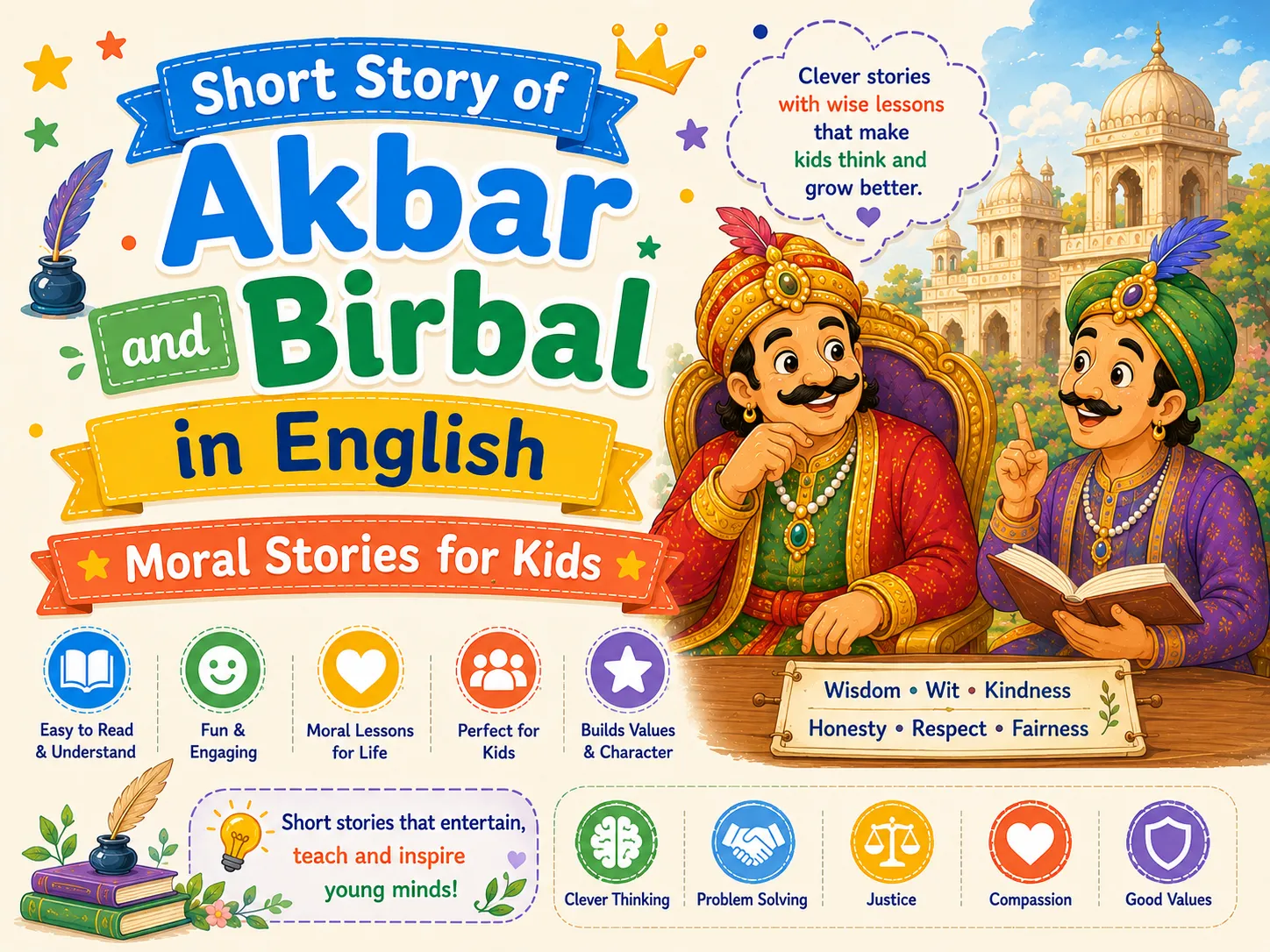
Akbar and Birbal stories have delighted children for generations with their clever plots, interesting characters, and meaningful life lessons.
These short stories are easy to read and help children develop important values such as honesty, kindness, patience, wisdom, fairness, and responsibility.
Along with entertaining adventures, they also introduce new vocabulary and encourage critical thinking.
Parents and teachers can make these stories even more meaningful by reading them aloud, asking simple questions, and discussing the moral after each story.
Through these enjoyable tales, children improve their reading, speaking, and listening skills while learning values that guide them in everyday life.
24 Short Story of Akbar and Birbal in English with Moral for Kids
The Merchant’s Missing Gold
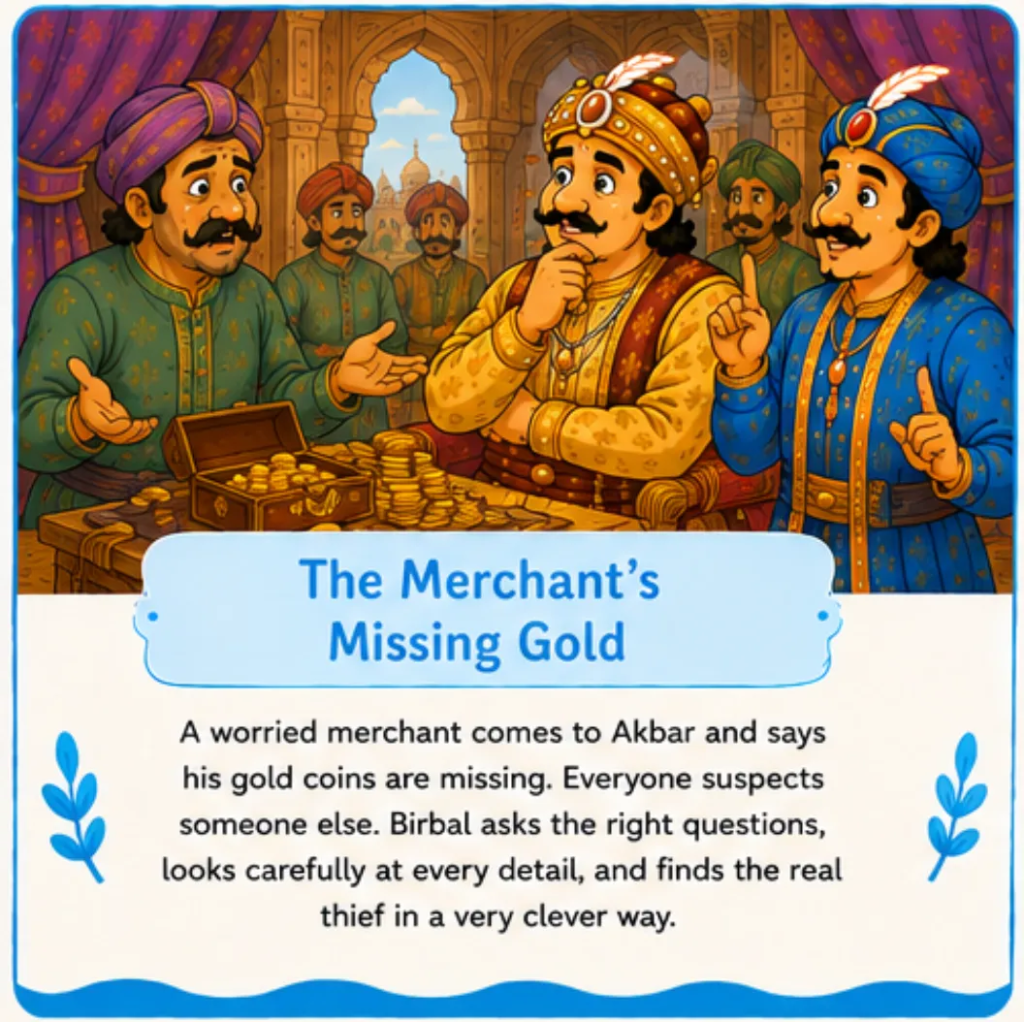
A worried merchant came to Emperor Akbar and said that his bag of gold coins had disappeared. Many people were questioned, but no one admitted taking it. Birbal quietly observed everyone’s behavior. He noticed one man looked nervous whenever the gold was mentioned. Birbal asked him a few clever questions, and the truth came out. The man returned the gold and apologized. Akbar praised Birbal’s wisdom, and the merchant happily got his money back.
Moral: Honesty always wins in the end.
Birbal Solves the Silent Argument
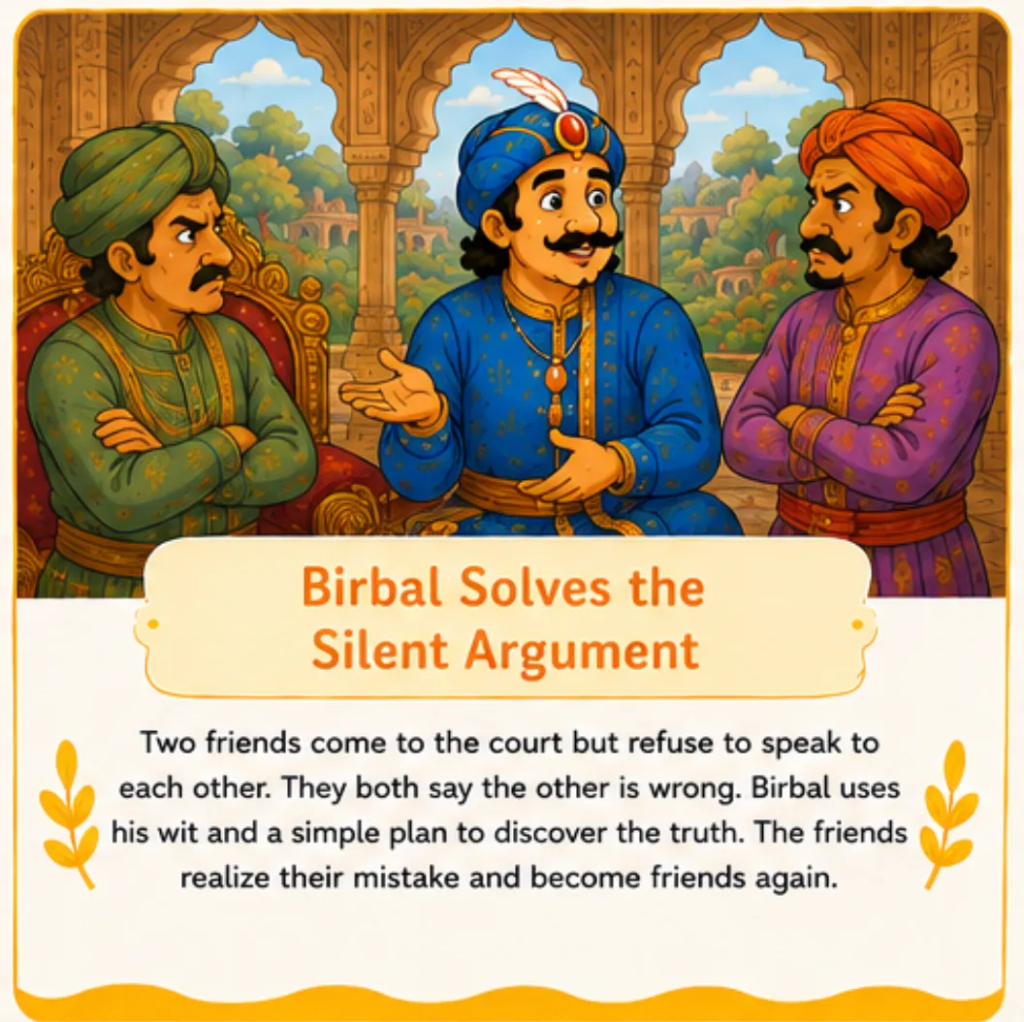
Two neighbors stopped speaking to each other after a small misunderstanding. They asked Emperor Akbar for help. Birbal invited them to share a meal but asked them to remain silent. Soon, they smiled, helped each other, and realized their friendship was more important than their pride. They apologized and became friends again. Akbar praised Birbal for solving the problem without a single harsh word.
Moral: Wisdom and understanding are stronger than anger.
The Clever Gardener’s Secret
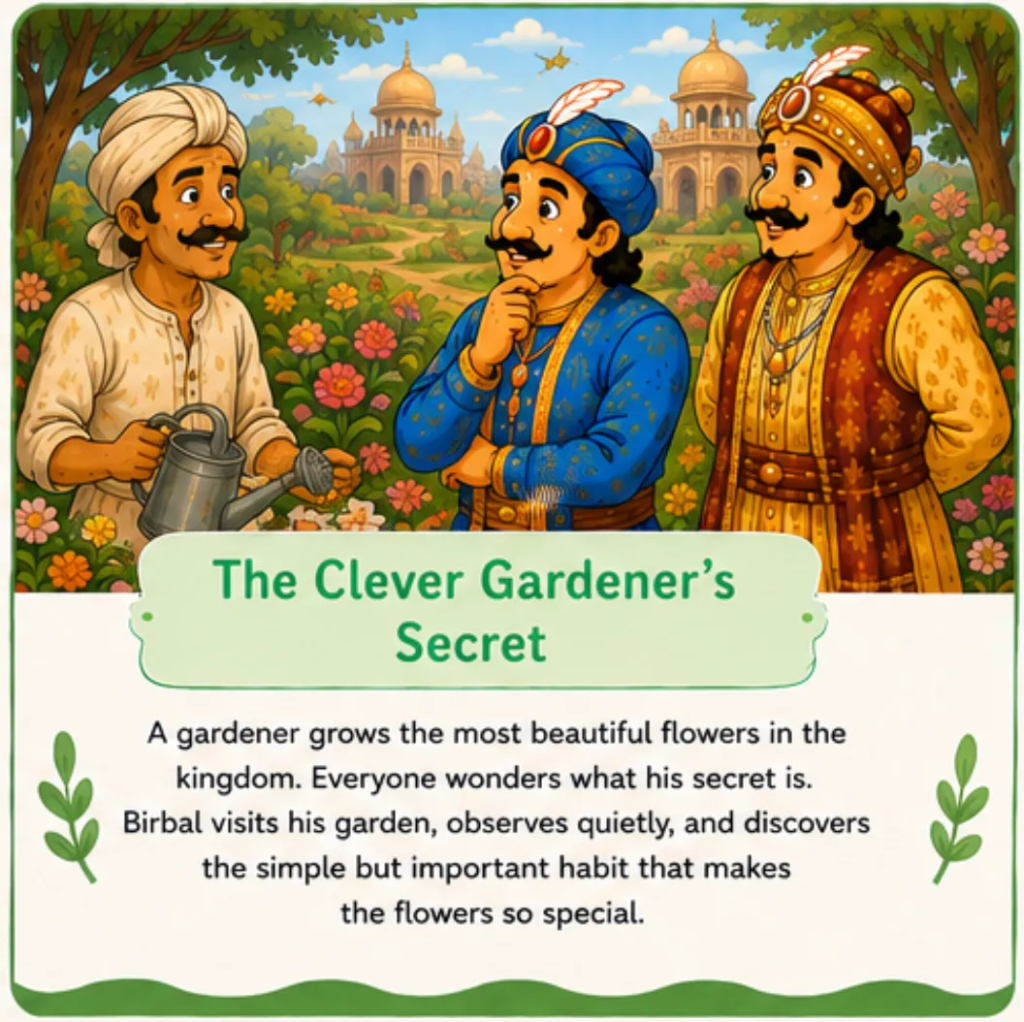
Akbar admired the beautiful flowers in the royal garden and asked the gardener how they bloomed so well. Some people thought he used magic, but Birbal smiled. The gardener explained that he watered the plants every day, removed weeds, and cared for them with patience. Akbar praised his dedication, and everyone learned that success comes from steady effort, not magic.
Moral: Hard work and patience always bring the best results.
The Magic Pot That Never Worked
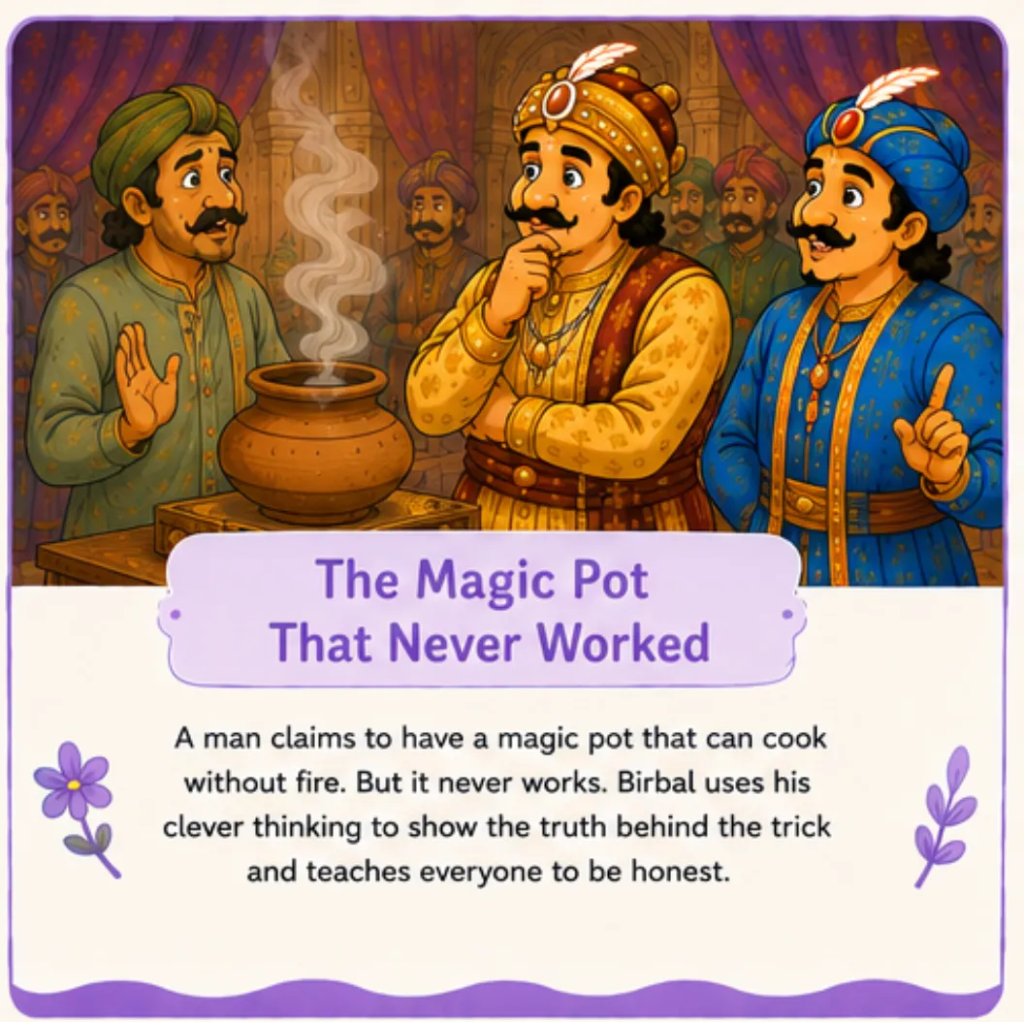
A traveler sold Akbar a pot, claiming it could grow gold overnight. Curious, Akbar asked Birbal to test it. Birbal filled the pot with ordinary seeds instead. Days later, only tiny plants grew. He smiled and said, “Real rewards come from patience and hard work, not magic.” The traveler admitted he had lied and apologized. Akbar thanked Birbal for revealing the truth.
Moral: There are no shortcuts to success.
Akbar’s Challenge of Three Questions
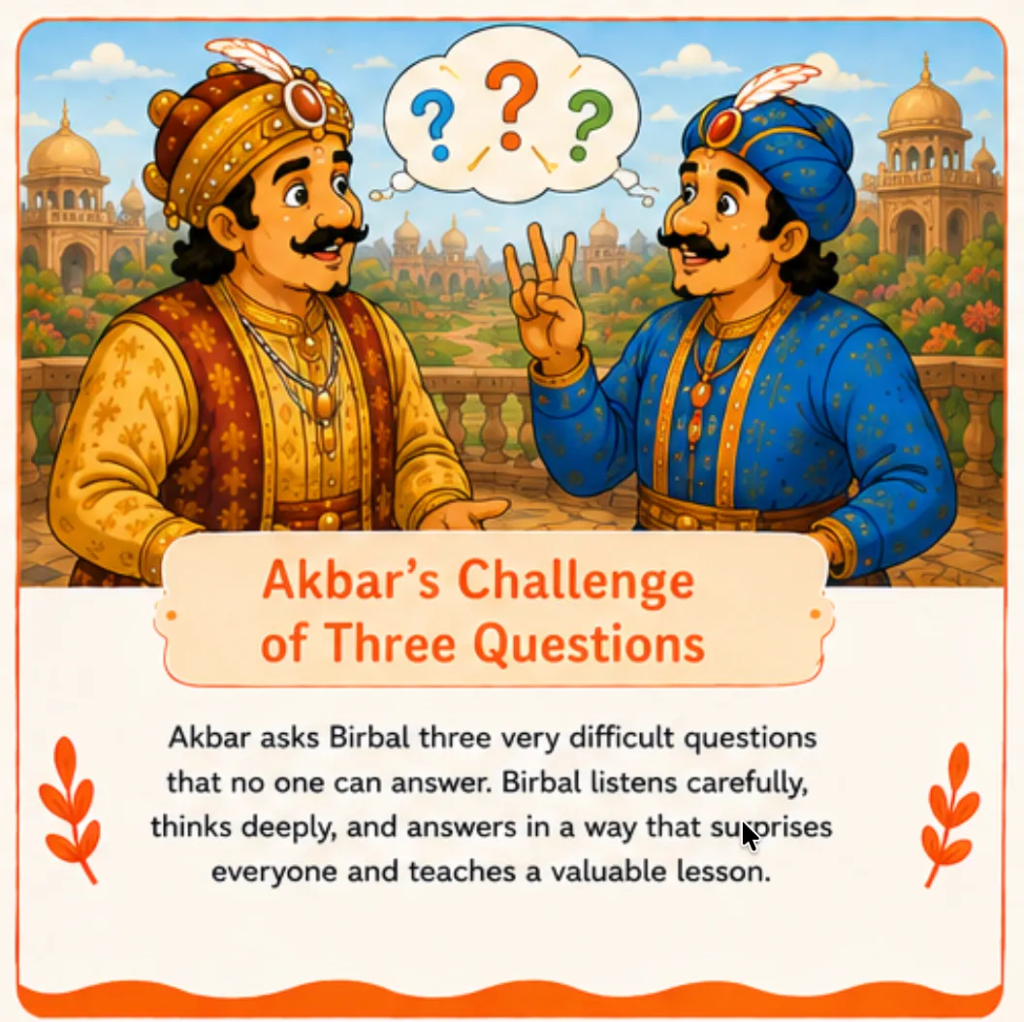
One day, Emperor Akbar asked his courtiers three difficult questions, but no one could answer them. Birbal listened carefully and replied with simple, thoughtful answers that impressed everyone. Akbar smiled and praised Birbal’s wisdom. The courtiers realized that asking questions and thinking calmly helps us learn new things and solve problems.
Moral: Curiosity and wisdom lead to knowledge.
The Painter Who Claimed Perfection
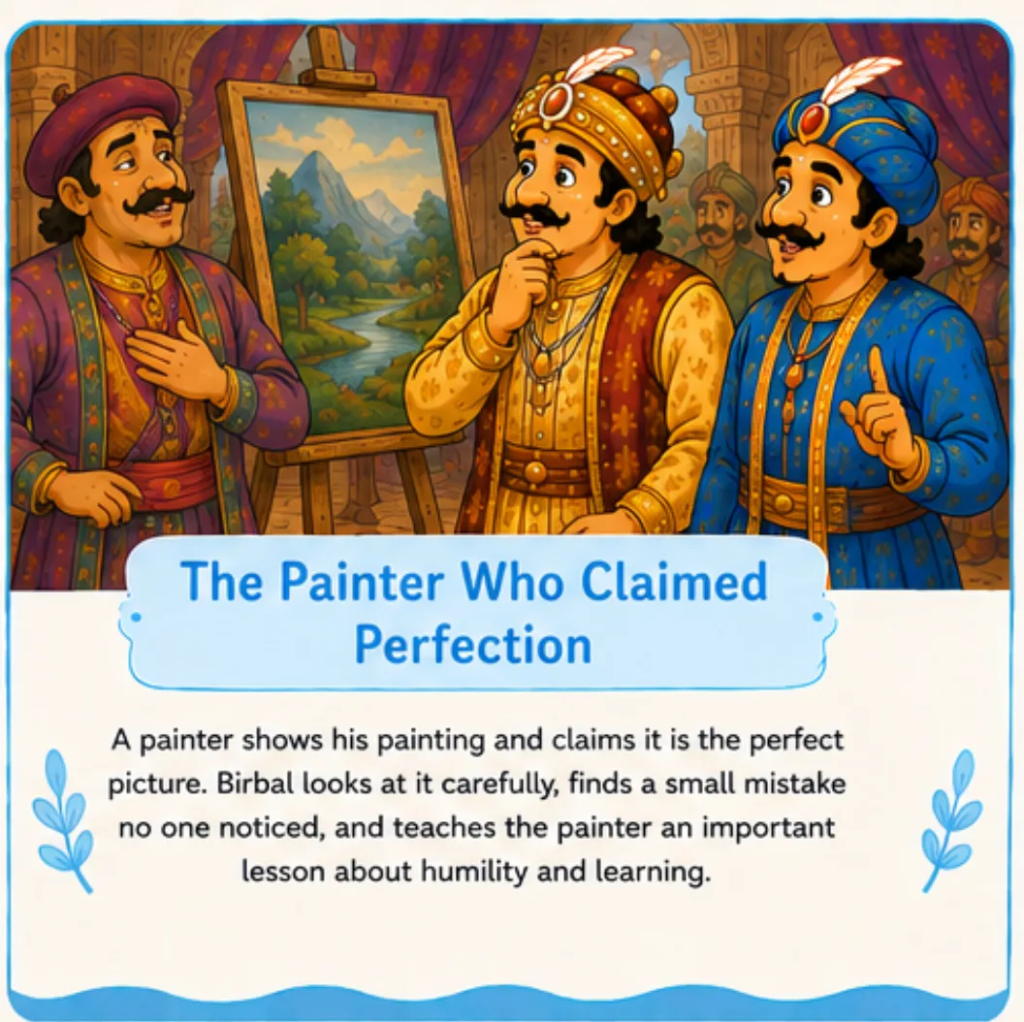
A famous painter proudly told Emperor Akbar that his artwork had no mistakes. Akbar asked Birbal to examine it. Birbal smiled and invited everyone to point out small improvements. Soon, many helpful ideas were shared. The painter realized that no one is perfect and that learning from others makes us better. He thanked Birbal for teaching him a valuable lesson.
Moral: Accepting mistakes helps us grow and improve.
Birbal and the Empty Treasure Chest
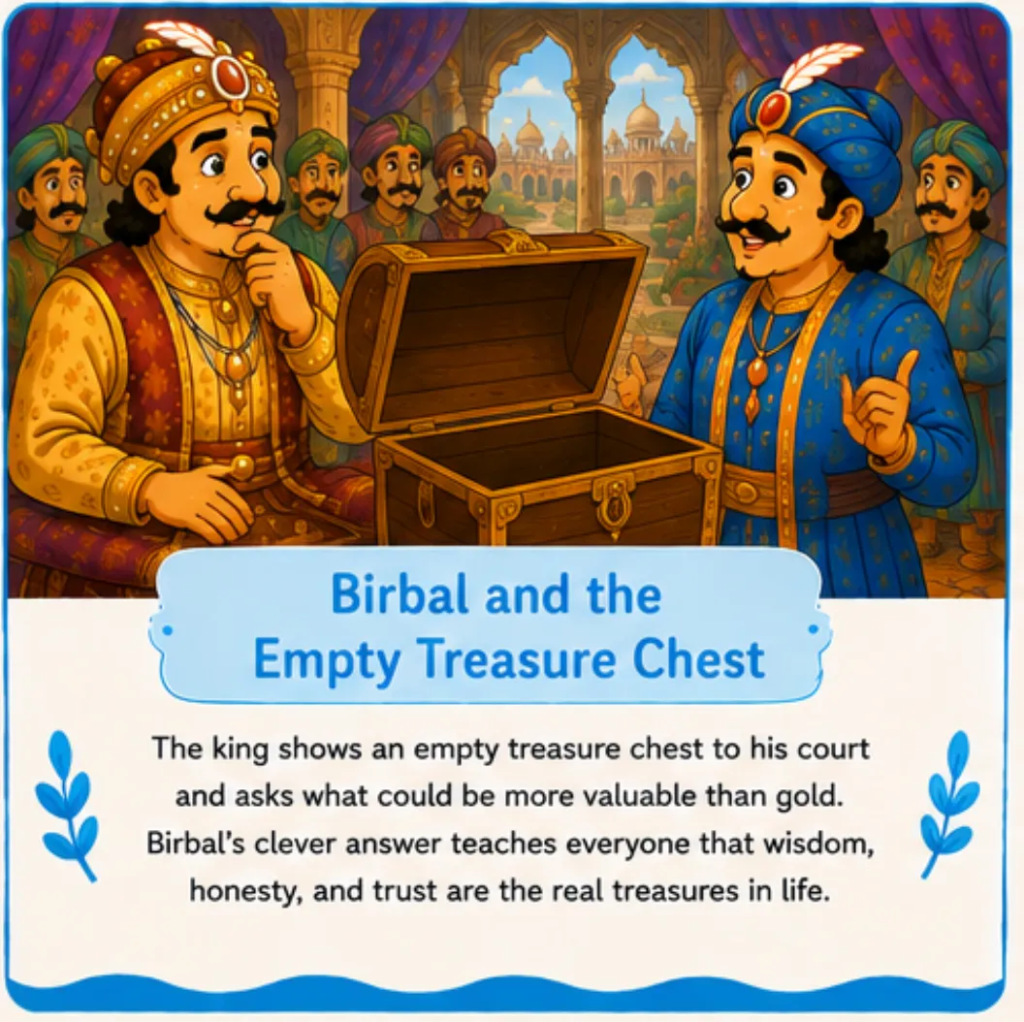
One day, Emperor Akbar found an old treasure chest in the palace. Everyone expected it to be full of gold, but it was completely empty. The courtiers were disappointed. Birbal smiled and said, “A wise mind is the greatest treasure anyone can have.” Akbar agreed, saying that knowledge and good judgment help people earn far more than gold. Everyone understood the true meaning of wealth.
Moral: Intelligence is more valuable than riches.
The King’s Lost Falcon
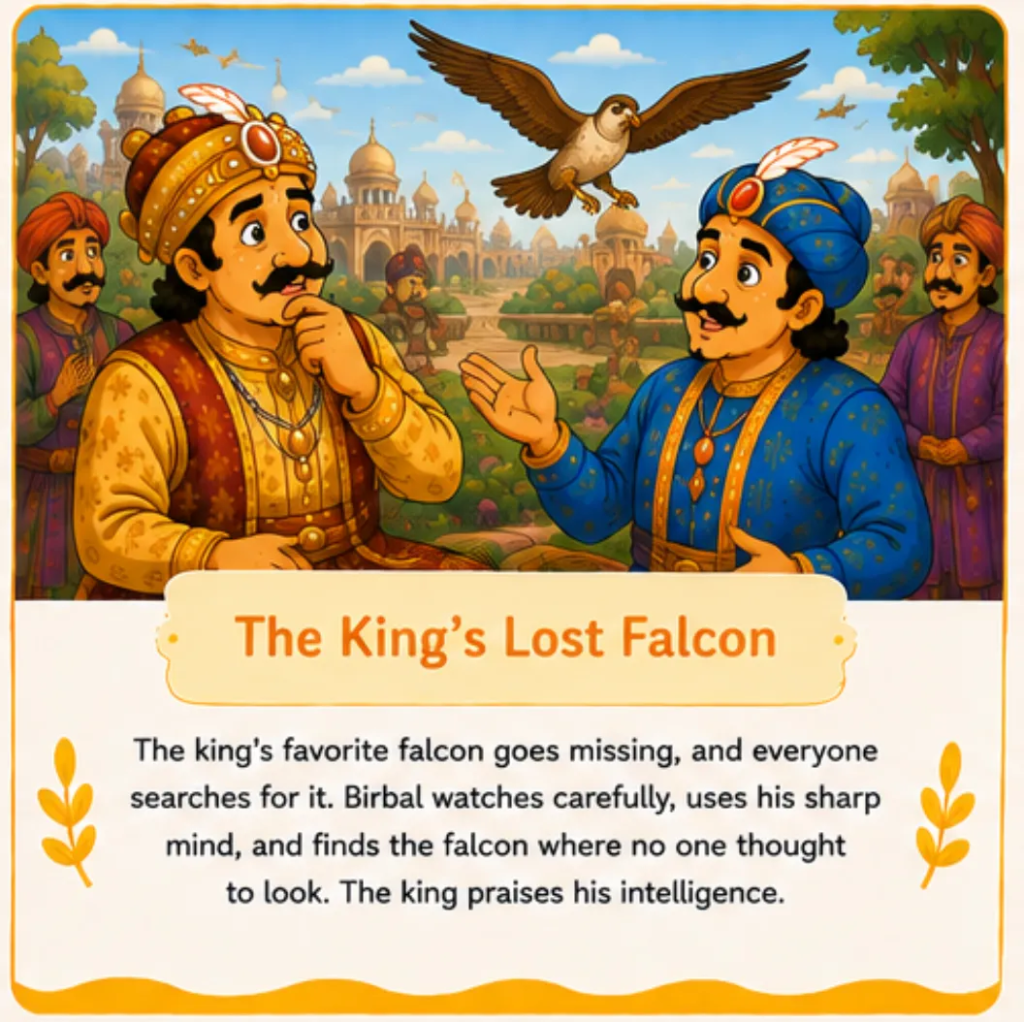
Emperor Akbar’s favorite falcon flew away during a hunting trip. Many servants searched carelessly, hoping someone else would find it. Birbal organized the search, gave everyone a clear task, and reminded them to stay responsible. Soon, one loyal servant found the falcon resting in a nearby tree. Akbar thanked everyone, especially Birbal, for teaching the importance of duty and teamwork.
Moral: Responsibility and teamwork lead to success.
The Farmer’s Honest Harvest
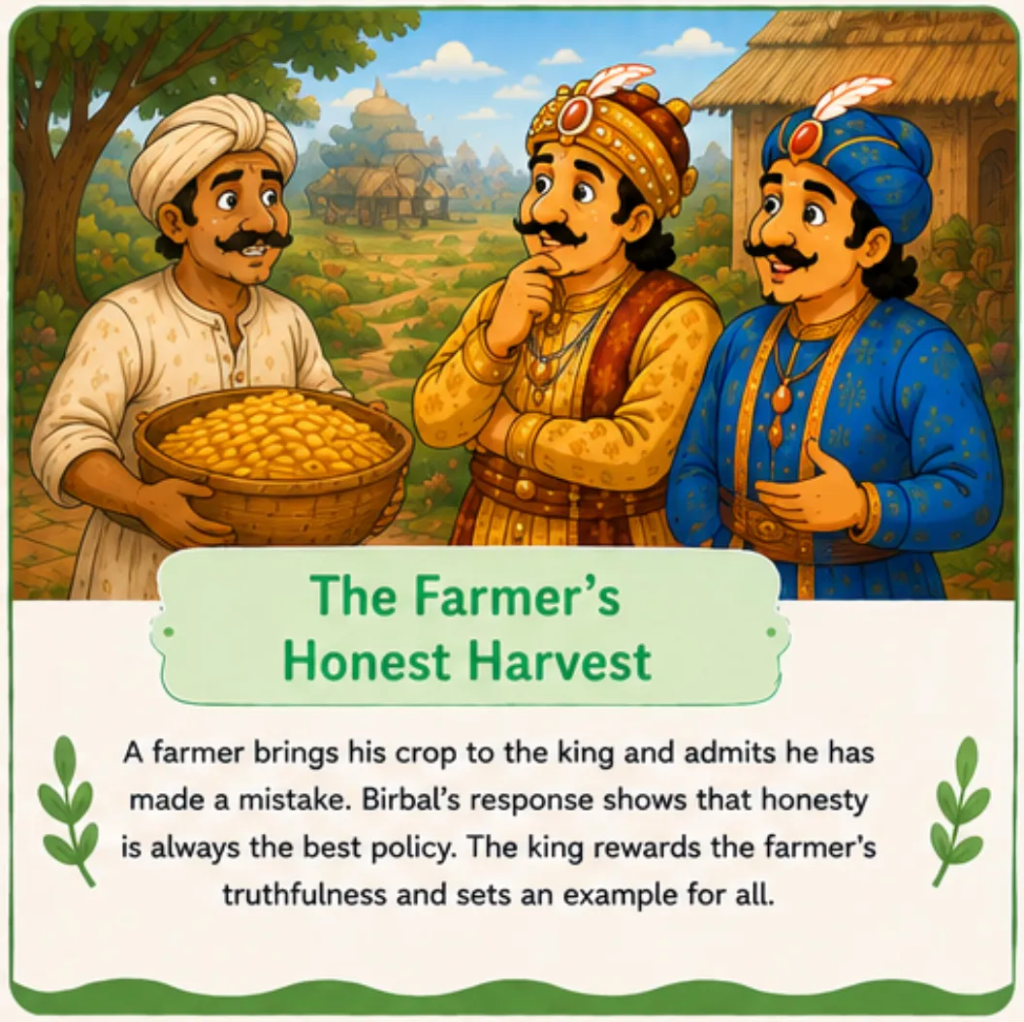
A farmer brought a basket of fresh wheat to Emperor Akbar and honestly admitted that a small part of the harvest had been damaged by heavy rain. Akbar appreciated his truthfulness. Birbal said that an honest person earns trust more valuable than money. The farmer was rewarded for his honesty and promised to keep working hard every season.
Moral: Honesty earns respect and lasting trust.
Birbal’s Lesson with a Candle
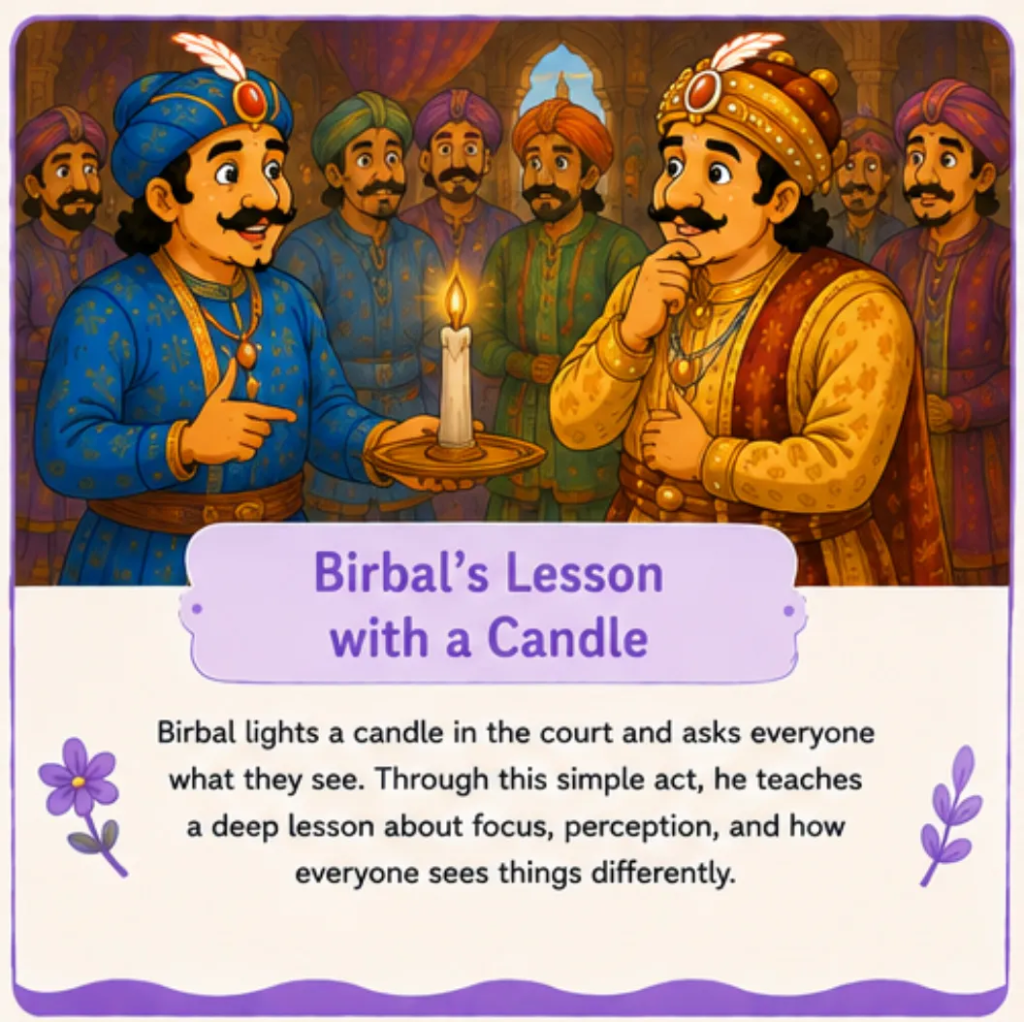
One evening, Emperor Akbar asked how a tiny candle could make any difference in a large dark hall. Birbal lit a single candle, and its gentle light spread across the room. “Even a small light can remove great darkness,” he said. Akbar smiled and understood that even small acts of kindness and effort can create a big change.
Moral: Small efforts can make a big difference.
The Jewel That Belonged to Everyone
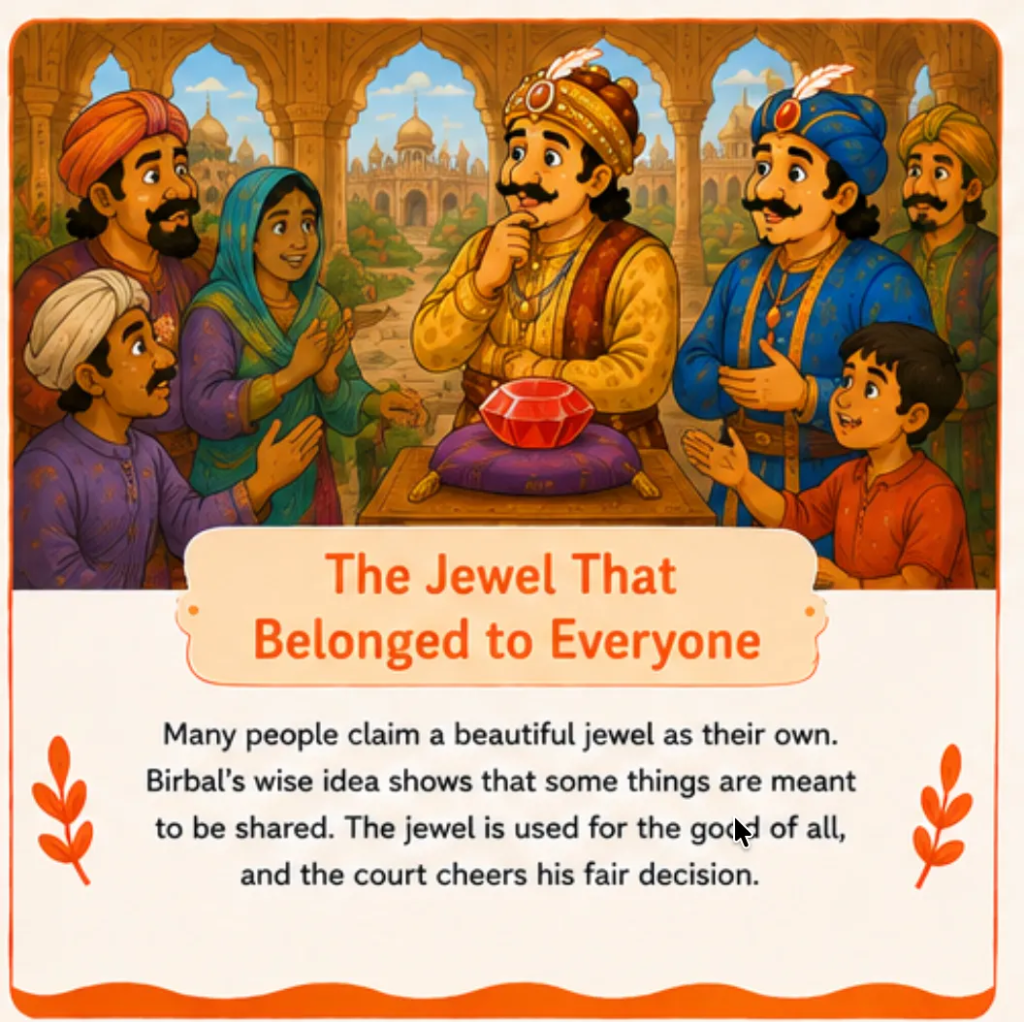
A beautiful jewel was found in the royal garden, and many people claimed it was theirs. Emperor Akbar asked Birbal to solve the dispute. Birbal questioned each person carefully and discovered that none could describe the jewel correctly. He returned it to the royal treasury until the true owner came forward with proof. Everyone praised Birbal’s fair judgment.
Moral: Fairness and truth should guide every decision.
Akbar’s Most Valuable Gift
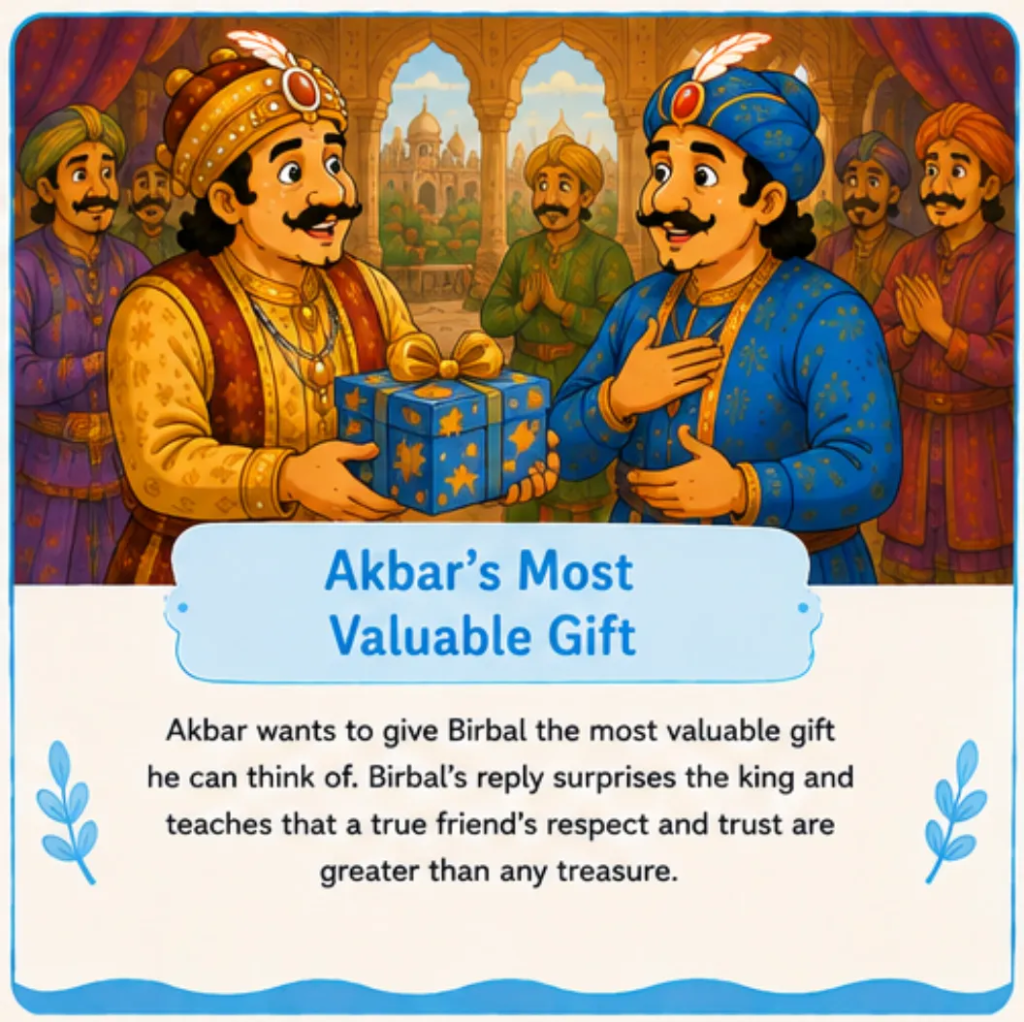
On his birthday, Emperor Akbar received expensive jewels, fine clothes, and precious gold. A poor old woman brought him only a basket of fresh fruits with a warm smile. Some courtiers laughed, but Birbal reminded them that a gift given with love is worth more than riches. Akbar happily accepted the fruits and thanked the woman for her kindness.
Moral: Love and kindness are the greatest gifts of all.
Birbal Outsmarts the Greedy Innkeeper
A greedy innkeeper charged travelers unfairly and kept extra money for himself. The travelers complained to Emperor Akbar. Birbal visited the inn disguised as a traveler and saw the dishonesty himself. The next day, he revealed the truth in Akbar’s court. The innkeeper returned the extra money and promised to treat every guest fairly.
Moral: Greed brings trouble, but honesty earns respect.
The Mystery of the Broken Bridge
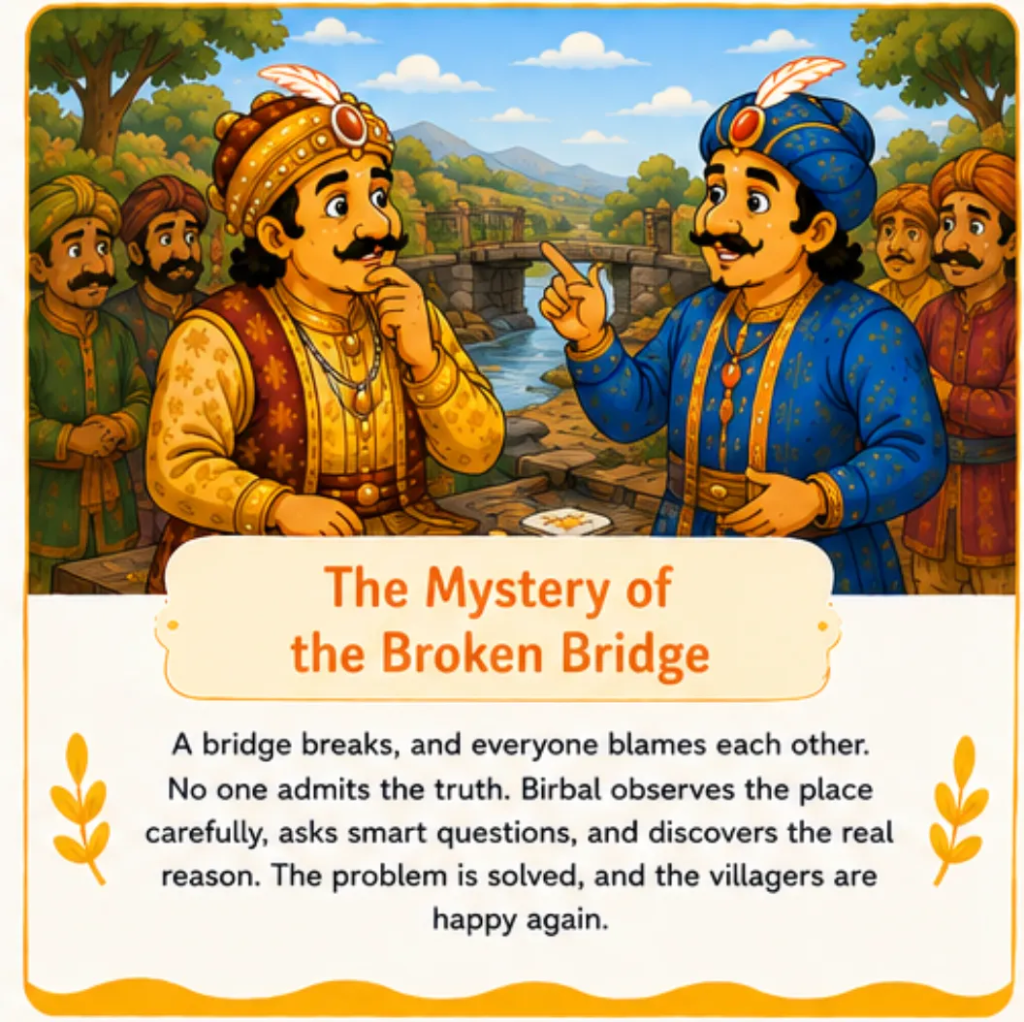
A wooden bridge near the kingdom suddenly broke, and everyone blamed one another. Emperor Akbar asked Birbal to investigate. Instead of arguing, Birbal gathered the villagers and had them work together to rebuild the bridge. While working, they discovered that old wood and heavy rains had caused the damage. Everyone learned that cooperation solves problems faster than blame.
Moral: Teamwork and unity help overcome every challenge.
The Two Friends and One Promise
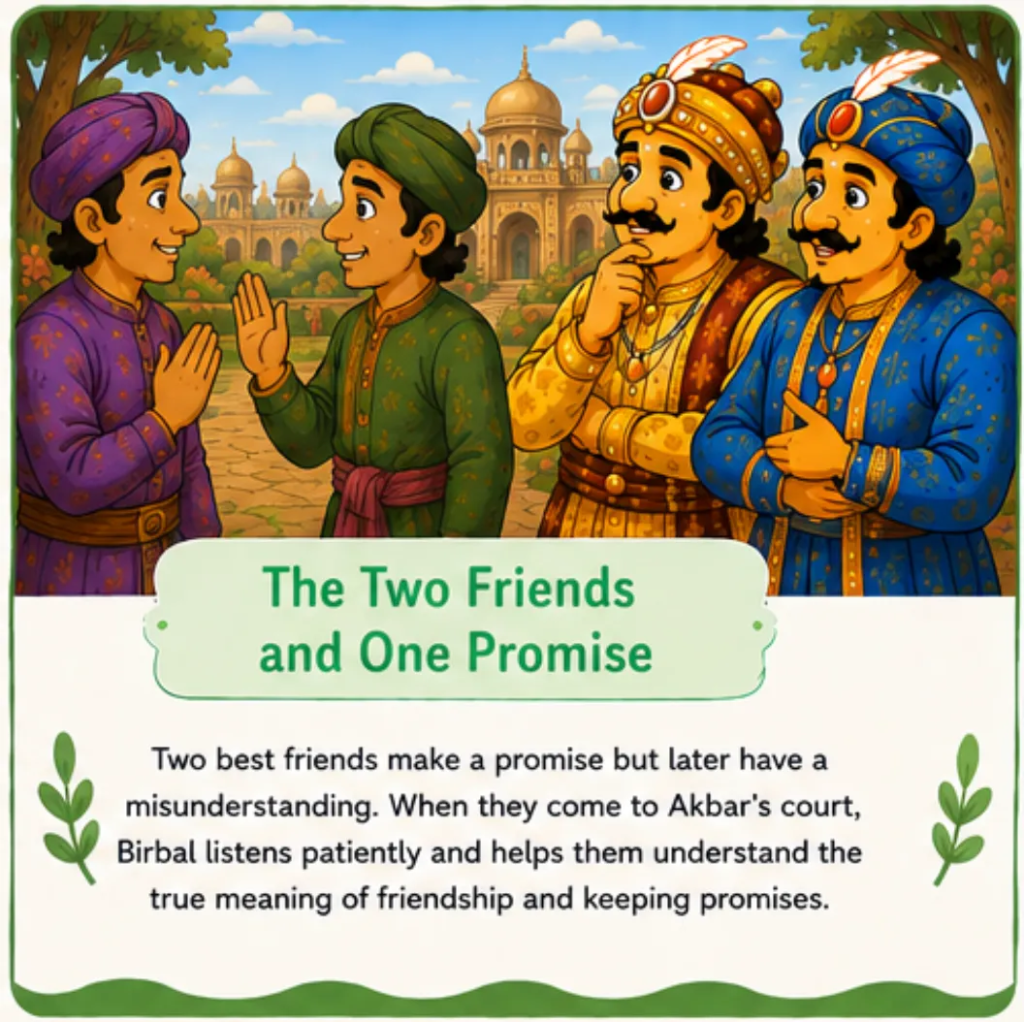
Two close friends promised to always help each other. One day, one friend lost his small bag of coins and felt worried. Without hesitation, the other friend shared his savings and helped him start again. Emperor Akbar praised their friendship, and Birbal said that true friends stand together in difficult times. Their bond became even stronger.
Moral: True friendship is built on trust, kindness, and support.
Birbal Judges the Singing Contest

Emperor Akbar organized a singing contest in the royal court. Many singers performed beautifully, but one singer was ignored because of his simple clothes. Birbal listened carefully without judging anyone by appearance. He chose the humble singer because his voice was the sweetest and most heartfelt. Akbar praised Birbal for making a fair decision based on talent alone.
Moral: True talent should always be judged fairly, not by appearance.
The Boy Who Spoke Only the Truth
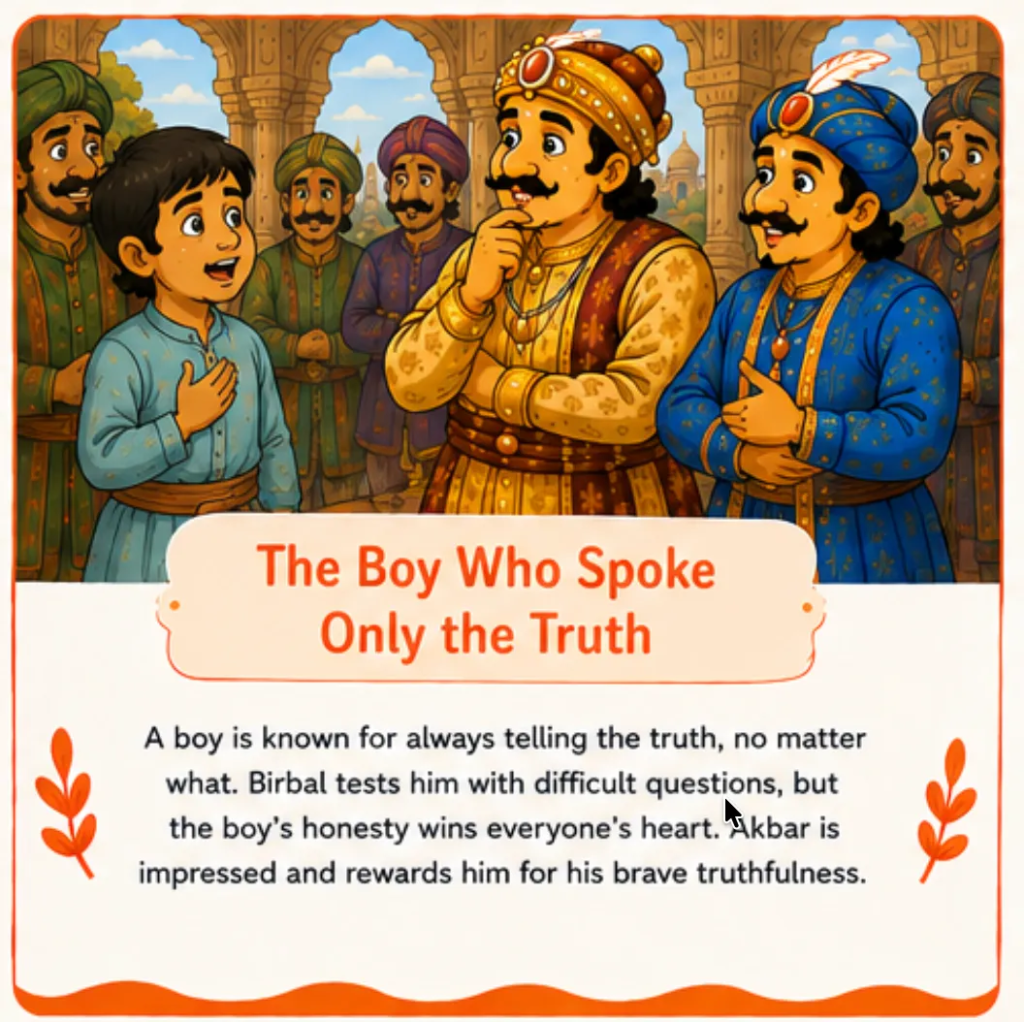
A young boy was known for always telling the truth. One day, he accidentally broke a clay pot in the market. Instead of running away, he admitted his mistake to the shopkeeper. Emperor Akbar heard about the boy’s honesty and rewarded him for his courage. Birbal smiled and said that truthfulness brings respect and trust wherever we go.
Moral: Always tell the truth, even when it is difficult.
Akbar’s Impossible Painting Contest
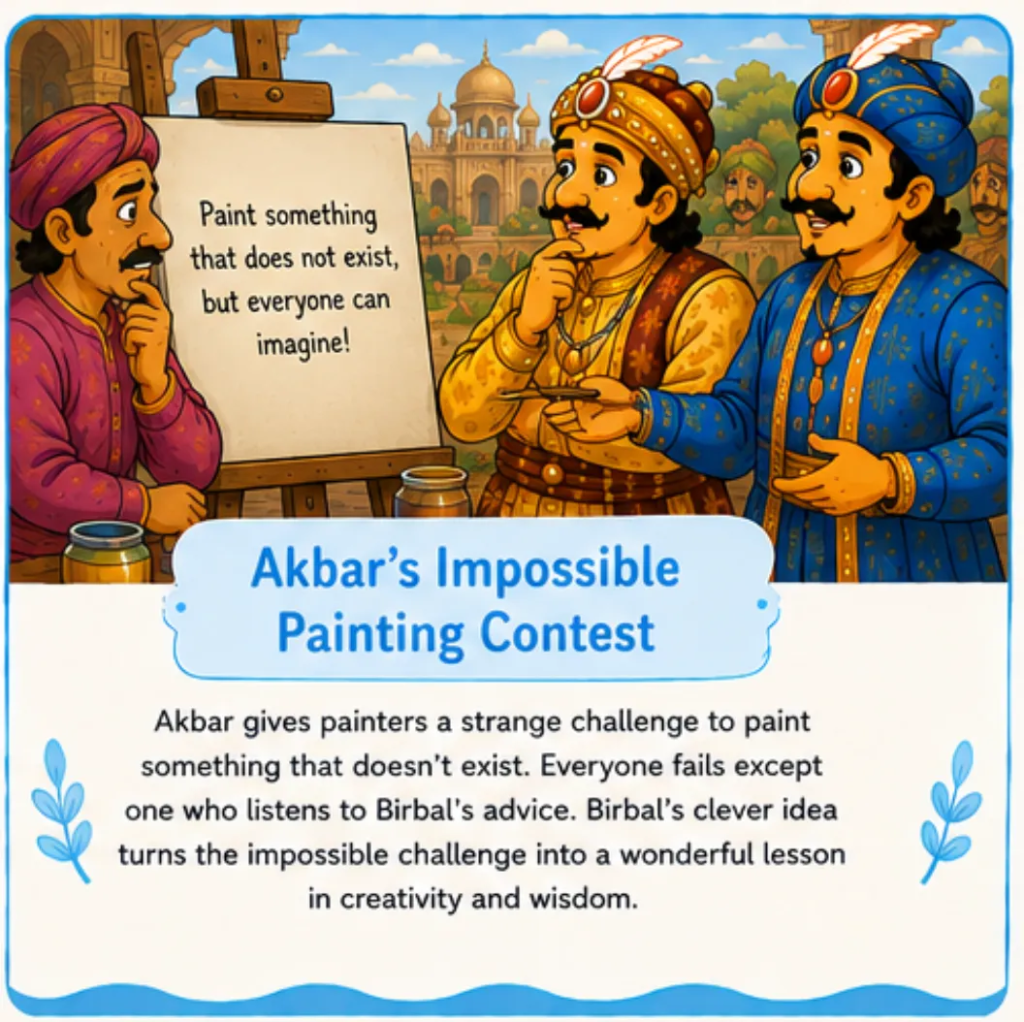
Emperor Akbar announced a painting contest with a difficult theme: “Paint the sound of happiness.” Many artists were confused, but one young painter created a picture of laughing children, singing birds, and blooming flowers. Birbal explained that true art expresses feelings, not just objects. Akbar admired the creativity and declared the young artist the winner.
Moral: Creativity grows when we think beyond the ordinary.
Birbal and the Talking Parrot
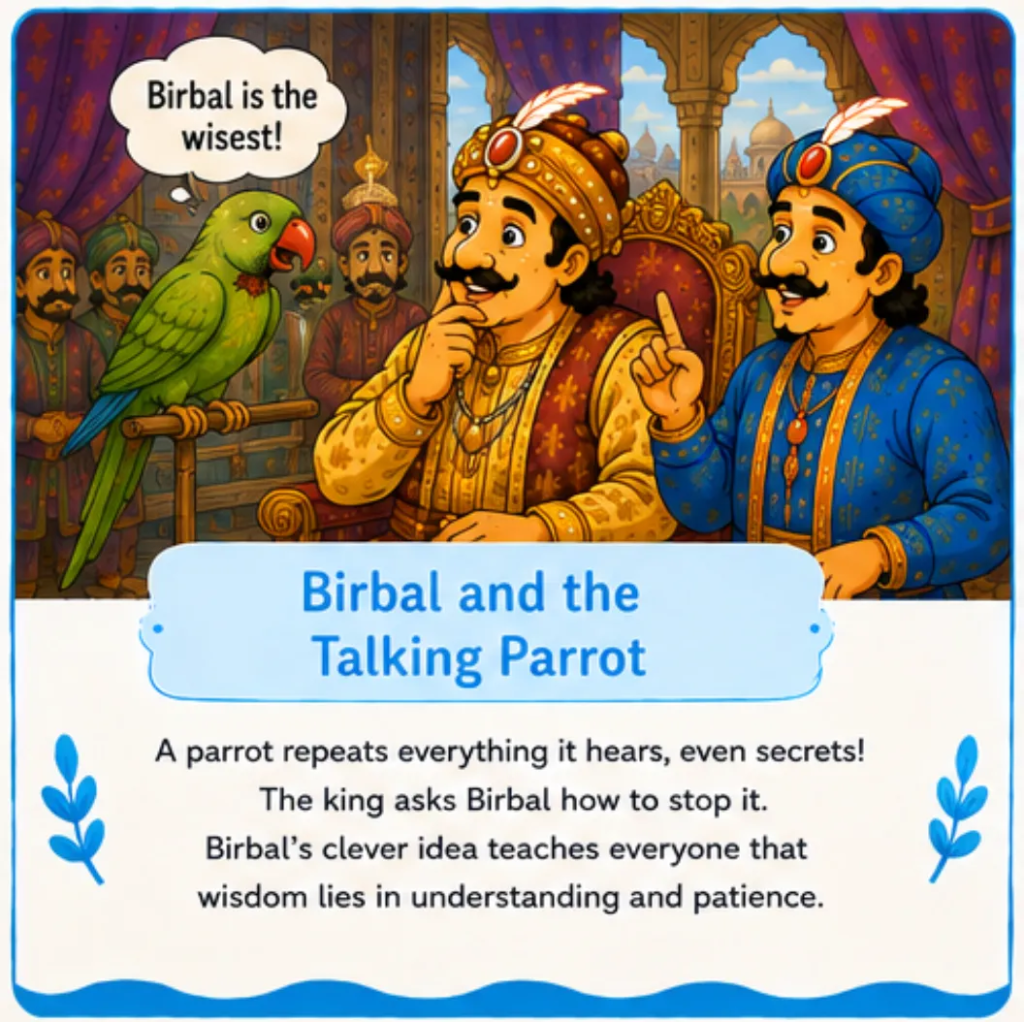
A merchant claimed his parrot could predict the future. Many people believed him without asking questions. Emperor Akbar asked Birbal to test the bird. Birbal noticed that the merchant gave secret signals before the parrot spoke. The trick was revealed, and the merchant admitted the truth. Akbar praised Birbal for using careful observation instead of blind belief.
Moral: Think carefully before believing everything you hear.
The Rich Man’s Heavy Heart
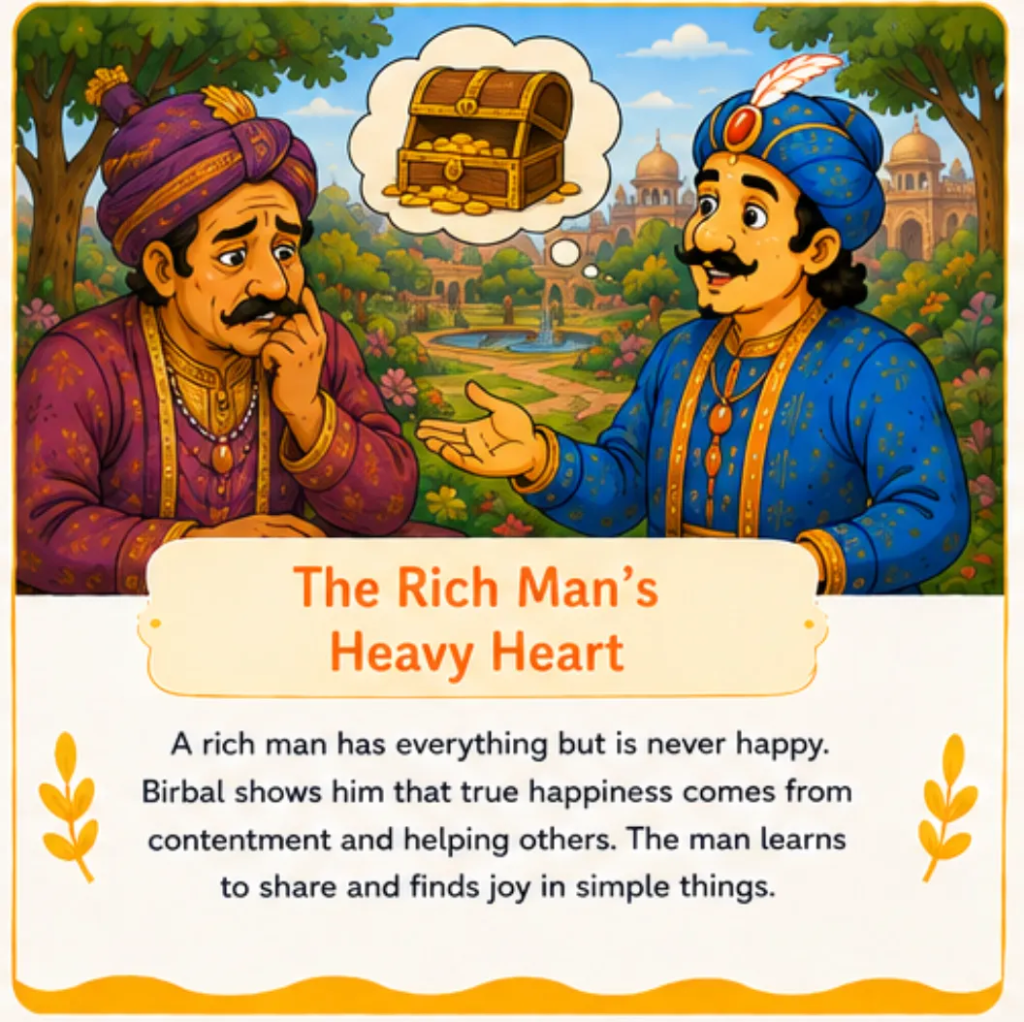
A wealthy man came to Emperor Akbar and said he had everything except happiness. Birbal took him to visit a poor family who shared their simple meal with smiles and gratitude. The rich man realized that love, kindness, and contentment bring true joy, not riches alone. He decided to help others and soon found happiness in giving.
Moral: True happiness comes from kindness and contentment, not wealth.
Birbal’s Clever Water Test
Two farmers argued over who owned a valuable water well. Emperor Akbar asked Birbal to settle the matter. Birbal suggested that each farmer should care for the well for one week. One farmer cleaned it and shared the water with everyone, while the other showed little interest. Birbal declared the caring farmer the rightful owner because his actions proved his responsibility.
Moral: Actions speak louder than words.
The Lost Ring in the Royal Garden
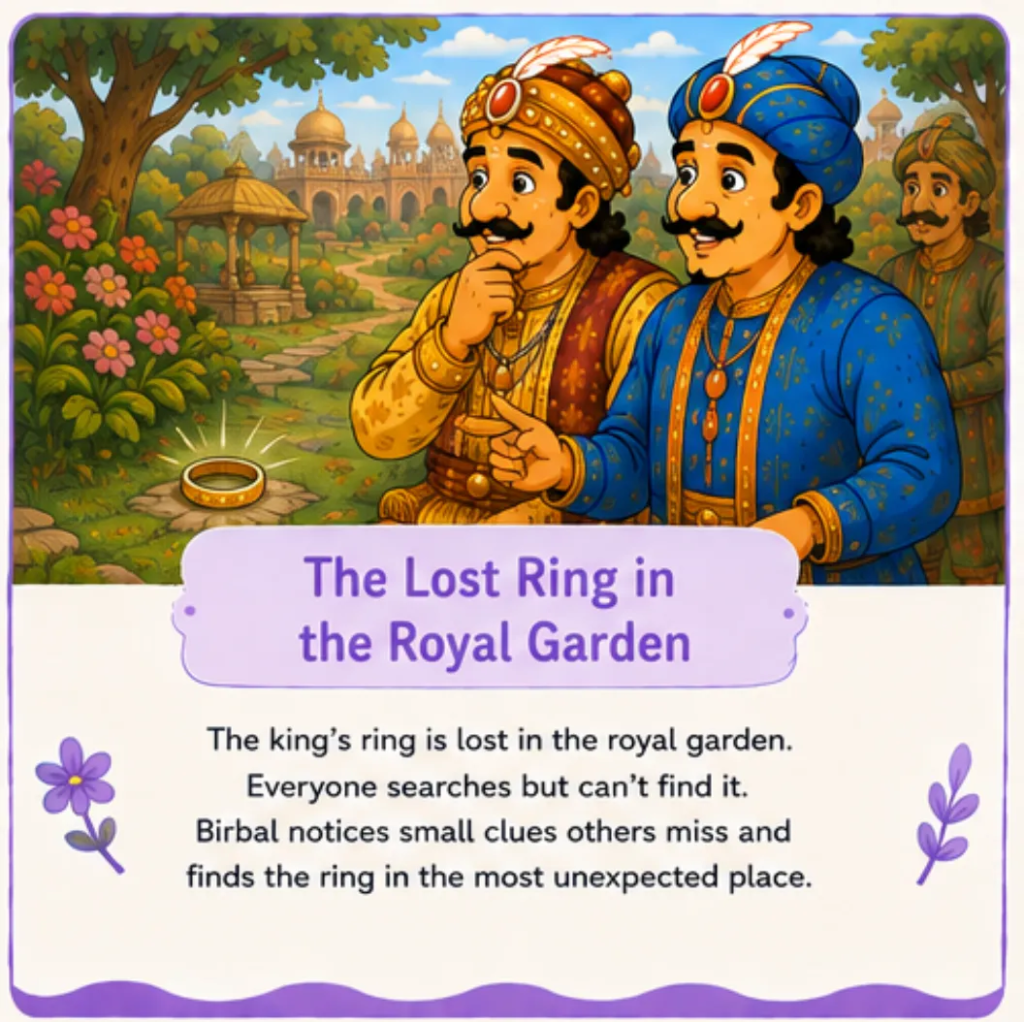
One morning, Emperor Akbar lost his favorite ring while walking in the royal garden. The gardeners searched everywhere but could not find it. Birbal calmly asked everyone to search carefully instead of rushing. After some time, a gardener found the ring hidden beneath a pile of dry leaves. Akbar thanked Birbal for reminding everyone that patience leads to success.
Moral: Patience and careful effort help solve problems.
Akbar’s Test of Kindness
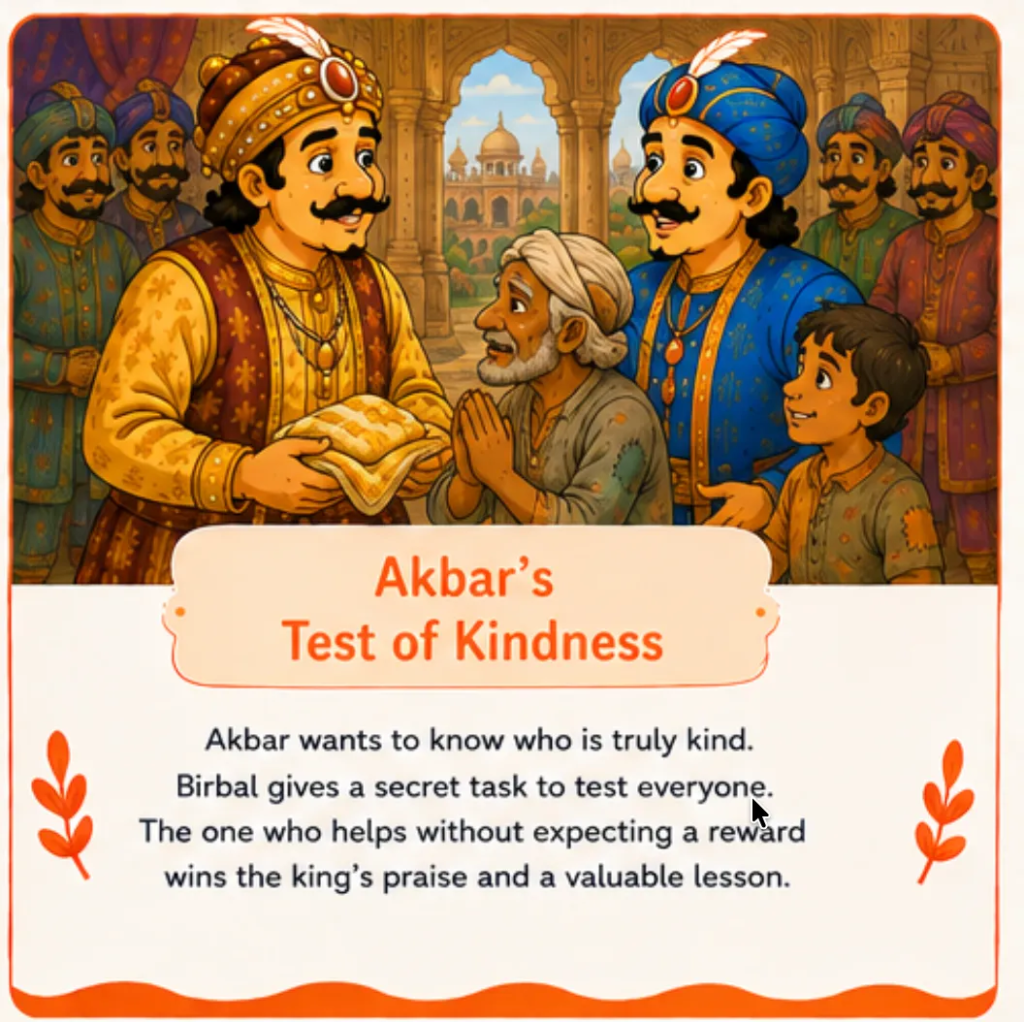
Emperor Akbar wanted to know who in his court was truly kind. He asked everyone to help an old traveler carrying a heavy bundle. Most people walked past, but one young courtier stopped to help without expecting a reward. Birbal smiled and said that true kindness comes from the heart, not from the hope of praise. Akbar rewarded the kind courtier for his good deed.
Moral: Kindness shown without expecting anything in return is the greatest kindness.
Birbal’s Final Lesson for the Young Prince
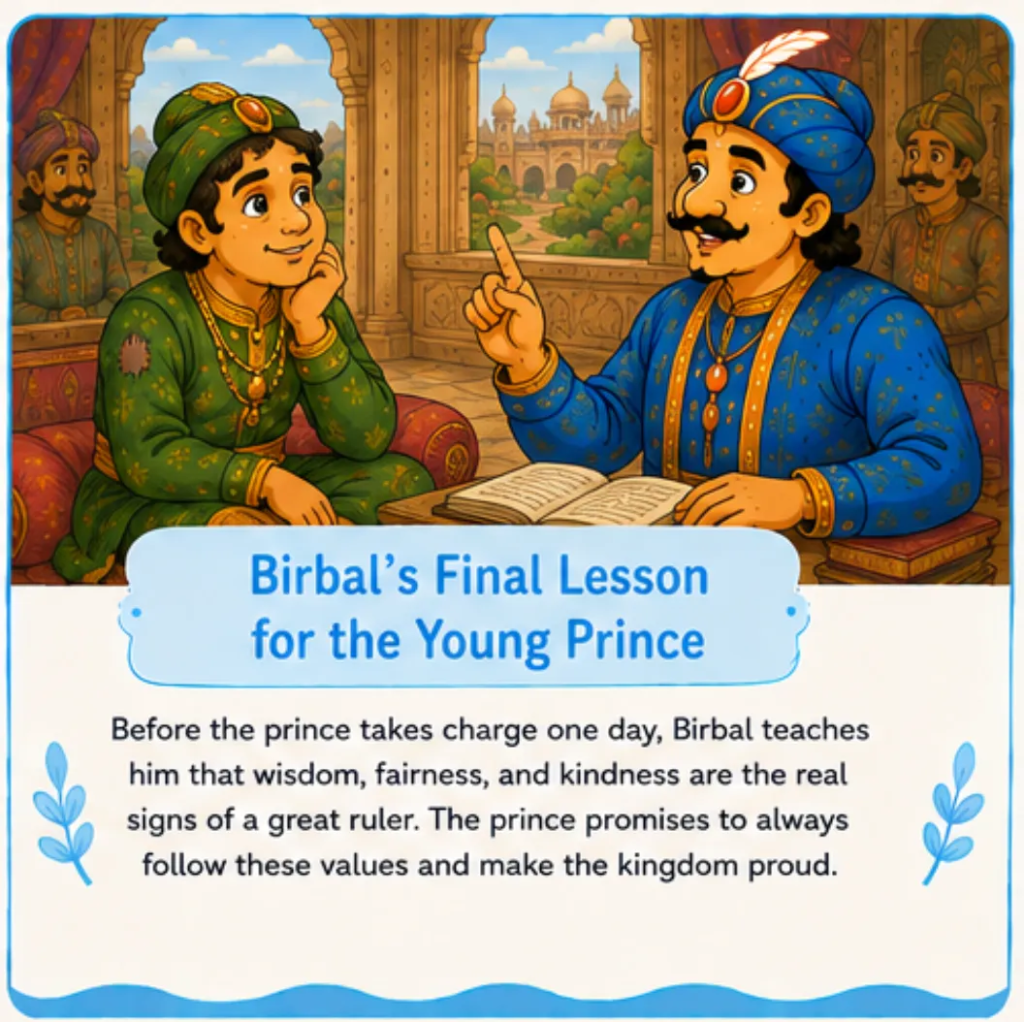
Before the young prince began learning to rule, Emperor Akbar asked Birbal to give him one final lesson. Birbal handed the prince a mirror and said, “A good ruler should first examine himself before judging others.” The prince understood that a wise leader must be honest, kind, humble, and fair. Akbar proudly smiled, knowing the future of the kingdom was in good hands.
Moral: A great leader leads with wisdom, kindness, honesty, and humility.
Vocabulary words that children can Learn from Stories
| Vocabulary | Meaning |
|---|---|
| Emperor | A king who rules a large empire |
| Court | The place where a king meets advisors |
| Merchant | A person who buys and sells goods |
| Gardener | A person who takes care of plants |
| Harvest | Crops collected from the fields |
| Treasure | Valuable money, gold, or jewels |
| Falcon | A fast-flying bird used for hunting |
| Honest | Always telling the truth |
| Wisdom | The ability to make good decisions |
| Curiosity | A strong desire to learn |
| Clever | Quick at thinking and solving problems |
| Responsibility | Taking care of your duties |
| Fairness | Treating everyone equally |
| Kindness | Being caring and helpful |
| Patience | Staying calm while waiting |
| Courage | Being brave even when afraid |
| Creativity | Using imagination to create new ideas |
| Talent | A natural skill or ability |
| Promise | A word or action that you will keep |
| Trust | Believing that someone is honest and reliable |
| Greed | Wanting more than you need |
| Gratitude | Feeling thankful |
| Contentment | Being happy with what you have |
| Respect | Showing care and value for others |
| Teamwork | Working together to achieve a goal |
| Effort | Hard work to complete something |
| Observe | To watch carefully |
| Judge | To decide fairly after understanding facts |
| Leader | A person who guides others |
| Humble | Not proud or boastful |
| Reward | A prize given for good work |
| Apologize | To say sorry for a mistake |
| Challenge | A difficult task to solve |
| Solution | The answer to a problem |
| Dispute | A disagreement or argument |
| Journey | A trip from one place to another |
| Royal | Related to a king or queen |
| Loyal | Faithful and supportive |
| Courageous | Very brave |
| Justice | Fair treatment according to what is right |
These vocabulary words help children improve their reading, speaking, writing, comprehension, and moral understanding while enjoying the stories.
How Parents Can Tell Akbar and Birbal Stories for a Positive Impact on Kids
Storytelling is more than just reading words. When parents make stories fun and interactive, children remember the lessons for a long time. Here is a simple step-by-step process.
1. Choose a Quiet Place
Find a calm and comfortable place without distractions. This helps your child focus on the story.
2. Read with Expression
Use different voices for Akbar, Birbal, and the other characters. Change your tone to match happy, funny, or exciting moments.
3. Show the Pictures
If the book has illustrations, pause and let your child observe them. Ask, “What do you think is happening here?”
4. Ask Simple Questions
During the story, ask questions such as:
- What do you think Birbal will do next?
- Was the character honest?
- What would you do in this situation?
This keeps children involved and improves their thinking skills.
5. Explain the Moral
After finishing the story, explain the moral in simple words. Connect it to real-life situations, such as sharing toys, telling the truth, helping friends, or respecting elders.
6. Encourage Your Child to Retell the Story
Ask your child to tell the story in their own words. This improves memory, confidence, and speaking skills.
7. Use Everyday Examples
Show how the story’s lesson can be used at home or school. For example, if the story is about honesty, praise your child whenever they tell the truth.
8. End with a Positive Conversation
Ask questions like:
- What was your favorite part?
- Which character did you like the most?
- What lesson will you remember today?
This helps children understand the story better.
9. Read Regularly
Reading one short story every day creates a healthy reading habit and helps children learn new values over time.
10. Appreciate Good Behavior
Whenever your child follows a lesson from the story, appreciate their effort. Positive encouragement helps children develop good habits naturally.
By making storytelling interactive, enjoyable, and connected to daily life, parents can help children develop honesty, kindness, patience, responsibility, creativity, confidence, and problem-solving skills while building a lifelong love for reading.
Moral Values Children Can Learn from These Akbar and Birbal Stories
The Akbar and Birbal stories are filled with valuable life lessons that help children build good character. Parents and teachers can use these stories to explain important values with simple everyday examples.
1. Honesty
Children learn that telling the truth earns trust and respect.
Example: Admit if you accidentally break a toy instead of hiding it.
2. Kindness
Being kind to others makes the world a happier place.
Example: Help a classmate who is struggling with homework.
3. Fairness
Everyone should be treated equally and judged without bias.
Example: Share toys fairly with your brothers, sisters, or friends.
4. Responsibility
Taking care of your duties shows that you can be trusted.
Example: Pack your school bag and keep your room tidy every day.
5. Patience
Good things often happen when we stay calm and wait.
Example: Wait for your turn while playing a game.
6. Hard Work
Success comes from effort, practice, and dedication.
Example: Practice reading every day to become a better reader.
7. Wisdom
Thinking carefully before acting helps solve problems.
Example: Think of a peaceful solution instead of arguing with a friend.
8. Courage
Being brave means doing the right thing, even when it feels difficult.
Example: Tell the truth even if you are afraid of being scolded.
9. Friendship
True friends help and support each other.
Example: Share your lunch with a friend who forgot theirs.
10. Teamwork
Working together makes difficult tasks easier.
Example: Help your classmates complete a group project.
11. Humility
Stay humble even when you are talented or successful.
Example: Win a competition without making fun of others.
12. Gratitude
Being thankful helps us appreciate what we have.
Example: Say “thank you” when someone helps you.
13. Respect
Respect everyone, regardless of their age or background.
Example: Listen politely when parents or teachers are speaking.
14. Creativity
Using your imagination helps you discover new ideas.
Example: Draw a unique picture instead of copying someone else’s work.
15. Contentment
Happiness comes from appreciating what you have, not always wanting more.
Example: Enjoy your toys instead of always asking for new ones.
16. Problem-Solving
Think calmly and carefully before making decisions.
Example: Find a peaceful way to solve a disagreement with a friend.
17. Generosity
Helping others without expecting anything in return brings real happiness.
Example: Donate books or clothes that you no longer use.
18. Self-Reflection
Before judging others, think about your own actions.
Example: Admit your mistake before blaming someone else.
Final Lesson
These Akbar and Birbal stories teach children that good character is built through honesty, kindness, wisdom, patience, hard work, fairness, respect, teamwork, courage, gratitude, and generosity. When children practice these values in everyday life, they grow into confident, responsible, and caring individuals.
Conclusion
Akbar and Birbal stories are more than just entertaining tales—they are valuable lessons that help children build strong character and good habits. Each story teaches an important moral through simple situations that young readers can easily understand and relate to. By reading these stories regularly, learning new words, and talking about the lessons together, parents and teachers can inspire children to become honest, kind, confident, and thoughtful individuals. These timeless stories continue to encourage curiosity, problem-solving, and compassion, making them a wonderful choice for every child’s reading journey.
