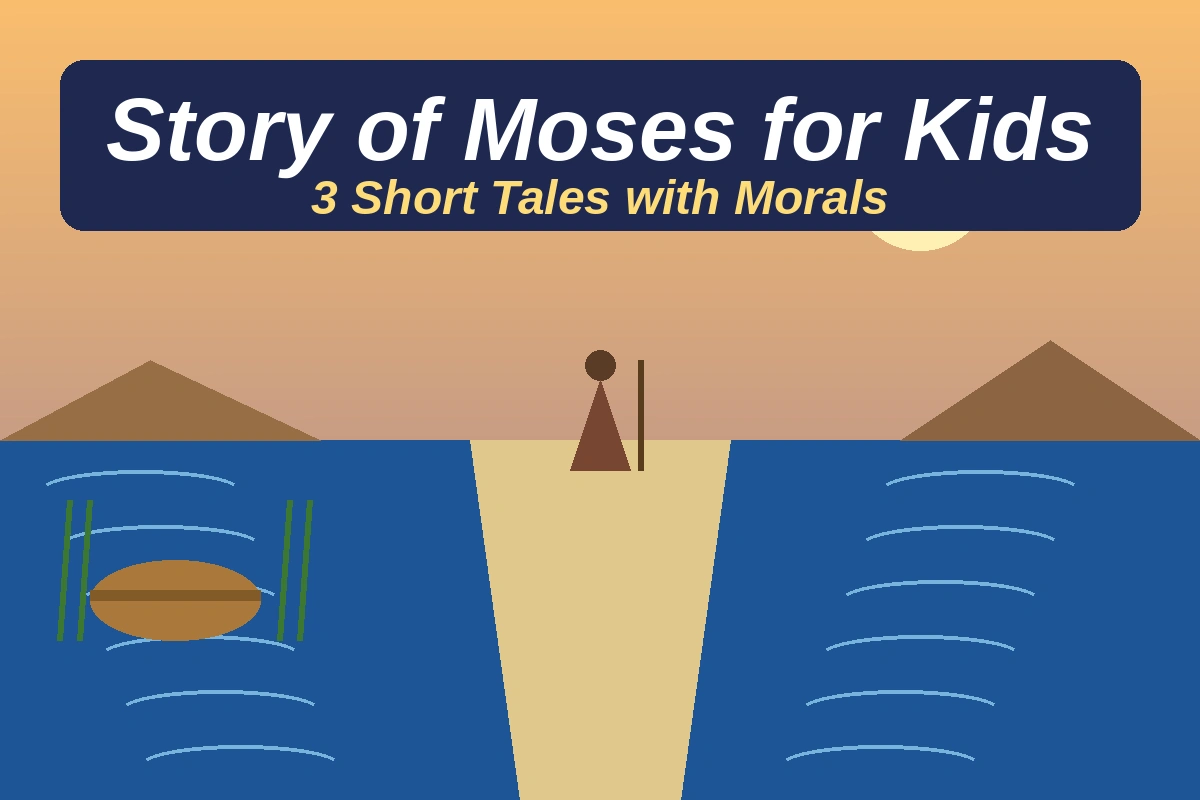
The story of Moses is one of the best known tales in the Bible. It has a baby floating on a river, a bush that burns without turning to ash, and a sea that opens like a path. Children love it because it is full of wonder, and parents love it because it teaches courage, trust and kindness in a way a child can hold on to.
On this page you will find three short tales from the life of Moses, written in simple English and ready to read aloud. Each one ends with a moral, and at the end there is a list of lessons and four questions that parents often ask. If your family enjoys Bible tales, you can also explore our Bible stories for kids, the short Bible stories for kids and the calm bedtime Bible stories for quiet evenings.
Read one tale a night, or read all three in one sitting. Stop now and then to ask your child what they think will happen next. That small pause turns a story into a conversation.
Baby Moses in the Basket
Long ago, in the land of Egypt, there lived a large family of people called the Hebrews. They worked hard every day, carrying heavy bricks and building big cities for the king. The king was called Pharaoh, and he was a worried man. He saw that the Hebrew people were growing in number, and he feared they might become too strong.
So Pharaoh made a hard and unfair rule. He said that the baby boys of the Hebrew families must not be allowed to grow up. The families were frightened and sad. Mothers held their little ones close and prayed for help.
In one of those homes lived a mother named Jochebed. She had a daughter named Miriam and a son named Aaron, and then a new baby boy was born. He was small and sweet, and Jochebed loved him with all her heart. She knew she had to keep him safe.
For three months she hid her baby. She kept him quiet and kept him close. Whenever a stranger passed by the door, she held her breath. But a baby grows, and a growing baby makes more sound. Soon Jochebed knew that she could not hide him at home for much longer.
She thought and thought. Then she had a gentle, clever idea. She wove a basket out of tall reeds that grew by the river and covered it with sticky tar so that water could not get in. She made it snug and soft. Then she laid her baby inside, kissed him goodbye, and carried the basket to the edge of the great river Nile.
It must have been the hardest thing she ever did. She placed the basket among the tall reeds near the bank, where it could rest safely and not drift far. Then she asked Miriam to stand a little way off and watch what would happen to her little brother.
Miriam hid behind the reeds and kept her eyes on the basket. The sun climbed higher. The water sparkled. The basket rocked softly, and the baby slept.
Then she heard voices and footsteps. A group of women was coming down to the river to bathe. In the middle of them walked a princess, the daughter of Pharaoh himself. She looked at the reeds and saw something unusual. She sent a servant to fetch it.
When the basket was opened, the baby began to cry. The princess felt her heart melt. “This must be one of the Hebrew babies,” she said softly. She did not want to hurt him. She wanted to keep him safe.
This was the moment Miriam had been waiting for. She stepped out from the reeds, brave and polite. “Shall I go and find a Hebrew woman to nurse the baby for you?” she asked. The princess smiled and said, “Yes, please go.”
Miriam ran home as fast as her feet could carry her and called her mother. Jochebed hurried to the river. The princess placed the baby in her arms and said, “Take this child and care for him, and I will pay you for it.” Imagine how happy and thankful Jochebed felt. The baby she had feared to lose was now safe in her arms, and he was safe with the blessing of the princess herself.
When the boy grew older, Jochebed took him to the palace. The princess made him her own son and gave him a name. She called him Moses, which sounds like a word that means “pulled out,” because she had pulled him out of the water.
And so the little boy who was once hidden in a basket grew up in the house of the very king who had feared him. Nobody in the palace knew how important he would one day become.
Moral: A mother’s love and a sister’s courage can protect a child in the hardest times, and kind hearts can make a safe way where none seemed to exist.
Moses and the Burning Bush
Moses grew into a strong young man. He lived in the palace, but he never forgot that his own people, the Hebrews, were treated unfairly. One day he saw an Egyptian overseer being cruel to a Hebrew worker. Moses was upset and tried to help, but things went badly. Afraid of what might happen, he left Egypt and went far away to a quiet land called Midian.
There Moses started a new life. He married, became part of a family, and took up the simple work of a shepherd. Every morning he led his sheep over the dry hills to find green grass and cool water. The days were slow and peaceful. The palace, the bricks and the angry king felt like a story from another life.
For many years Moses cared for the flock. He learned to be patient. He learned to notice small things, like a lamb who was tired or a cloud that meant rain. A shepherd needs these gifts, and as you will see, the gifts would be needed again.
One day Moses led his sheep to the far side of the desert, to a mountain called Horeb. As he walked, something caught his eye. A bush was on fire. That was not strange by itself, because dry bushes sometimes burn in the desert sun. But this bush kept burning and burning, and it was not turning to ash. The leaves stayed green. The branches stayed whole.
Moses stopped. “This is strange,” he said to himself. “I will go closer and see why the bush does not burn up.” He took a few careful steps toward it.
Then he heard a voice call his name from the bush. “Moses, Moses!” And Moses answered, “Here I am.” The voice told him not to come any closer and to take off his sandals, because he was standing on holy ground. Moses covered his face, for he felt small and a little afraid.
The voice told Moses that God had seen the sadness of the Hebrew people in Egypt. God had heard their cries and wanted to help them. And God wanted Moses to go to Pharaoh and lead the people out of slavery, toward a good land of their own.
Moses could hardly believe it. “Who am I to go to Pharaoh?” he asked. “I am only a shepherd. What if the people do not listen to me?” He gave one reason after another. He even said that he was not good at speaking and often struggled to find the right words.
But the voice was patient. “I will be with you,” it said. That was the promise that mattered most. Moses would not have to walk the road alone. His brother Aaron would go with him and help him speak. And he would be given signs to show the people that he had truly been sent.
Moses took a deep breath. He was still nervous, but he was ready. He said goodbye to his family, picked up his shepherd’s staff, and set out on the long road back to Egypt. The shepherd who had once run away was now walking back with a brave heart, because he knew he was not alone.
Back in Egypt, Moses and Aaron went to Pharaoh and asked him to let the Hebrew people go. Pharaoh did not want to listen. He said no again and again. It took many days and many difficult events before his heart began to change. Through all of it Moses kept going, one step at a time.
Moral: When we are afraid of a big task, we can remember that we do not have to be perfect. Courage grows when we take the first step and trust that help is near.
Moses and the Crossing of the Sea
At last Pharaoh agreed to let the Hebrew people go. There was great joy. Families packed their bread, their blankets and their animals. Children walked beside their parents, holding hands and asking, “Where are we going?” Moses led them out of Egypt, and a tall cloud went before them in the day to show the way.
They walked and walked until they reached the edge of a wide sea. The water stretched far in front of them, deep and dark. The people stopped and looked around. They were tired and hungry, and this was a very big sea.
Then someone looked back and gasped. Far behind them, a cloud of dust was rising. Pharaoh had changed his mind. He was sending his horses and chariots after the people. The Hebrews were caught between the army behind them and the sea in front of them.
Fear spread through the crowd like wind through tall grass. Some people cried. Some people shouted at Moses. “Why did you bring us here?” they said. “Wouldn’t it have been better to stay in Egypt?”
Moses was frightened too, but he stayed calm. He lifted his voice and said, “Do not be afraid. Stand still and see how you will be helped today.” His words were steady, and slowly the shouting grew quieter.
Then Moses was told to lift his staff and stretch his hand over the sea. He did exactly that. A strong wind began to blow through the night. And little by little, the waters moved apart. A path appeared, a dry road with a wall of water standing on the right side and on the left side.
The children stared with wide eyes. The grown ups could hardly believe it. But the path was real, and it was open. One by one, family by family, the people stepped onto the dry ground and began to walk across. Mothers carried babies. Fathers led the animals. Grandparents leaned on sturdy sticks. Nobody was left behind.
Behind them, the army of Pharaoh came racing after them. But as the people reached the far shore and stood safe on the other side, the waters came back together. The sea closed over the road. The chariots could follow no more.
The people stood on the shore, breathing hard, and then something wonderful happened. They began to sing. Miriam, the same brave sister who had once watched the basket in the reeds, picked up a tambourine and led the women in a joyful dance. The sound of music rose over the water and filled the morning air.
The journey was not over. The people had many more days of walking in the wilderness ahead of them. But on that morning they knew that they were free, and they knew that they had been helped. They had learned that the path can open even when it seems blocked on every side.
Moral: When we feel trapped and afraid, we should stay calm, trust, and keep walking forward. A way often opens when we least expect it.
Lessons Children Can Learn from the Story of Moses
These three tales are different, but they share the same heart. Here are some simple lessons you can talk about with your child after reading.
- Love protects. Jochebed and Miriam did everything they could to keep a baby safe.
- Bravery can be small. Miriam was only a child, yet she stepped forward and spoke up at exactly the right time.
- Kindness matters. The princess chose to help a baby even though it was risky for her.
- It is okay to feel afraid. Moses felt nervous at the burning bush, but he still said yes.
- We are never alone. The promise “I will be with you” gave Moses strength for every step.
- Stay calm in trouble. At the sea, Moses asked the people to stand still and trust, and that calm helped everyone.
- Work together. Moses had Aaron and Miriam beside him, and big jobs are easier with a team.
Here are a few questions you can ask at bedtime. Which character was the bravest, and why? How do you think Jochebed felt when she put the basket by the river? What would you say to a friend who is afraid to try something new?
Frequently Asked Questions About the Story of Moses
Who was Moses in the Bible?
Moses was a leader of the Hebrew people. As a baby he was saved from danger, he grew up in the palace of Pharaoh, and later he led his people out of Egypt. He is remembered in the Bible as a shepherd, a leader and a faithful messenger.
What age is the story of Moses good for?
The baby in the basket is a gentle tale that works well for children from about three or four years old. The burning bush and the crossing of the sea suit children from about five to ten. Younger children enjoy it best when a parent reads slowly and shows the pictures.
Where is the story of Moses found in the Bible?
The tales of baby Moses, the burning bush and the crossing of the sea are told in the book of Exodus. The retellings on this page are short and simple, so they leave out many details that you can find in the full text.
What is the main lesson of the story of Moses?
The main lesson is trust and courage. Moses was afraid and felt unprepared, yet he took each step one at a time. The story also shows how love, kindness and teamwork can help people through very hard times.
Final Thoughts
The story of Moses shows children that even the smallest person can be part of something big. A baby in a basket, a sister behind the reeds, a shepherd with a staff: each of them mattered. When you read these tales together, you give your child a picture of courage, kindness and trust that can stay with them for years.
If your child enjoyed this page, try more calm reading from our Bible stories for kids collection, the tale of Zacchaeus, or our short moral stories for kids. Keep reading together, one story at a time.
