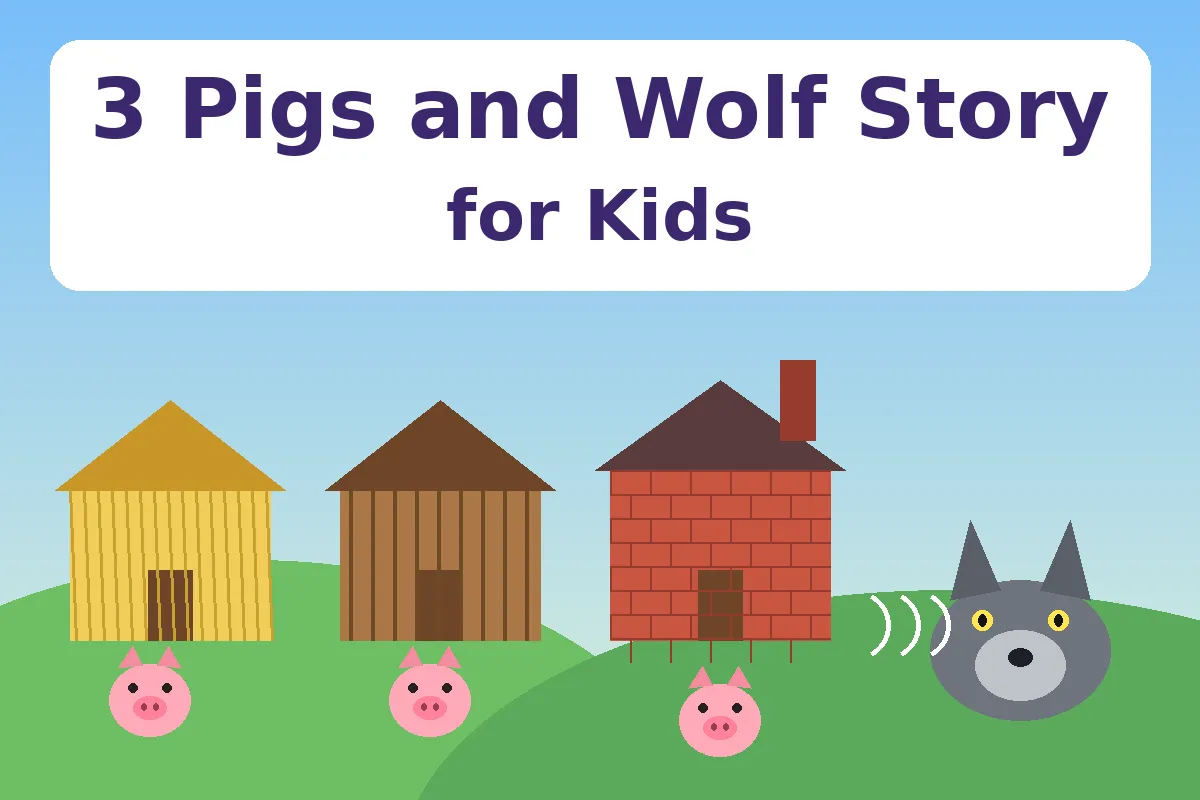
Few tales are as loved as the 3 pigs and wolf story. A wolf huffs, a house falls down, and a clever little pig saves the day. Children ask for it again and again, and parents enjoy telling it because the lesson is so clear. This page has the full story in simple English, a second wolf tale from Aesop, a ten line version for tired bedtimes, and easy ways to talk about the morals afterwards.
If your child likes this kind of tale, you may also enjoy our fairy tale short stories for kids, our collection of short animal stories for kids and the preschool short stories for the youngest readers. For a quiet end to the day, try the calming bedtime stories as well.
The Three Little Pigs Story
Once upon a time, a mother pig lived at the edge of a green meadow with her three little pigs. The pigs grew bigger every day. One morning the mother pig gave each of them a hug and said, “You are old enough to build your own homes now. Work hard, be careful, and always remember that a wolf lives in the woods nearby.”
The three little pigs packed their small bundles and set off down the road. They waved goodbye until their mother was just a tiny dot behind them.
The first little pig was cheerful but a little lazy. Soon he met a farmer who was carrying a big load of straw. “Please, sir, may I have some straw to build a house?” asked the pig. The kind farmer gave him a bundle. The first pig piled the straw into a house in less than an hour. “Done already!” he sang. “Now I can play all afternoon.”
The second little pig walked a little further. He met a woodcutter with a cart full of sticks. “Please, sir, may I have some sticks to build a house?” The woodcutter smiled and handed over a pile. The second pig tied the sticks together and built a house by lunchtime. It was a bit wobbly, but he did not mind. “That was quick,” he said, and he went off to pick berries.
The third little pig was the quietest of the three. He walked on until he met a bricklayer pushing a wheelbarrow of red bricks. “Please, sir, may I have some bricks to build a house?” The bricklayer nodded and said, “Bricks are heavy, little one. It will take you many days.” “That is fine,” said the third pig. “I want my house to be strong.”
So the third pig worked from morning till evening. He carried one brick at a time. He mixed the mortar and laid each row straight. His hooves grew tired and his back grew sore. His brothers laughed at him. “Come and play!” they called. “Why work so hard?” But the third pig kept going. At last he built a sturdy house with a thick door, a tight roof and a tall chimney.
One evening, a big grey wolf came padding out of the woods. His stomach rumbled. He sniffed the air and smelled pig. Soon he found the house of straw and knocked on the door.
“Little pig, little pig, let me come in,” said the wolf in a sweet voice.
“No, no, not by the hair on my chinny chin chin!” squeaked the first pig.
“Then I will huff, and I will puff, and I will blow your house down!” said the wolf. He took a deep breath and blew. Whoosh! The straw flew up into the air like golden confetti, and the first little pig ran away as fast as his legs could carry him.
He ran all the way to his brother’s house of sticks and banged on the door. “Let me in, let me in! The wolf is chasing me!” The second pig opened the door and shut it tight behind him. “Do not worry,” he said. “This house is stronger than straw.”
But the wolf had followed the footprints. He knocked on the door of sticks. “Little pigs, little pigs, let me come in,” he said.
“No, no, not by the hair on our chinny chin chins!” cried the two pigs.
“Then I will huff, and I will puff, and I will blow your house down!” The wolf took an even bigger breath and blew. Crack! The sticks rattled, the walls wobbled, and the whole house tumbled to the ground. The two little pigs squealed and ran out the back door, with their hearts thumping.
They ran and ran until they reached the house of bricks. The third pig saw them through the window and opened the door at once. “Come in, come in!” he said. “Quickly!” He locked the door and slid the bolt. The two frightened pigs hugged their brother and cried, “We are so sorry we laughed at you. Your house is the best house of all.”
“It is all right,” said the third pig. “You are safe now. Let us have some warm soup.”
A moment later, there was a heavy knock. The wolf stood outside, panting from the long chase. “Little pigs, little pigs, let me come in,” he growled.
“No, no, not by the hair on our chinny chin chins!” answered all three pigs together.
“Then I will huff, and I will puff, and I will blow your house down!” The wolf filled his chest with air and blew with all his might. Nothing happened. He huffed again, and puffed harder. Still nothing happened. The bricks did not even wobble. The wolf blew until he was dizzy and his cheeks were sore.
“Hmm,” thought the wolf. “I will have to be clever.” He looked up and saw the tall chimney. “I will climb up on the roof and come down the chimney,” he said to himself. He found a ladder behind the house and began to climb.
Inside, the third pig heard scratching on the roof. He was calm and quick. “Brothers, please help me,” he said. Together they filled the biggest pot with water and hung it over the fire in the fireplace. The water began to bubble and steam.
The wolf crept to the top of the chimney. He slid down, down, down, and landed with a splash in the hot pot. “Yowwww!” he yelped. He leaped out of the pot, shot back up the chimney and ran away through the woods, howling. He ran so far and so fast that he never came back to bother the three little pigs again.
After that day, the three little pigs lived together in the strong brick house. The first two brothers helped to build a cosy garden around it, and they never again said that hard work was silly. In the evenings they sat by the warm fire and told the story to each other, and they all agreed that the third pig had been very wise.
Moral: Hard work and careful planning keep us safe. A quick shortcut may look easy, but a strong and patient effort lasts.
The Boy Who Cried Wolf
Wolves appear in many fables. Here is another well known tale, an old fable credited to Aesop. This one is not about building. It is about telling the truth and keeping trust.
A long time ago, a young shepherd boy looked after a flock of sheep on a hillside above his village. The days were long and quiet. The sheep munched grass, the sun moved slowly across the sky, and the boy grew very bored.
One afternoon he had an idea. He stood up, cupped his hands around his mouth and shouted as loudly as he could, “Wolf! Wolf! A wolf is chasing the sheep!”
The villagers heard him and dropped their work. Farmers dropped their tools. Mothers left their cooking. Everyone ran up the hill to help. But when they arrived, panting and worried, there was no wolf at all. The boy was laughing. “I only wanted to see how fast you could run,” he giggled.
The villagers were not pleased. “Please do not do that again,” said an old man. “A false alarm is not a joke.” Then they walked back down the hill, shaking their heads.
A few days later, the boy felt bored again. He remembered how funny it had felt, and he shouted once more, “Wolf! Wolf! Please help me!” Once again the villagers hurried up the hill. Once again they found no wolf, only a boy rolling on the grass with laughter. This time the villagers were truly angry. They went home saying, “We will not be fooled again.”
Then one evening, as the sun went down, a real wolf slipped out of the trees. Its eyes shone and its teeth were sharp. The sheep bleated and scattered in fear. The boy was terrified. He ran about, screaming with all his breath, “Wolf! Wolf! A real wolf is here! Please help me!”
The villagers heard his shouts. But they only looked at each other and said, “He is playing his old game again. We will not go.” Nobody climbed the hill.
The wolf scattered the flock, and the boy lost many of his sheep. When it was dark, he walked down to the village with tears on his face. “There really was a wolf,” he sobbed. “Why did nobody come?”
An old woman put her hand on his shoulder. “Dear child,” she said gently, “nobody believes a person who has lied before, even when that person finally tells the truth.” The boy never forgot those words. From that day on, he told only the truth, and slowly the village learned to trust him again.
Moral: Nobody believes a liar, even when the liar is telling the truth. Honesty builds trust, and trust is hard to win back.
The Three Little Pigs in 10 Lines
Short on time? Read this quick version aloud at bedtime. It is also handy for school recitation and for toddlers who like short stories. Younger children may enjoy our stories for 3 year olds too.
- Three little pigs left home to build their own houses.
- The first pig built a house of straw very quickly.
- The second pig built a house of sticks and also finished early.
- The third pig took his time and built a house of strong bricks.
- A hungry wolf came and blew down the house of straw.
- He blew down the house of sticks too, and the pigs ran away.
- All three pigs hid inside the brick house.
- The wolf huffed and puffed but could not blow the bricks down.
- He climbed down the chimney and fell into a pot of hot water.
- The wolf ran away, and the three pigs lived happily in the brick house.
Where the Three Little Pigs Story Comes From
The Three Little Pigs is a folk tale, which means it was told aloud by ordinary families long before it was written down. The version most people know today was printed in English Fairy Tales, a book collected by Joseph Jacobs in 1890. Older printed versions exist from the 1800s, and some of them are quite different. In one of them, the heroes are not pigs at all.
Over the years, the story has been retold in picture books, songs, plays and cartoons. Some retellings are gentle and leave out the pot of hot water. Others change the ending so that the wolf learns his lesson and becomes friendly. You can choose the style that suits your child. The tale is old, but its message is still fresh today.
Lessons Kids Can Learn from These Stories
After reading, children often want to talk. Here are the key lessons from both stories that you can discuss together.
- Hard work pays off. The third pig worked for many days, and his strong house kept everyone safe.
- Do not rush. The first two pigs wanted to finish early so they could play, but fast and careless work did not protect them.
- Think before you act. The third pig planned for danger before it came.
- Help your family. The third pig forgave his brothers and opened the door to them, even though they had laughed at him.
- Stay calm in danger. The pigs used a clever plan with the pot of water instead of panicking.
- Always tell the truth. The shepherd boy lost the trust of his village because of his false alarms.
- Trust is precious. It takes a long time to build and only a moment to break.
Fun Activities After the Story
Stories stay in a child’s mind longer when they get to play with them. Try some of these simple ideas at home or in class.
Build Three Little Houses
Use straws, craft sticks and small blocks or cardboard bricks. Ask your child to build the three houses and then blow on each one gently. Which one stays up? This is a fun way to see the lesson with their own eyes.
Act It Out
Give each family member a role: three pigs, a wolf, a farmer, a woodcutter and a bricklayer. Children love the “chinny chin chin” lines and the huffing and puffing. Acting also helps young readers remember the order of events.
Draw and Retell
Fold a sheet of paper into four boxes. Ask your child to draw the beginning, the straw house, the stick house and the brick house. Then let them tell the story in their own words while pointing at each box. If they enjoy this, try the same activity with our easy short stories for kids.
Questions to Ask Your Child
- Why did the third pig take so long to build his house?
- How do you think the first pig felt when the wolf blew his house down?
- What would you have done if you were the second pig?
- Why did the villagers stop believing the shepherd boy?
- What can we do when we make a mistake, like the two older pigs did?
Frequently Asked Questions
Who wrote the story of the three little pigs?
The story has no single author. It is an old folk tale that was told aloud for many years. The best known English version was printed by Joseph Jacobs in 1890.
What is the moral of the 3 pigs and wolf story?
The main moral is that hard work and careful planning protect us. The third pig built a strong house of bricks, and it was the only home that stood up to the wolf.
What age is the three little pigs story good for?
It works well for children from about two to eight years old. Toddlers enjoy the repeated lines, and older children enjoy talking about why the third pig was wise.
Is the wolf scary in this story?
The wolf can sound a little scary, but you can change your voice to make him silly instead. If your child is sensitive, you can skip the pot of hot water and end with the wolf simply running away.
Final Thoughts
The 3 pigs and wolf story has stayed popular for generations because it is simple, fun to read aloud and full of good sense. The third little pig reminds us that patience and effort are worth more than a quick shortcut, and the boy who cried wolf reminds us that honesty keeps trust safe. Read these two tales together, act them out, build some little houses, and talk about the morals. Your child will enjoy the story, and the lessons will stay with them long after bedtime.
Looking for more to read? Browse our short stories for kids in English and keep the story time going.
