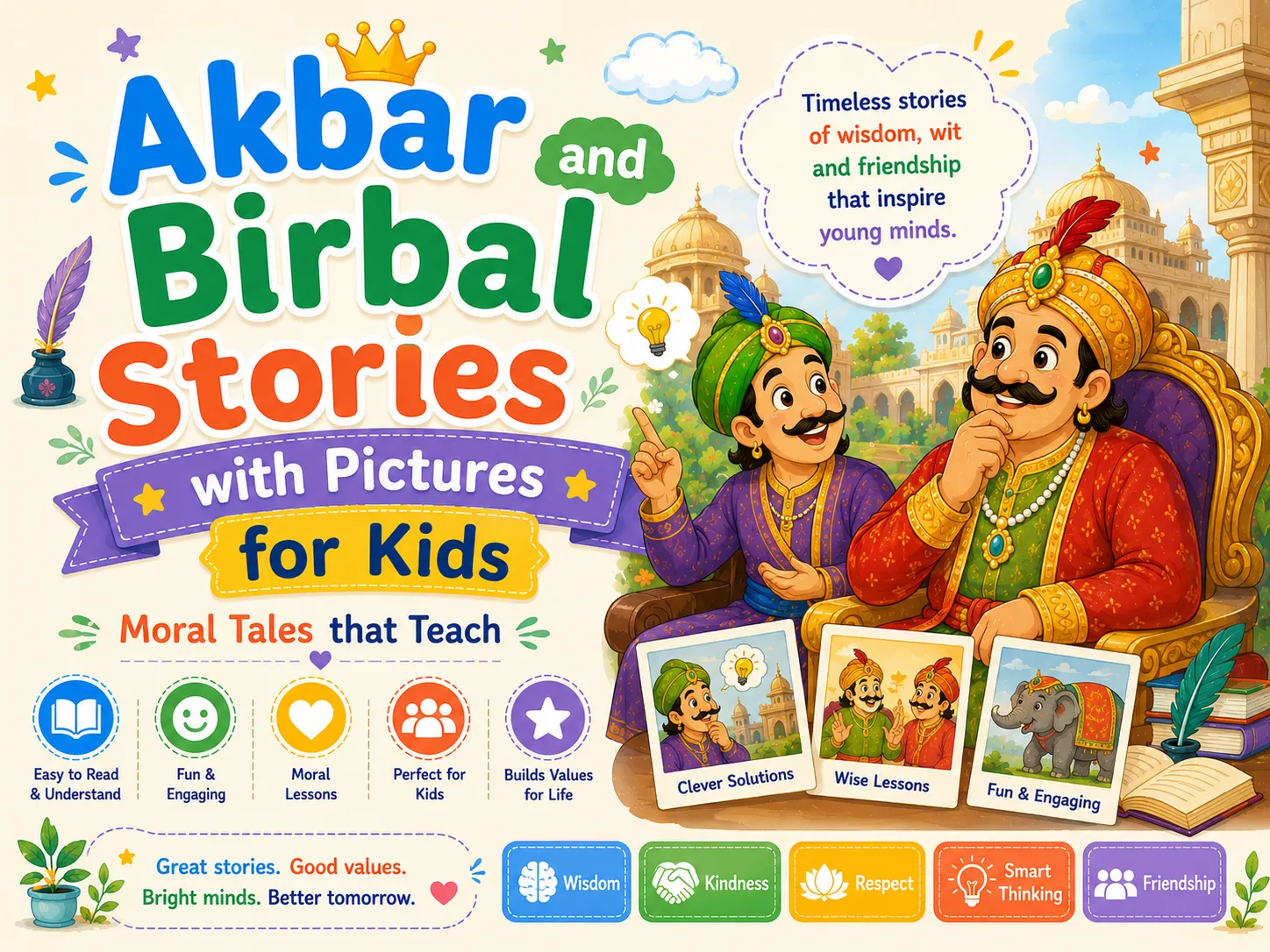
Akbar and Birbal stories with pictures are a wonderful way to introduce children to timeless tales of wisdom, kindness, and clever thinking.
Filled with colorful illustrations and simple language, these stories make reading more enjoyable and help young readers understand important life lessons.
Every story features Emperor Akbar and his wise advisor Birbal solving interesting problems through intelligence, honesty, and fairness.
Whether you are a parent looking for a fun bedtime story or a teacher searching for engaging reading material, these illustrated stories are perfect for children.
They encourage imagination, improve reading skills, and inspire kids to think creatively while enjoying classic tales that have been loved for generations.
24 Best Akbar and Birbal Stories with Pictures for Kids
The Wise Answer to Akbar’s Impossible Question
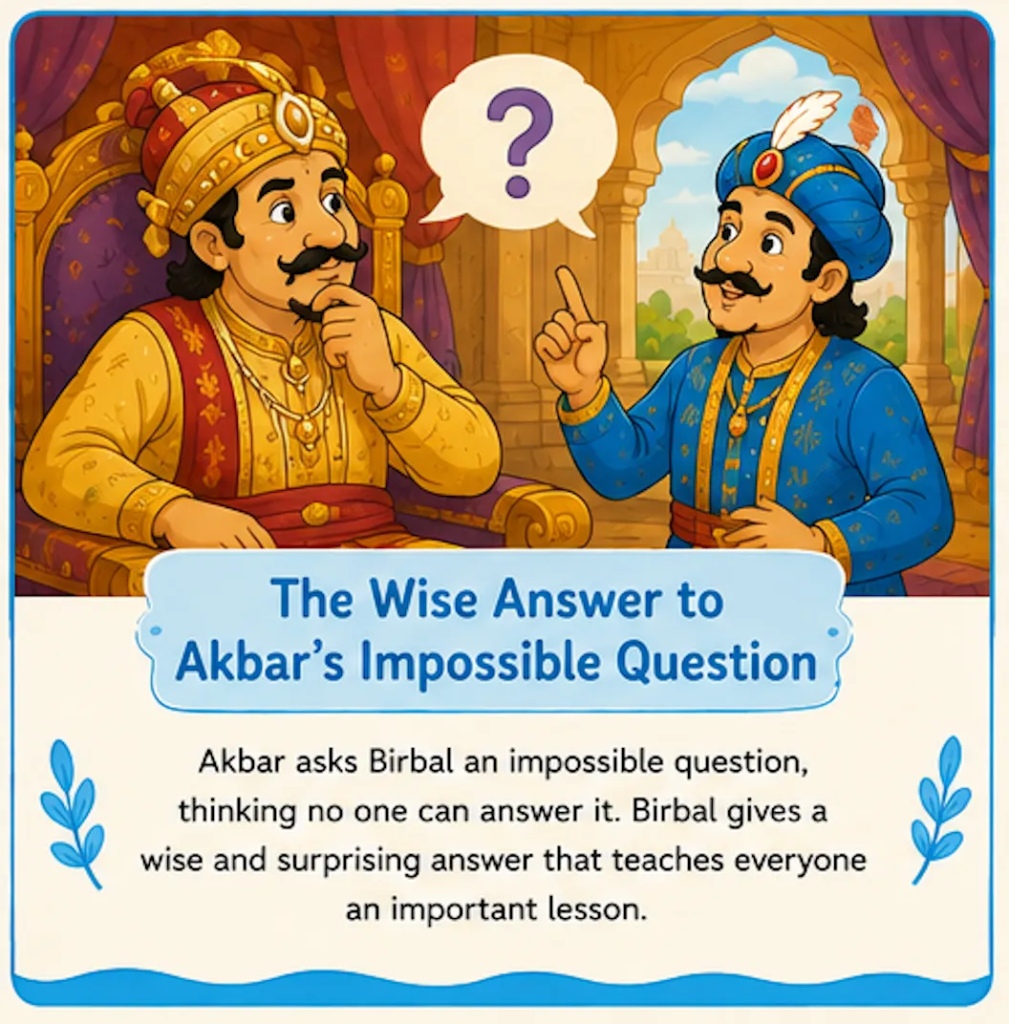
One day, Emperor Akbar decided to test Birbal’s wisdom. He asked, “Tell me, Birbal, what is the most powerful thing in the world?” The ministers gave many answers. Some said money, others said strength, and a few said a large army. Akbar was not satisfied.
Birbal smiled and replied, “Your Majesty, the most powerful thing is wisdom. Money can be lost, strength fades with age, and even a great army can be defeated. But wisdom helps people solve problems, make good decisions, and overcome every challenge.”
To prove his point, Birbal solved a difficult dispute between two merchants without using force or wealth. Akbar saw that Birbal’s intelligence brought peace where others had failed.
The emperor happily said, “You have answered my impossible question perfectly. True wisdom is greater than power or riches.”
From that day onward, everyone in the royal court admired Birbal’s intelligence even more.
Birbal and the Pot of Wisdom
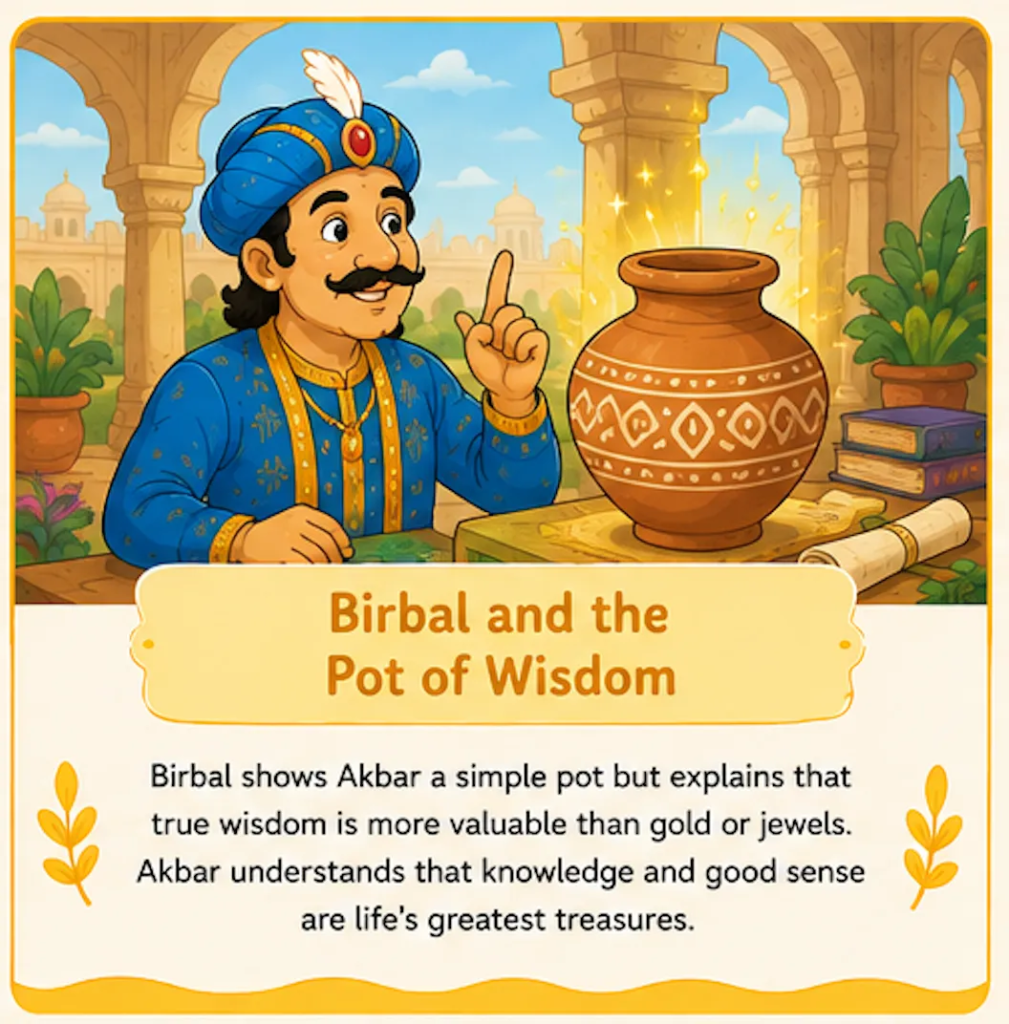
One morning, Emperor Akbar placed a large empty clay pot in the royal court and announced, “Whoever can fill this pot with wisdom will receive a special reward.” The ministers looked at one another in confusion. Some filled the pot with books, while others dropped in scrolls full of advice. Akbar shook his head because the pot still did not contain true wisdom.
When Birbal’s turn came, he left the pot empty. Everyone laughed, thinking he had given up.
Birbal smiled and said, “Your Majesty, wisdom cannot be stored in a pot. It grows in a person’s mind through learning, experience, kindness, and good actions. An empty pot reminds us that we should always keep our minds open to new knowledge.”
Akbar was delighted by Birbal’s thoughtful answer. He praised Birbal and declared that the greatest wisdom is the desire to keep learning throughout life.
Moral: True wisdom comes from learning, experience, and an open mind—not from objects.
How Birbal Caught the Clever Thief
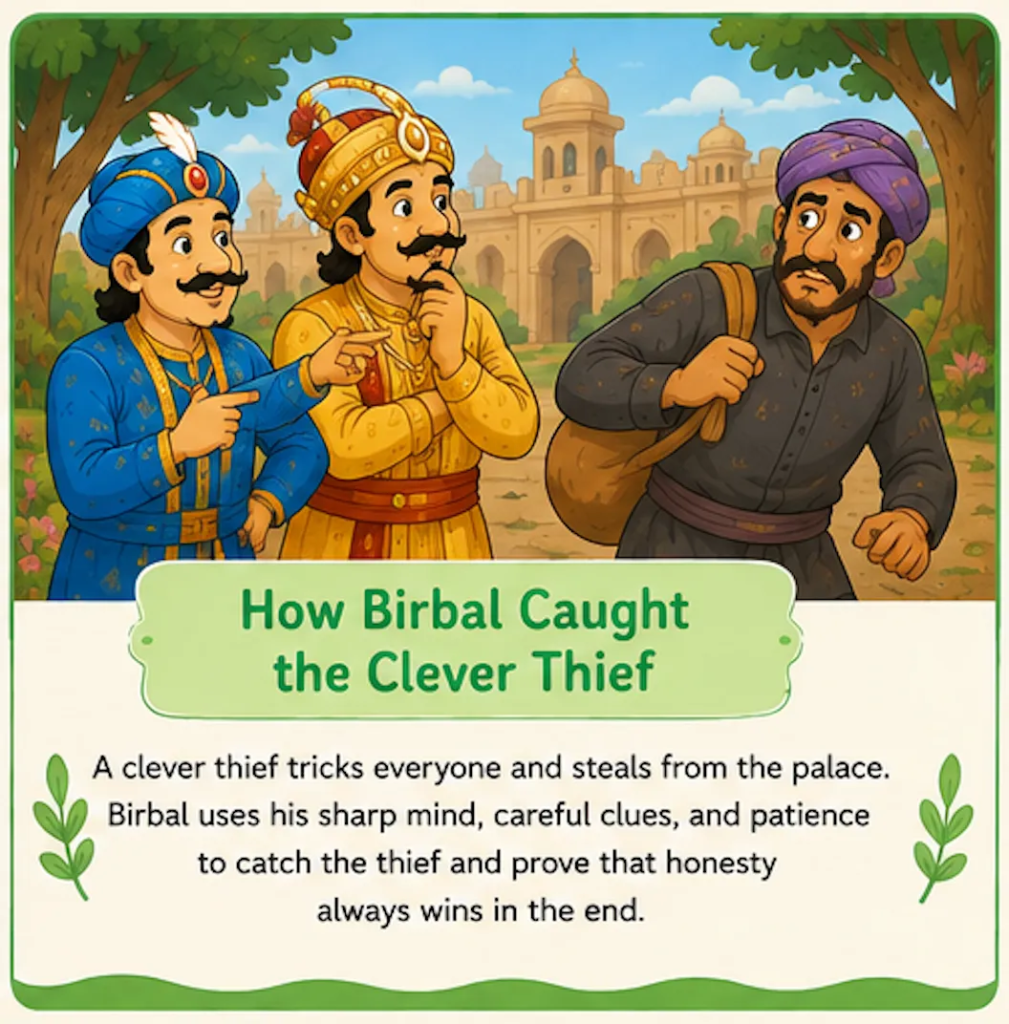
A wealthy merchant came to Emperor Akbar’s court and complained that a valuable gold necklace had been stolen. Many people were questioned, but no one admitted the crime. Akbar asked Birbal to solve the mystery.
Birbal gathered all the suspects and handed each one a small wooden stick. He said, “Keep this stick with you tonight. By tomorrow morning, the stick of the guilty person will grow two inches longer.”
The real thief became frightened. He thought the stick would really grow, so he secretly cut two inches off his stick during the night.
The next morning, Birbal collected all the sticks. He immediately noticed one stick was shorter than the others. Smiling, he pointed to its owner and said, “Only the guilty person would be afraid enough to cut the stick.”
The thief confessed, returned the necklace, and apologized. Akbar praised Birbal for using intelligence instead of force to catch the criminal.
Moral: A guilty conscience often reveals the truth, and wisdom is stronger than fear.
Also Read:
The Crow That Solved the King’s Puzzle
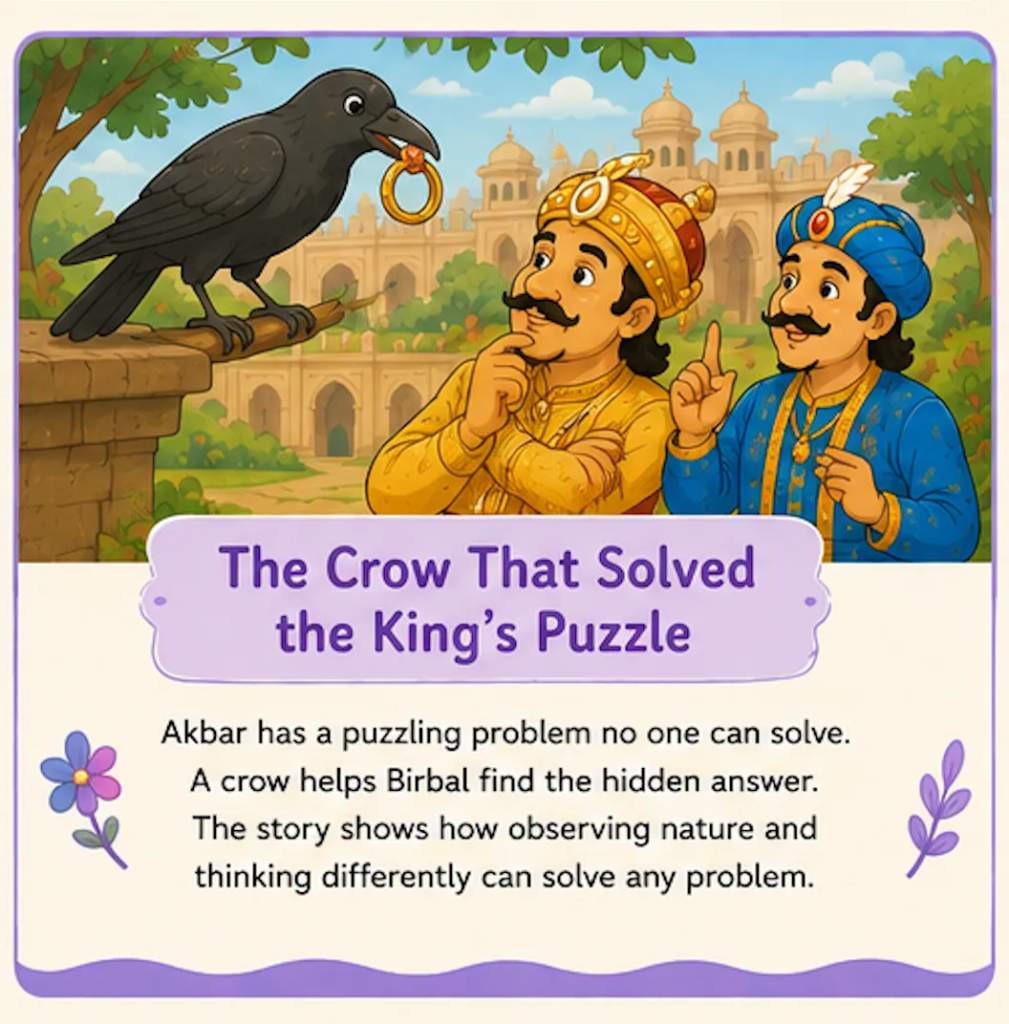
One afternoon, Emperor Akbar showed a painting of a crow to the royal court and asked, “Can anyone tell me what this crow is thinking?” The ministers guessed that the crow was hungry, tired, or looking for food, but none of their answers satisfied the emperor.
Birbal quietly walked to the palace garden and scattered a handful of grains on the ground. Soon, the crow in the painting’s pose was matched by a real crow that flew down to eat the grains.
Birbal smiled and said, “Your Majesty, we cannot truly know what is in another’s mind. Instead of making wild guesses, we should observe carefully and use logic. The crow came because it found food, not because of our imagination.”
Akbar appreciated Birbal’s wise explanation. He praised him for teaching everyone the importance of observation and clear thinking instead of assumptions.
Moral: Observe the facts before making decisions, and never judge based on guesses alone.
Birbal’s Lesson on Honesty
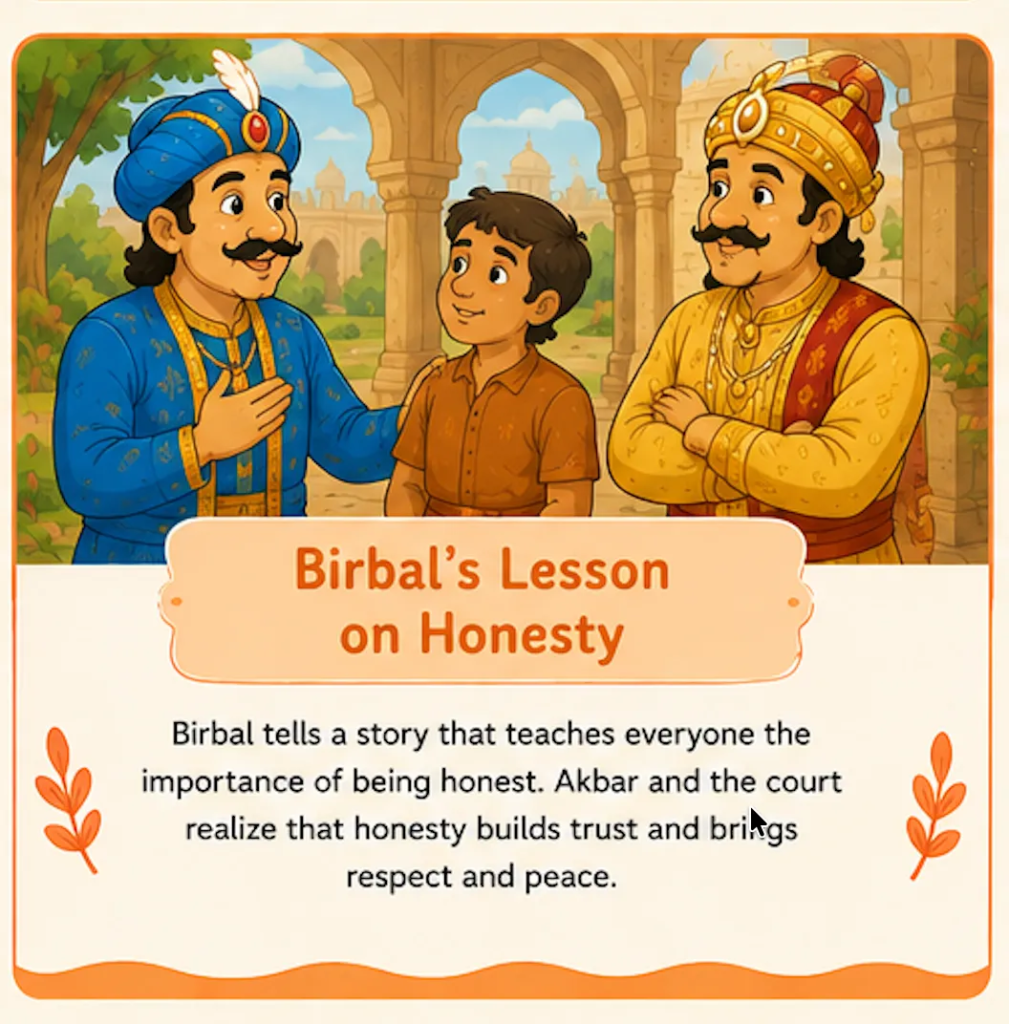
One day, Emperor Akbar found a beautiful gold coin in the palace garden. He asked the royal guards to announce that the owner could collect it from the court. The next morning, several people claimed the coin belonged to them. Each person gave a different story, making it difficult to know who was telling the truth.
Akbar turned to Birbal for help. Birbal asked each claimant to describe the coin in detail. Most of them guessed its size and design. However, one old gardener said, “I cannot describe it well because I never looked at it carefully. I only know it is the coin I earned after many days of hard work.”
Birbal smiled and handed the coin to the gardener. “An honest person speaks the truth, even when it does not help them,” he said.
Akbar praised the gardener’s honesty and rewarded him for his good character. Everyone in the court learned that truthfulness is more valuable than gold.
Moral: Honesty earns trust, respect, and lasting rewards.
Akbar’s Test of True Friendship
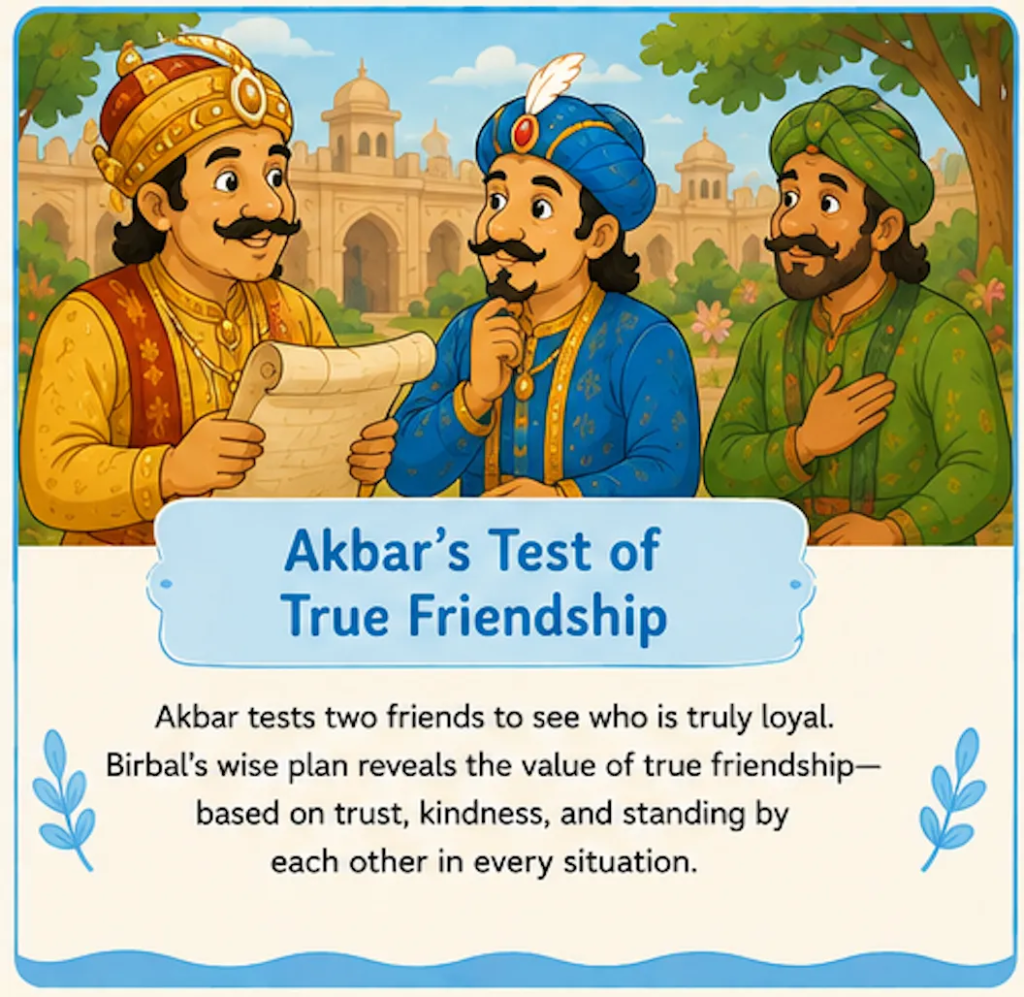
One day, Emperor Akbar asked his ministers, “How can we know who is a true friend?” Everyone gave different answers, but none convinced the emperor. He then asked Birbal to find the answer.
The next day, Birbal invited two close friends to the royal court. He quietly asked one of them to help move some heavy boxes, while the other was offered a chance to attend a grand feast. The first friend immediately stayed behind to help without asking for anything in return. The second friend chose the feast and forgot about his companion.
Birbal turned to Akbar and said, “A true friend stands by you in times of need, not only in times of joy.”
Akbar smiled and praised Birbal’s simple but meaningful test. Everyone in the court realized that real friendship is shown through actions, not just kind words.
Moral: A true friend helps you when you need support and stays with you in both happy and difficult times.
The Farmer Who Wanted Justice
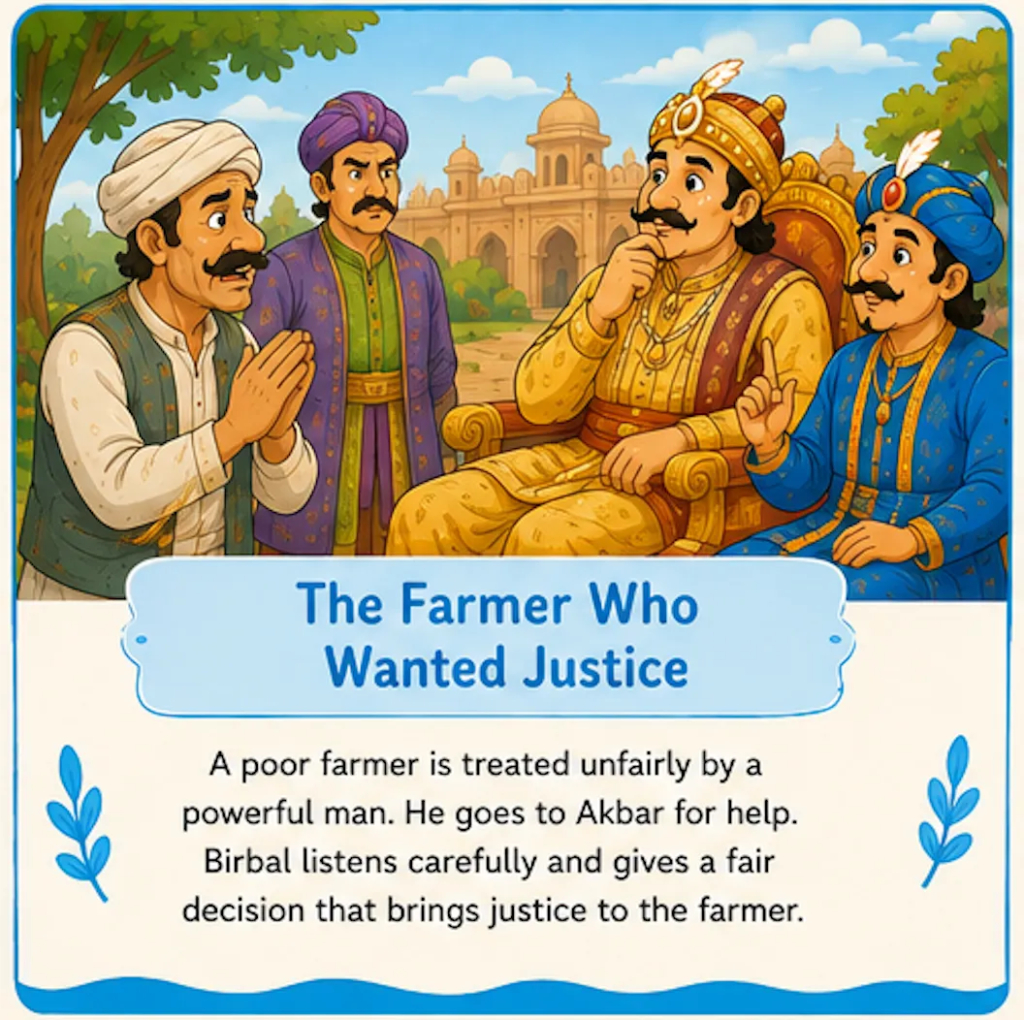
A poor farmer came to Emperor Akbar’s court with tears in his eyes. He said that a wealthy landlord had taken his fertile piece of land and claimed it as his own. The landlord insisted that the land belonged to him because he had more money and influence.
Akbar asked Birbal to investigate. Birbal visited the field and noticed that the farmer knew every corner of the land. He could point out where he had planted mango trees, where the well was dug, and even where a bird’s nest had rested for years. The landlord could not answer any of these questions.
Birbal turned to Akbar and said, “The one who truly cares for the land knows it best.” Akbar declared the farmer the rightful owner and ordered the landlord to return the land immediately.
The grateful farmer thanked the emperor and Birbal for protecting the truth. The court admired Birbal’s fairness and wisdom.
Moral: Truth and justice always shine brighter than wealth and power.
Birbal and the Magic Stick Mystery
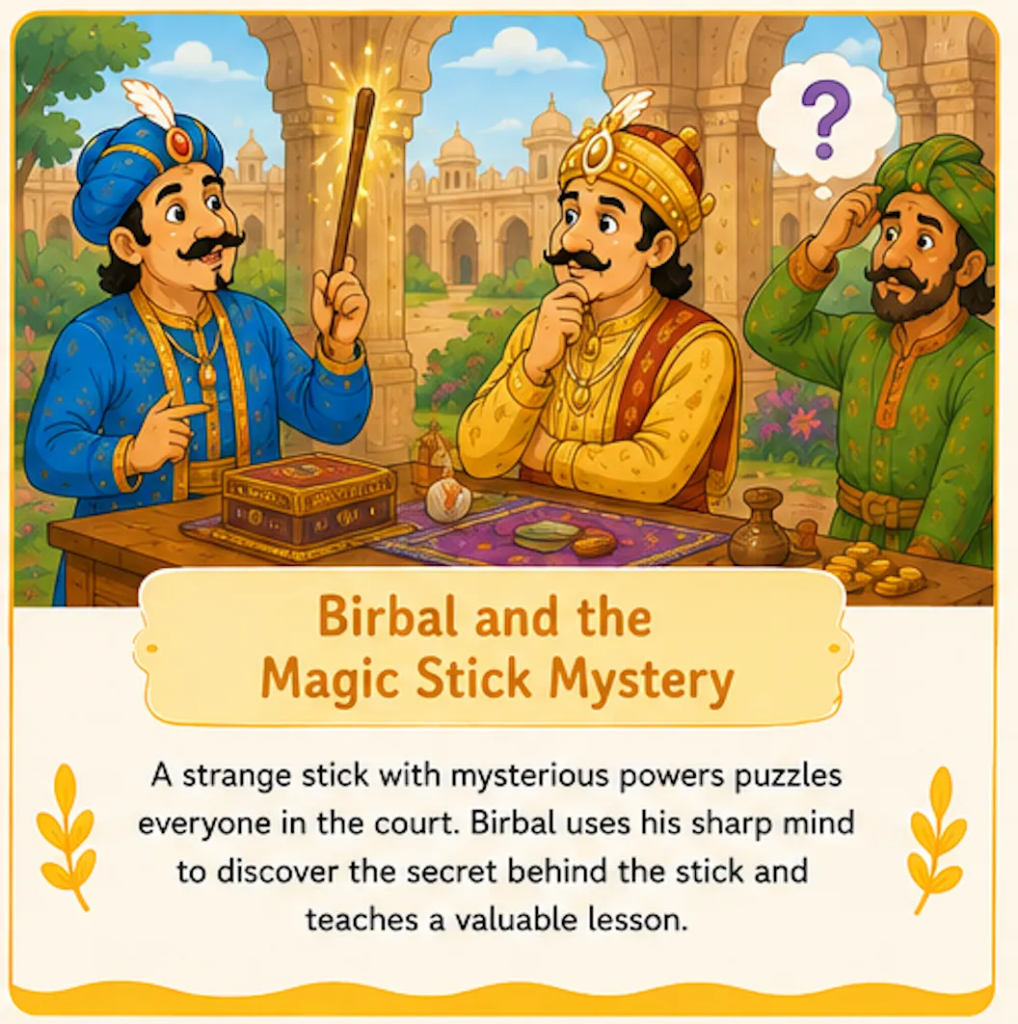
One day, a priceless silver cup disappeared from the royal palace. Emperor Akbar ordered a search, but no one could find it. Suspecting that the thief was one of the palace servants, he asked Birbal to solve the mystery.
Birbal gave each servant a wooden stick of the same length and said, “These are magic sticks. By tomorrow morning, the stick of the guilty person will grow three inches longer.”
The servants took the sticks home. The real thief became frightened. Thinking the stick would really grow, he secretly cut three inches off his stick during the night.
The next morning, Birbal collected the sticks. One stick was much shorter than the rest. Birbal pointed to its owner and said, “Your fear has revealed the truth.”
The servant admitted stealing the silver cup, returned it, and apologized. Akbar praised Birbal for using clever thinking instead of punishment to uncover the truth.
Moral: A guilty conscience often exposes the truth, and wisdom is the best tool for solving problems.
The Rich Merchant and the Poor Carpenter
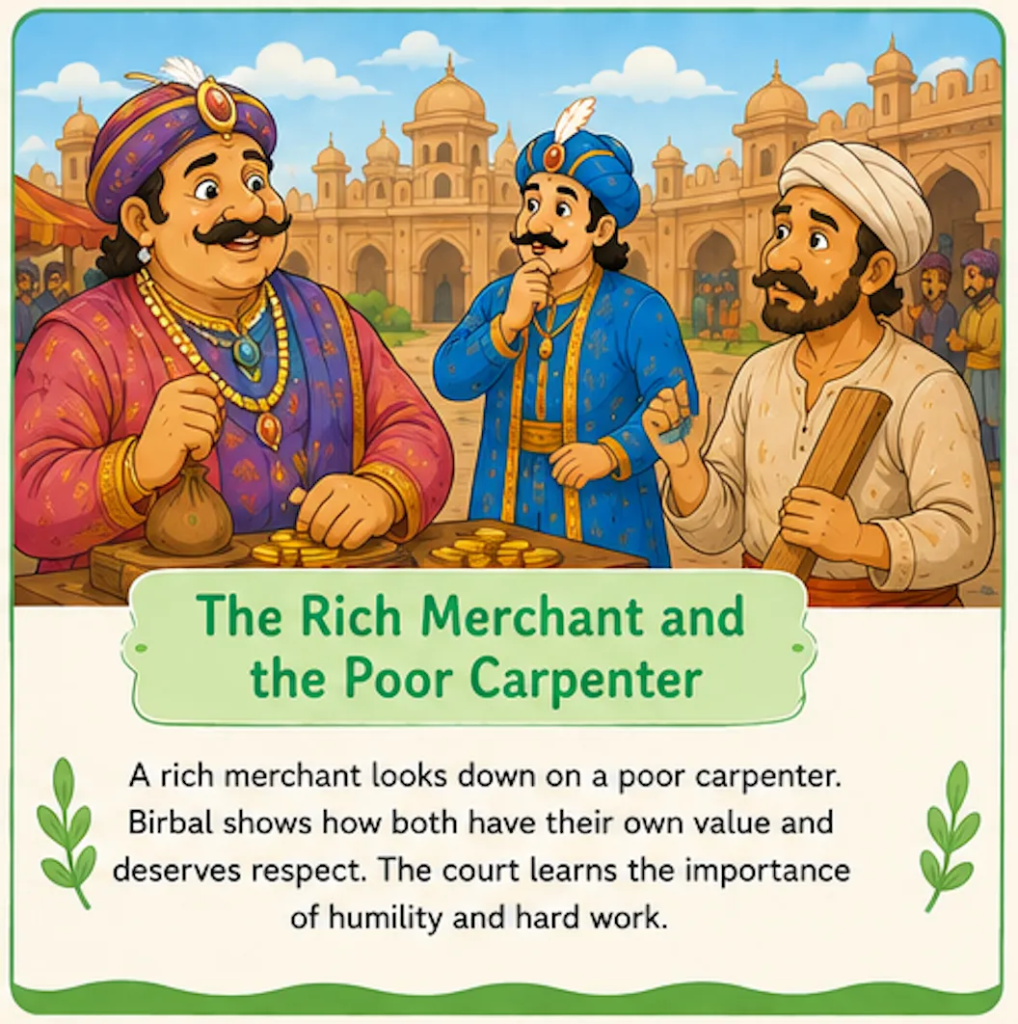
A rich merchant visited Emperor Akbar’s court and accused a poor carpenter of failing to repay a loan. The carpenter insisted that he had already returned every coin, but he had no written proof. The court was unsure whom to believe.
Akbar asked Birbal to settle the matter. Birbal questioned both men carefully. The merchant confidently described the money he had lent but could not remember where or when it had been returned. The carpenter, however, explained the exact day, the place near the village well, and even the witnesses who had seen him repay the loan.
Birbal called the witnesses, and they confirmed the carpenter’s story. The merchant realized he had been caught lying and admitted his mistake. Akbar ordered him to apologize and warned him never to misuse his wealth to trouble honest people.
The carpenter thanked the emperor and Birbal for protecting justice. Everyone in the court learned that truth is more valuable than riches.
Moral: Honesty and truth are stronger than wealth and false claims.
Who Owned the Mango Tree? Birbal’s Fair Decision
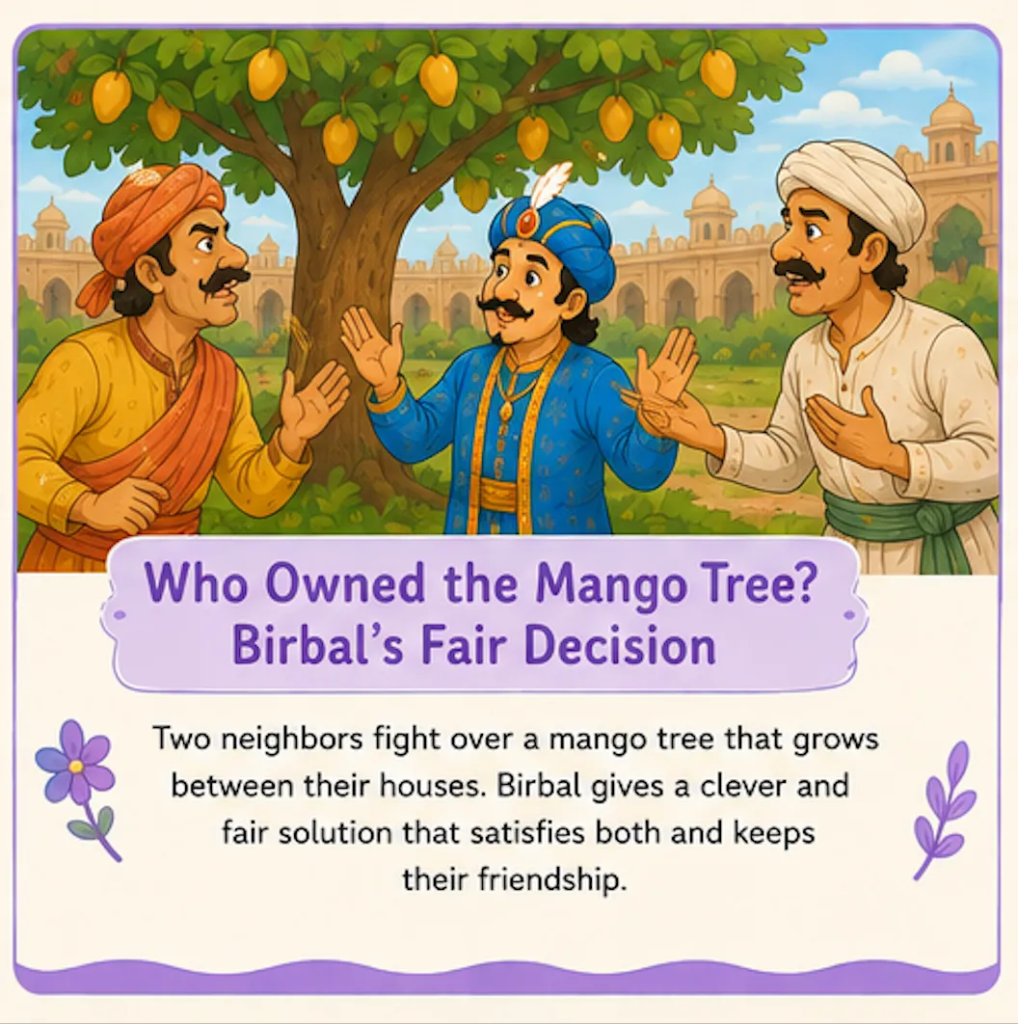
Two neighbours came to Emperor Akbar’s court, each claiming ownership of a mango tree growing between their houses. Both insisted that the tree belonged to them, and no one could decide who was telling the truth.
Akbar asked Birbal to solve the dispute. Birbal secretly told his guards to announce that the mango tree would be cut down the next morning because its real owner could not be identified.
When the news spread, one neighbour quickly agreed, saying it did not matter. The other neighbour rushed to the court and pleaded, “Please don’t cut the tree! Even if I lose it, let it continue to give shade and sweet mangoes.”
Birbal smiled and said, “The person who truly cares for the tree is its real owner.” Akbar agreed and declared the caring neighbour the rightful owner of the mango tree.
Everyone praised Birbal’s wisdom and fairness.
Moral: True ownership is shown through care, love, and responsibility—not just by making a claim.
Birbal Proves That Intelligence Beats Strength
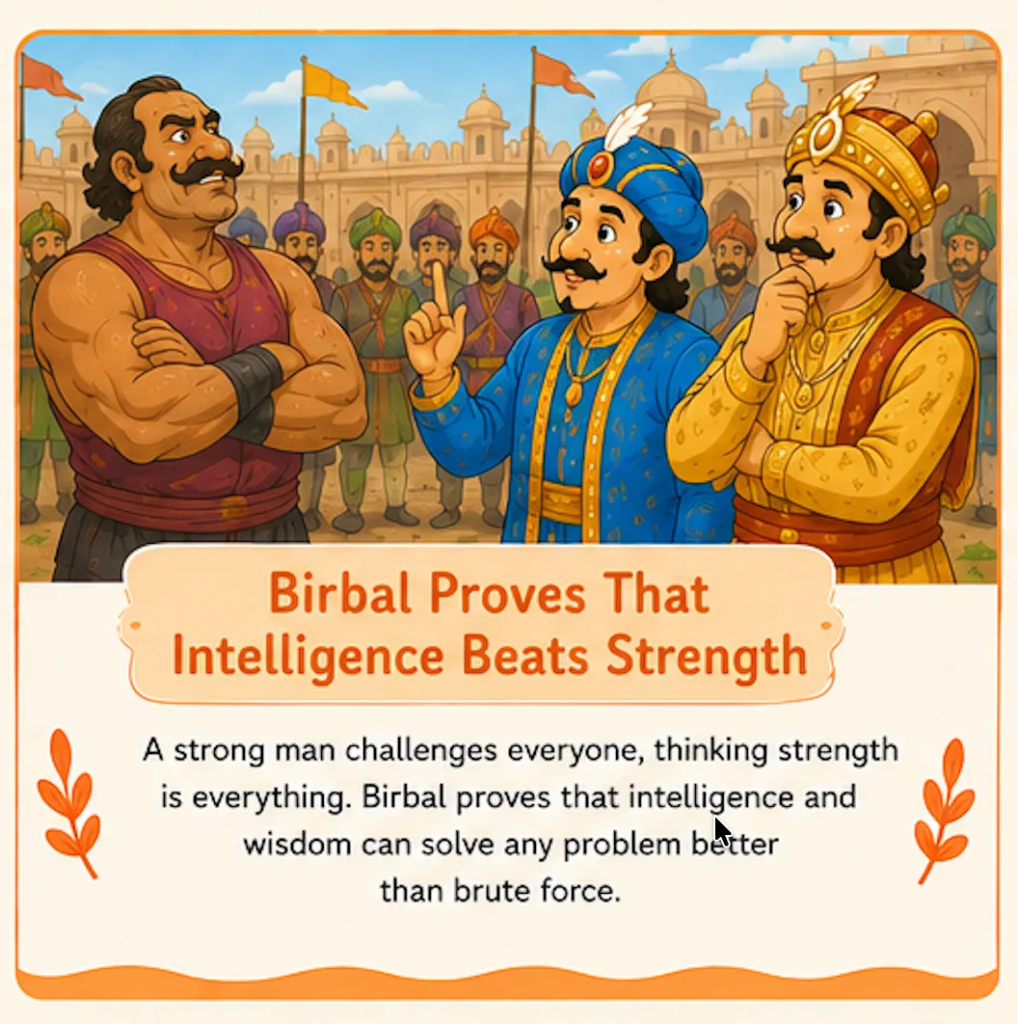
One day, Emperor Akbar asked his court, “Which is greater—strength or intelligence?” The strongest soldiers proudly claimed that physical power could overcome any obstacle. Birbal smiled but remained silent.
The next morning, Birbal invited everyone to the palace garden. He placed a large, heavy stone in the middle of a narrow path. The strongest men tried to lift it but failed. Birbal then called a gardener, who used a long wooden pole as a lever. With a little effort, the stone rolled aside, clearing the path.
Birbal turned to Akbar and said, “Your Majesty, strength is useful, but intelligence shows us the best way to use it. A clever mind can solve problems that muscles alone cannot.”
Akbar applauded Birbal’s demonstration and praised his wisdom. The courtiers realized that success comes from thinking wisely, not just being strong.
Moral: Intelligence helps us solve problems more effectively than strength alone.
The King’s Ring That Suddenly Disappeared
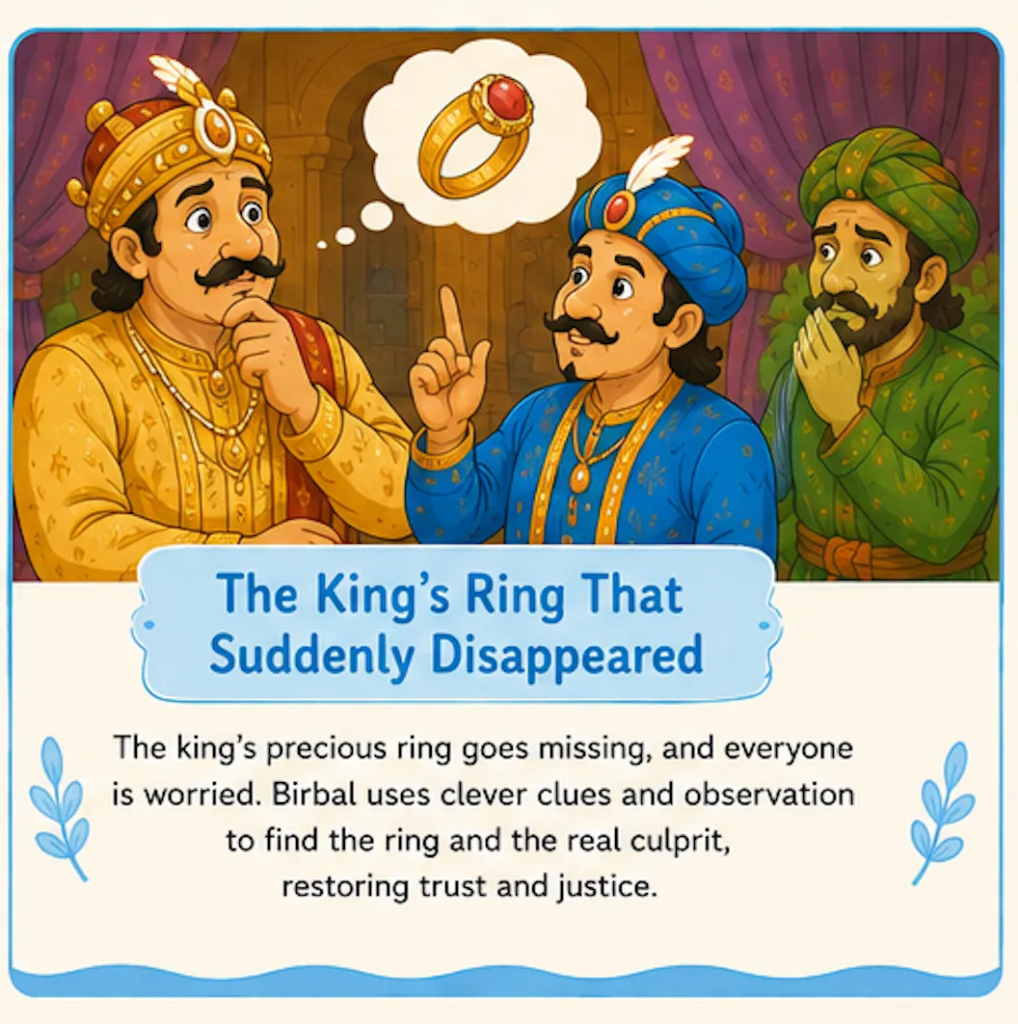
One morning, Emperor Akbar noticed that his precious ring was missing. The entire palace searched for it, but it was nowhere to be found. Some ministers began accusing the palace servants without any proof.
Akbar asked Birbal to investigate. Birbal gathered all the servants and calmly said, “The person who has taken the ring should return it before sunset. If not, the truth will reveal itself.”
Feeling guilty, the servant who had found the ring but was afraid to admit it quietly placed it inside a flower vase in the palace garden before sunset.
Later, Birbal asked everyone to search the garden together. The ring was found in the vase. Birbal looked at the nervous servant, who confessed that he had picked up the ring and hidden it because he feared being blamed for stealing it.
Akbar forgave the servant after he apologized and praised Birbal for solving the case without punishing an innocent person.
Moral: Honesty and courage to tell the truth are always better than hiding a mistake.
Birbal’s Clever Plan to Catch a Liar
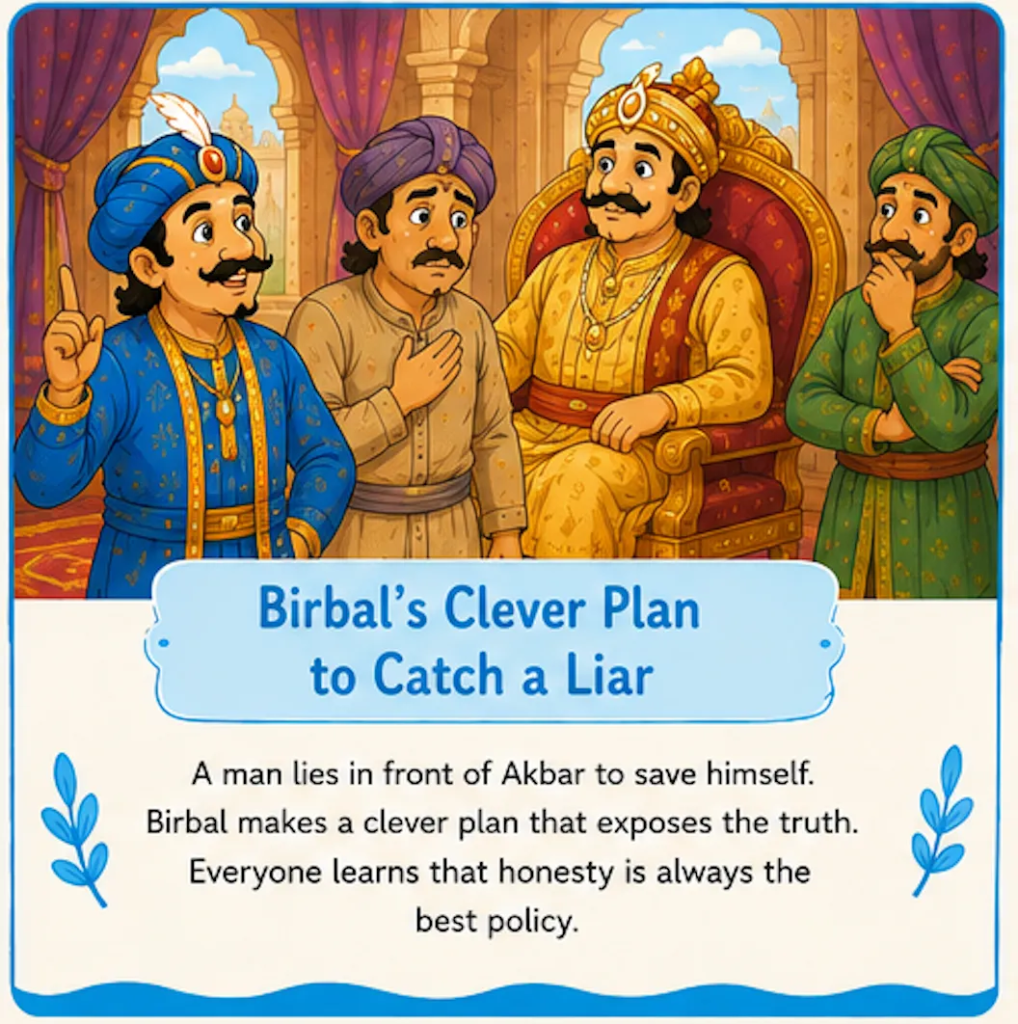
One day, two traders arrived at Emperor Akbar’s court arguing over a bag of silver coins. Each claimed that the bag belonged to him. Since there were no witnesses, Akbar asked Birbal to discover the truth.
Birbal examined the bag carefully and then asked each trader to describe what was inside besides the coins. One trader quickly made up a story, saying there was a lucky charm hidden in the bag. The other trader replied, “There is nothing else inside. I packed only the silver coins.”
Birbal opened the bag in front of everyone. As the honest trader had said, it contained only silver coins. Birbal smiled and said, “A liar often adds unnecessary details to make a false story sound believable.”
The dishonest trader admitted that he had tried to steal the bag. Akbar praised Birbal for his sharp thinking and returned the silver coins to their rightful owner.
Moral: Lies may sound convincing for a while, but the truth always comes to light.
Akbar Learns the Value of Patience
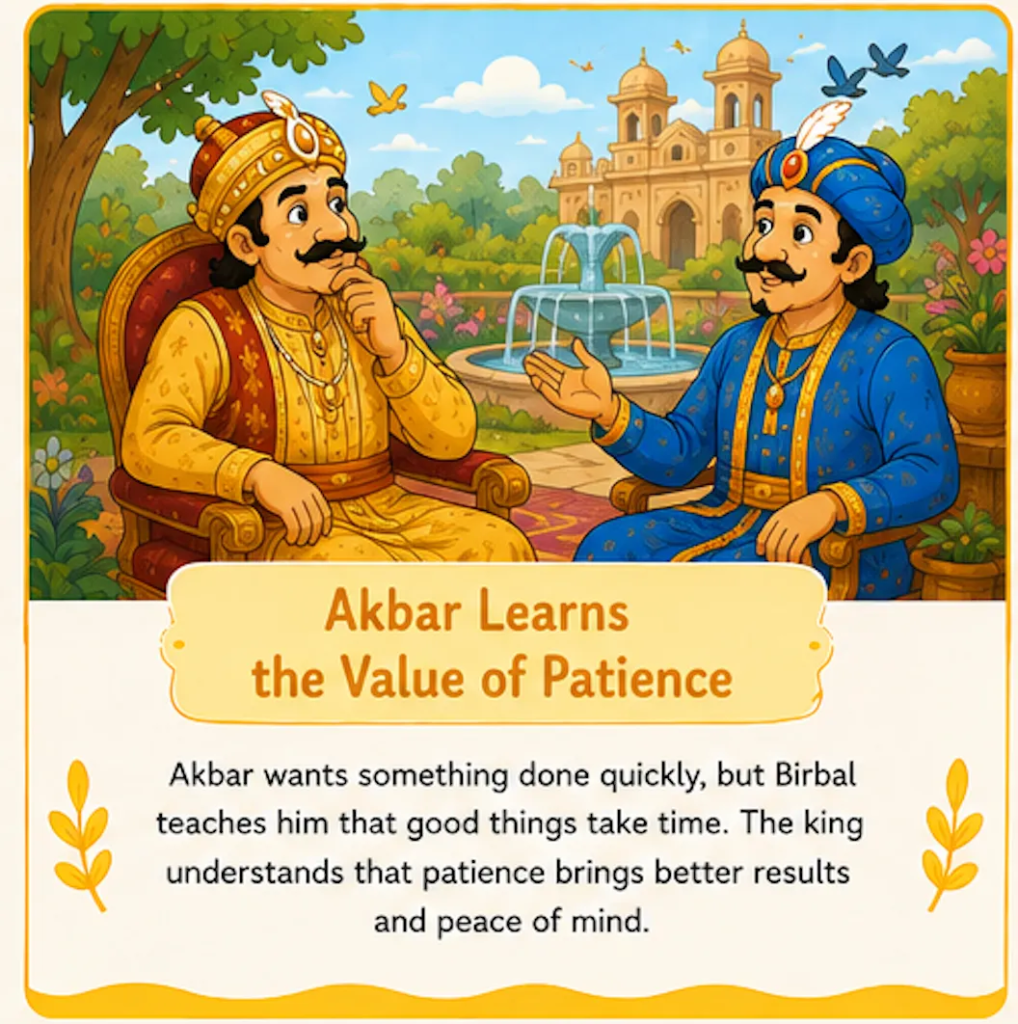
One day, Emperor Akbar wanted a beautiful rose plant in the palace garden to bloom immediately. He ordered the royal gardeners to make the flowers blossom by the next morning. The gardeners tried everything they knew, but the buds remained closed.
Seeing their worry, Birbal stepped forward and said, “Your Majesty, some things cannot be rushed. Nature follows its own time.”
To explain, Birbal planted two seeds. He watered one every day with care and left the other without attention. After a few weeks, the first seed grew into a healthy plant, while the second never sprouted.
Birbal smiled and said, “Just as a plant needs time, care, and patience to grow, success also comes slowly through steady effort.”
Akbar realized his mistake and thanked the gardeners for their hard work. From that day on, he became more patient and thoughtful before giving orders.
Moral: Patience and consistent effort lead to the best results.
The Boy Who Outsmarted the Greedy Moneylender
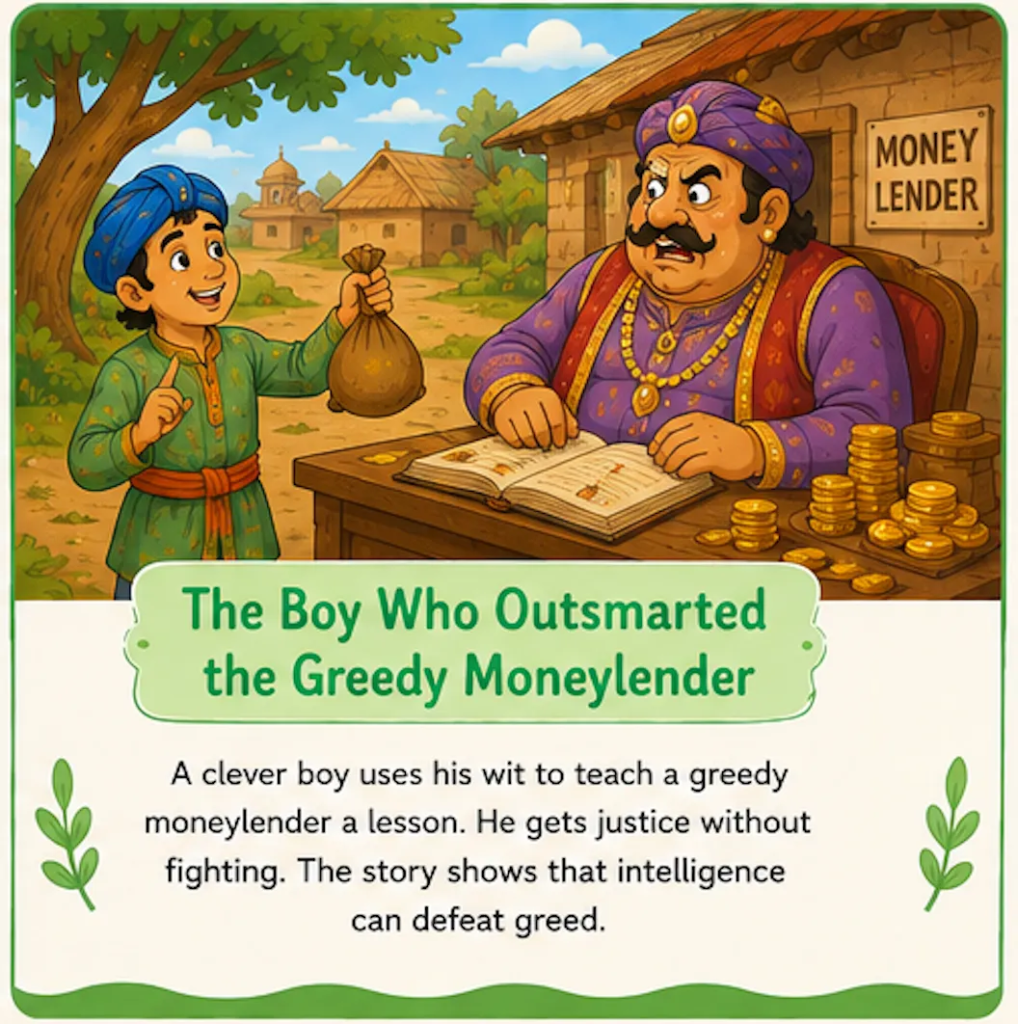
A poor boy borrowed a few silver coins from a greedy moneylender to help his family. After a few months, he returned the money with the agreed payment. However, the moneylender demanded even more, claiming the boy still owed him extra coins.
The frightened boy went to Emperor Akbar’s court for justice. Akbar asked Birbal to hear the case.
Birbal requested the moneylender to explain the agreement. The man proudly described every detail but kept changing the amount he claimed. The boy calmly repeated the same simple story each time. Birbal realized the moneylender was lying.
Birbal said, “An honest person remembers the truth, but a dishonest person keeps changing it.” He ordered the moneylender to accept the original payment and warned him never to cheat poor people again.
The boy thanked Birbal for protecting him. Everyone in the court praised Birbal’s wisdom and fairness.
Moral: Honesty and truth always defeat greed and dishonesty.
Birbal and the Four Foolish Men
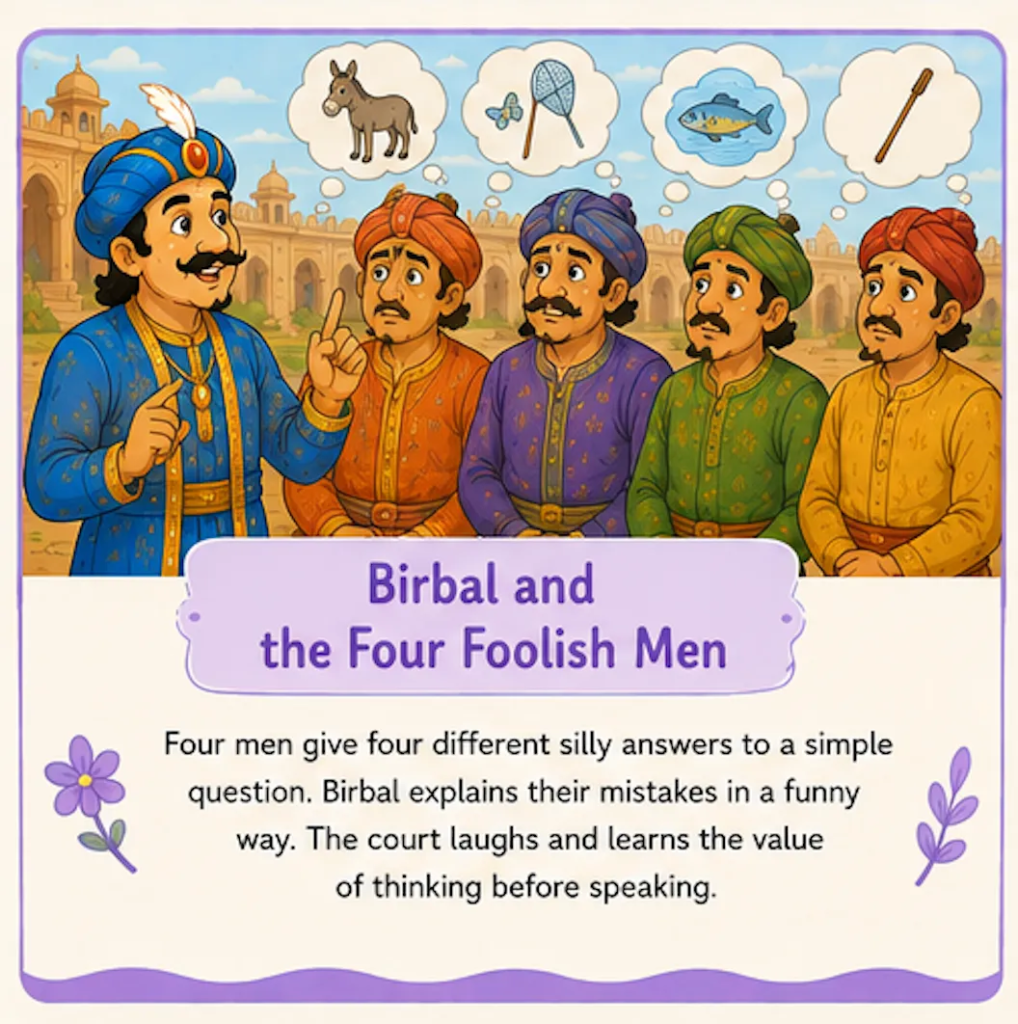
One day, Emperor Akbar asked Birbal, “Can you find the four most foolish men in my kingdom?” Birbal accepted the challenge and set out on his journey.
First, he met a man carrying a bundle of hay on his head while sitting in an empty bullock cart. When Birbal asked why, the man replied, “I don’t want my bullocks to carry the extra weight!” Birbal smiled and invited him to the court.
Next, he met another man searching for his ring under a street lamp. Birbal asked where he had lost it. The man answered, “In my house, but it is brighter here!” Birbal brought him along too.
Back in the court, Birbal said, “These are two foolish men. The third is the person who sent me looking for them instead of doing more important work.” Akbar laughed.
Birbal then bowed and added, “And the fourth is me, for spending my time on such a task!”
Akbar burst into laughter and rewarded Birbal for his wit.
Moral: Use your time wisely and always think carefully before acting.
The Real Owner of the Lost Horse
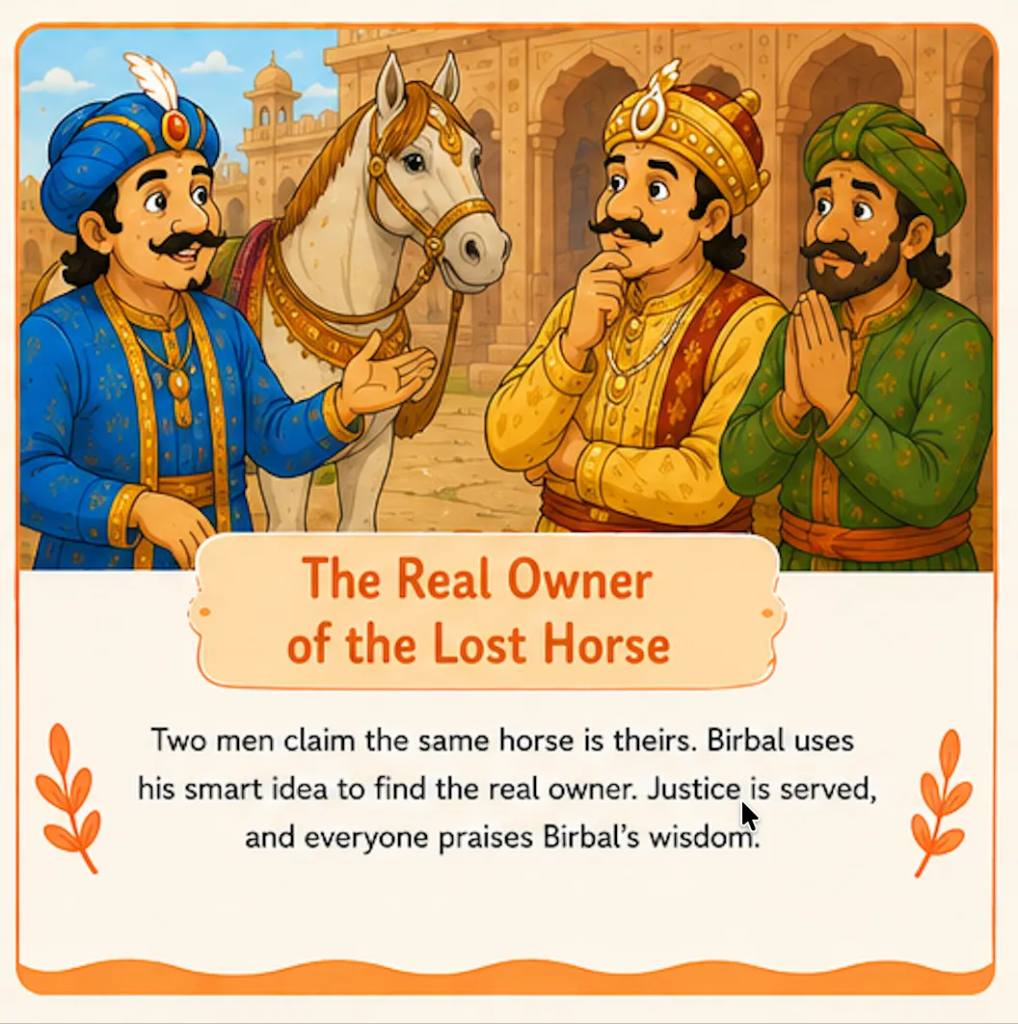
One morning, two men arrived at Emperor Akbar’s court, each claiming ownership of a beautiful white horse. Neither had any papers or witnesses to prove their claim. Unsure of the truth, Akbar asked Birbal to settle the dispute.
Birbal took the horse to the royal stable and kept it there for the night. The next morning, he asked both men to call the horse, one at a time.
The first man called loudly, but the horse did not move. When the second man gently called its name and stroked its neck, the horse happily trotted toward him and nuzzled his hand. It was clear that the horse recognized its true master.
Birbal smiled and said, “Love and care create a bond that cannot be faked.” Akbar declared the second man the rightful owner and warned the first man never to make false claims again.
Everyone in the court admired Birbal’s wisdom and fair judgment.
Moral: Truth is revealed through genuine care, honesty, and kindness.
Birbal’s Funny Answer About the Stars in the Sky
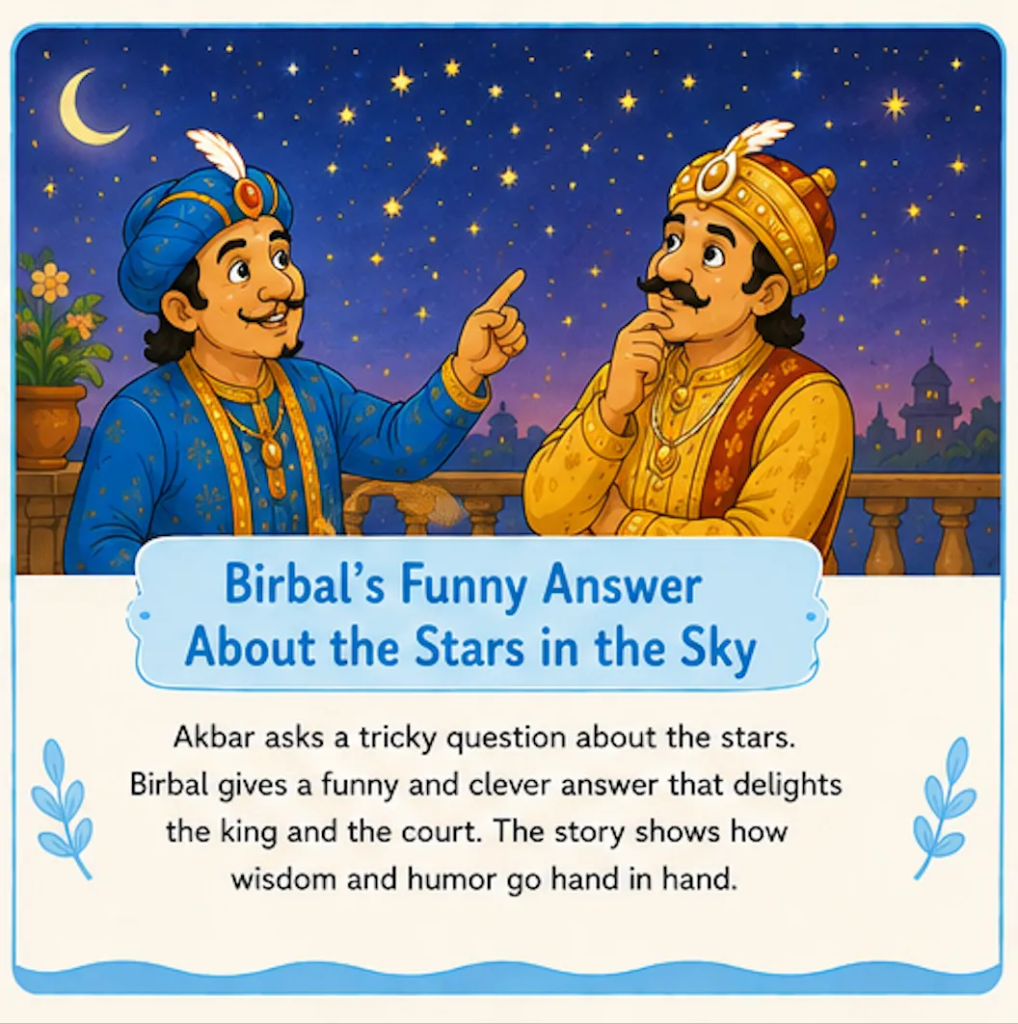
One clear night, Emperor Akbar looked at the sparkling sky and asked Birbal, “Can you tell me exactly how many stars are in the sky?”
The ministers tried to guess. Some gave very large numbers, while others admitted they did not know. Akbar smiled and waited for Birbal’s answer.
Birbal pointed to a fluffy sheep grazing nearby and said, “Your Majesty, the sky has exactly as many stars as there are hairs on this sheep.”
Akbar laughed and asked, “How can anyone prove that?”
Birbal replied with a smile, “Anyone who doubts my answer is welcome to count the sheep’s hairs and then count the stars. If both numbers match, they will know I am right!”
The entire court burst into laughter. Akbar praised Birbal for his clever wit and quick thinking. He realized that some questions are meant to test wisdom rather than find an exact answer.
Moral: Clever thinking and a sense of humor can solve even the trickiest questions.
The Sweetest Thing in the Kingdom
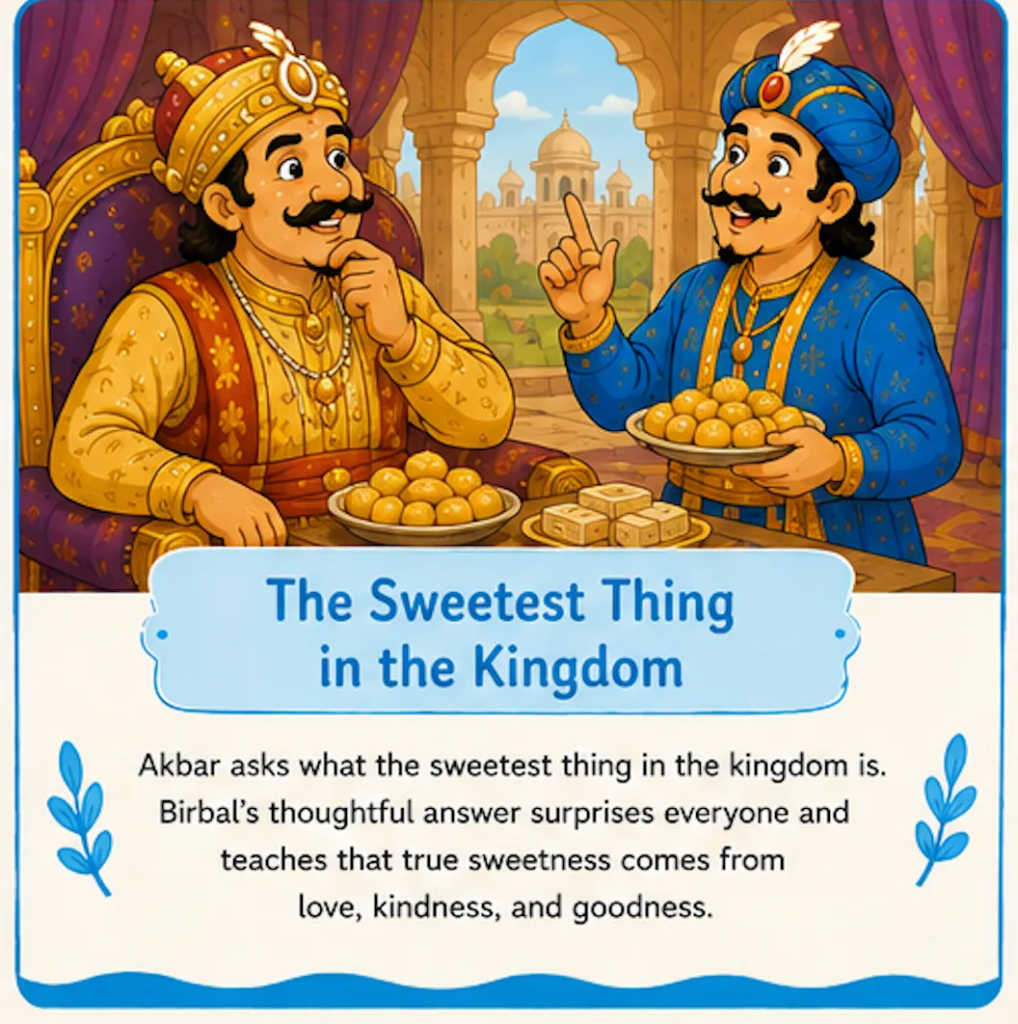
One day, Emperor Akbar asked his ministers, “What is the sweetest thing in the entire kingdom?” Some replied, “Honey is the sweetest.” Others said, “Fresh mangoes,” while a few answered, “Delicious sweets from the royal kitchen.”
Akbar was not fully convinced and turned to Birbal for the answer.
Birbal smiled and said, “Your Majesty, kind words are the sweetest thing in the world.”
To prove his point, Birbal politely greeted an angry man waiting outside the court. He listened to the man’s problems with patience and spoke to him with respect. Within minutes, the man’s anger disappeared, and he left with a smile.
Birbal then said, “Sweet food brings happiness for a short time, but kind words can heal a sad heart, build friendships, and spread joy for a lifetime.”
Akbar nodded in agreement and praised Birbal’s wisdom. Everyone in the court promised to speak kindly to others.
Moral: Kind and gentle words are sweeter than any food because they bring happiness to people’s hearts.
Akbar’s Challenge to Count the Crows
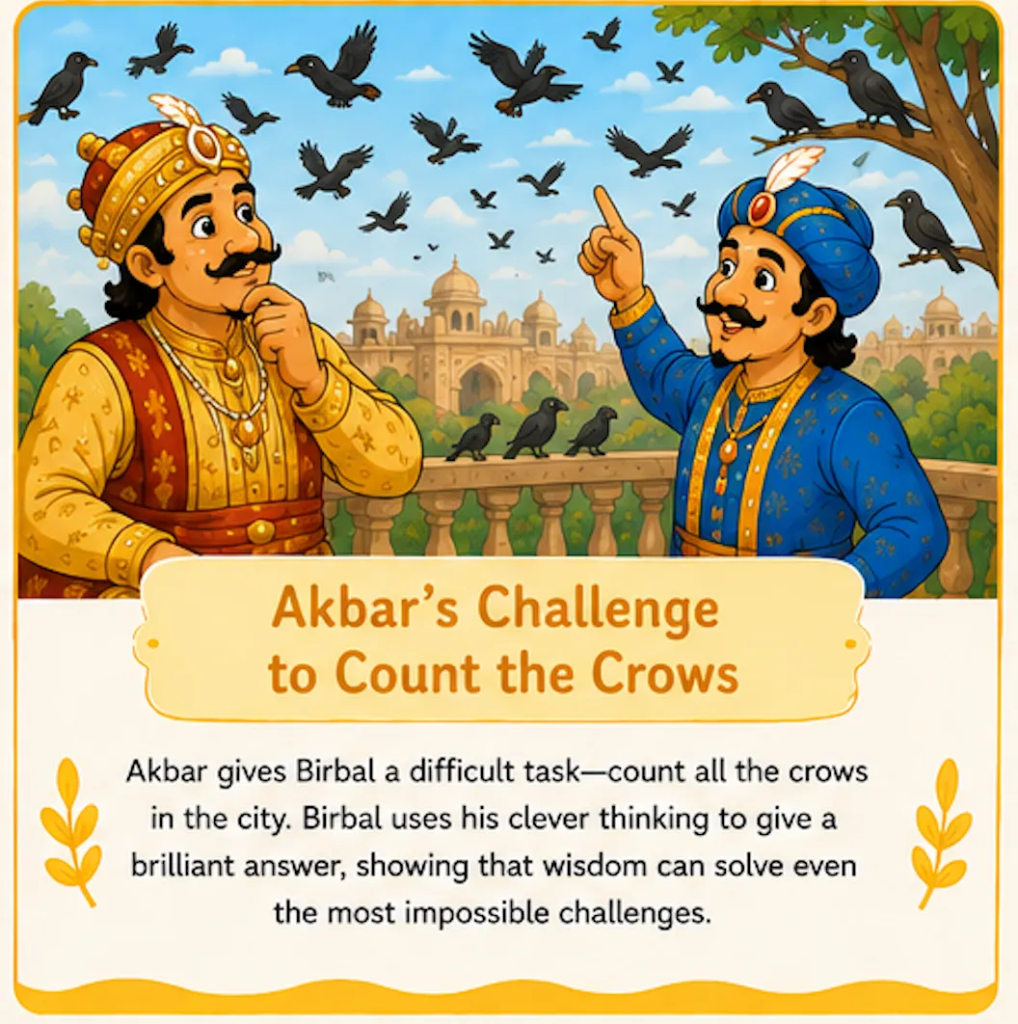
One morning, Emperor Akbar looked out of the palace window and asked Birbal, “Can you tell me how many crows live in our capital city?”
The ministers were surprised by the unusual question. Some suggested sending soldiers to count every crow, while others said the task was impossible.
Birbal smiled and replied, “Your Majesty, there are exactly 9,875 crows in the city.”
Akbar raised his eyebrows and asked, “What if we count them and find more or fewer?”
Birbal answered, “If there are more, then some crows must have come to visit their relatives from nearby villages. If there are fewer, then some have gone to visit their own relatives elsewhere.”
The royal court burst into laughter. Akbar admired Birbal’s quick thinking and clever answer. He realized that wisdom is not just about knowing facts but also about thinking calmly and creatively.
Moral: Intelligence and presence of mind can solve even the most difficult or unusual questions.
Birbal Teaches Why Kindness Always Wins
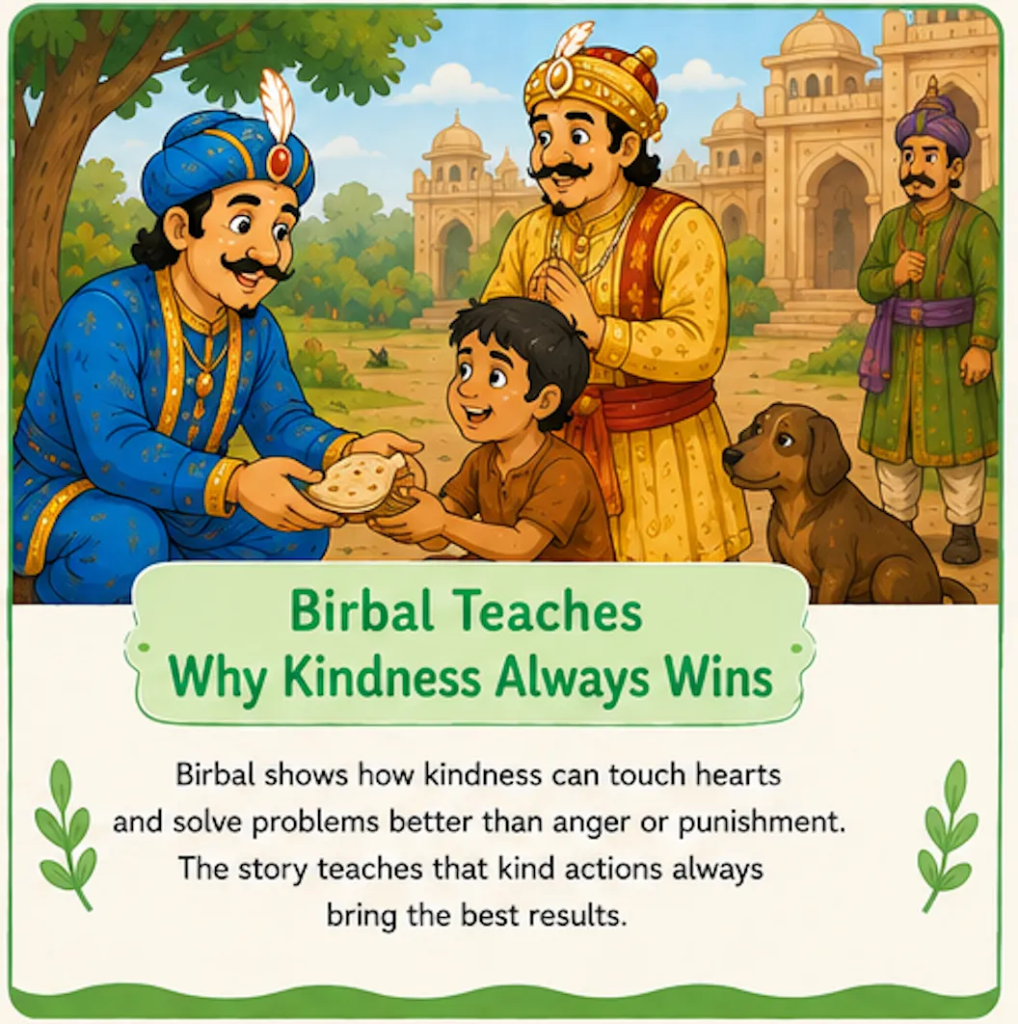
One day, Emperor Akbar noticed two boys arguing over a basket of ripe guavas. Each claimed that the basket belonged to him, and soon they began shouting at each other. The people around them could not settle the matter.
Akbar asked Birbal to solve the dispute. Instead of scolding the boys, Birbal spoke to them gently. He asked each boy to explain his side of the story. After listening carefully, Birbal learned that one boy had picked the guavas, while the other had carried the heavy basket all the way to the market.
Birbal smiled and said, “Both of you worked hard. Instead of fighting, share the guavas equally and enjoy the reward together.”
The boys realized their mistake, apologized to each other, and happily divided the basket. Akbar praised Birbal for choosing kindness over anger.
The people in the court understood that gentle words and fairness can solve problems better than arguments.
Moral: Kindness, patience, and fairness bring peace and happiness to everyone.
The Honest Woodcutter Who Met Akbar
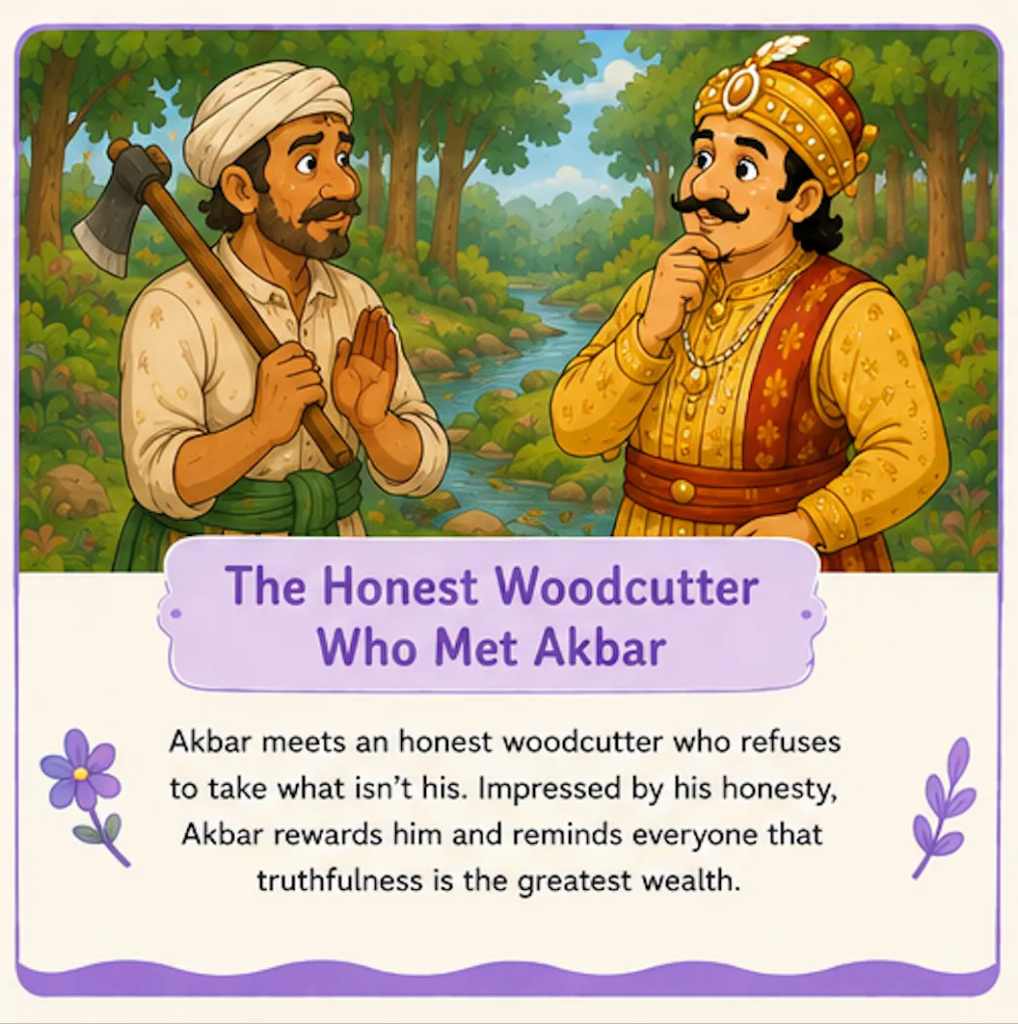
One day, while walking through a forest, Emperor Akbar and Birbal heard someone crying. They found a poor woodcutter searching near a river. The woodcutter explained that his only axe had slipped into the water while he was cutting firewood. Without it, he could not earn money to feed his family.
Birbal asked the guards to search the river. Soon, they found two axes—one made of gold and the other of iron. Birbal showed the golden axe first, but the woodcutter shook his head and said, “That is not mine.” Then Birbal showed the iron axe. The woodcutter smiled and said, “Yes, this is my axe.”
Akbar was impressed by the man’s honesty. He rewarded the woodcutter with the golden axe as a gift and praised him before everyone.
Birbal said, “A truthful heart is more valuable than gold.”
The woodcutter thanked the emperor and promised to remain honest throughout his life.
Moral: Honesty always brings respect and unexpected rewards.
Birbal Solves the Mystery of the Missing Necklace
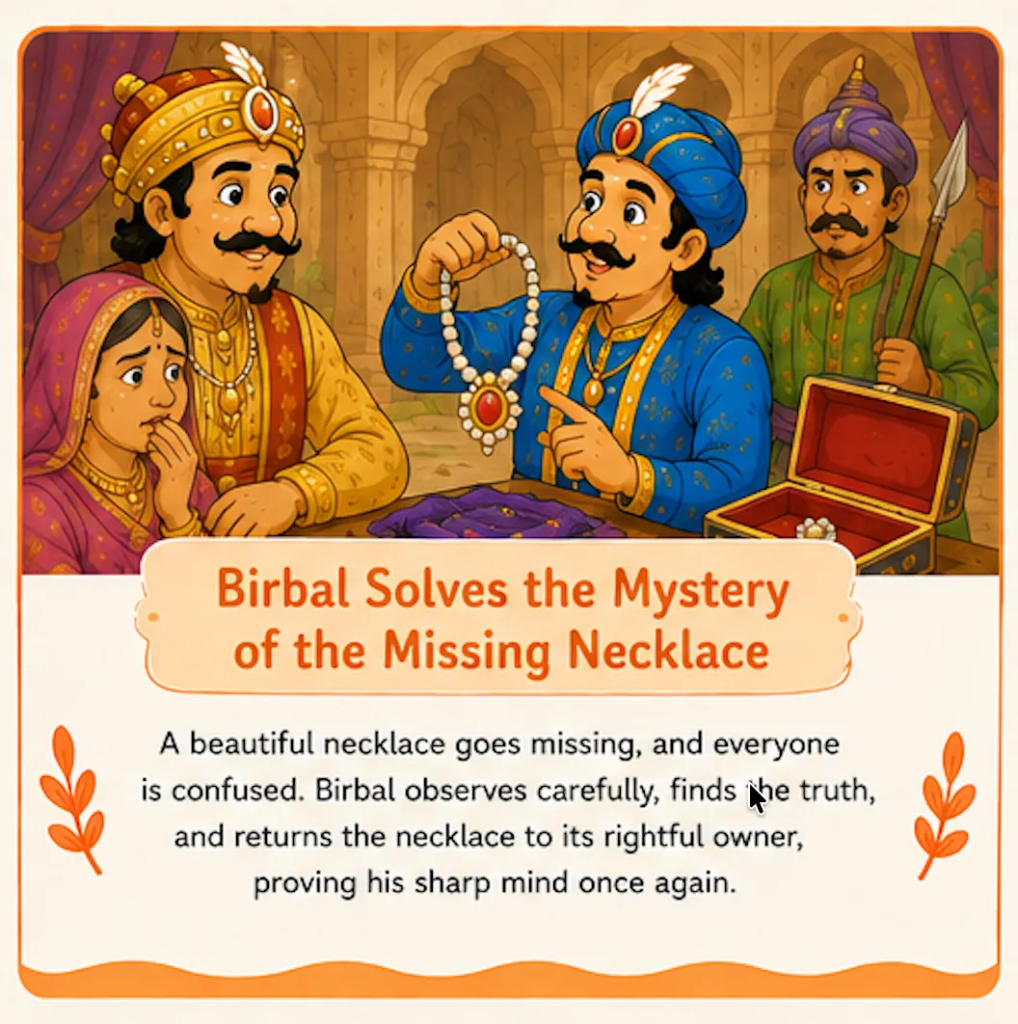
One morning, the queen discovered that her precious pearl necklace was missing from her room. The palace guards searched everywhere, but they could not find it. Some servants were wrongly suspected, and everyone became worried.
Emperor Akbar asked Birbal to investigate. Birbal gathered all the servants and calmly asked them to describe what they had done that morning. As each person spoke, Birbal carefully watched their expressions. One servant seemed nervous and kept changing his story.
Birbal then asked everyone to check their belongings. The frightened servant suddenly admitted that he had hidden the necklace inside a flower pot, hoping to take it later. He returned the necklace and apologized for his mistake.
Akbar praised Birbal for solving the mystery with patience and careful observation instead of making false accusations. The innocent servants were relieved, and peace returned to the palace.
Moral: Patience, careful observation, and honesty help reveal the truth.
The Day Birbal Saved an Innocent Villager

One day, a frightened villager was brought before Emperor Akbar. A wealthy trader accused him of stealing a bag of silver coins. The villager insisted that he was innocent, but he had no one to support his claim.
Akbar asked Birbal to investigate the case. Birbal listened carefully to both men and noticed that the trader kept interrupting the villager. Birbal then asked the trader to describe the bag of coins in detail. The trader confidently gave an answer, but when Birbal opened the bag, he found a small family charm inside. The villager immediately recognized it and explained that his wife had stitched it into the bag for good luck.
Birbal smiled and said, “Only the true owner would know about this hidden charm.” The trader realized he had been caught and confessed that he had made a false accusation.
Akbar punished the dishonest trader and praised Birbal for protecting an innocent man through wisdom and fairness.
Moral: Truth always triumphs, and wise judgment protects the innocent.
Kid-friendly vocabulary list based on the Akbar and Birbal stories
| Vocabulary | Meaning |
|---|---|
| Emperor | A ruler of an empire |
| Kingdom | A country ruled by a king or queen |
| Royal Court | The place where the king meets ministers and solves problems |
| Minister | A trusted advisor to the king |
| Wisdom | The ability to make good decisions |
| Clever | Quick at thinking and solving problems |
| Intelligence | The ability to learn and understand |
| Honest | Always telling the truth |
| Honesty | The quality of being truthful |
| Truth | What is real and correct |
| Justice | Fair treatment for everyone |
| Fairness | Treating everyone equally |
| Kindness | Being caring and helpful |
| Patience | Staying calm while waiting |
| Respect | Treating others politely and kindly |
| Friendship | A close and caring relationship |
| Courage | Bravery in difficult situations |
| Confidence | Believing in yourself |
| Greed | Wanting more than you need |
| Reward | A prize for doing something good |
| Challenge | A difficult task to complete |
| Puzzle | A problem that needs thinking |
| Mystery | Something that is not yet explained |
| Clue | A hint that helps solve a mystery |
| Evidence | Facts that help prove something |
| Observe | To watch carefully |
| Decision | A choice made after thinking |
| Solution | The answer to a problem |
| Dispute | A disagreement or argument |
| Claim | To say something belongs to you |
| Merchant | A person who buys and sells goods |
| Carpenter | A person who makes things from wood |
| Farmer | A person who grows crops |
| Gardener | A person who takes care of plants |
| Villager | A person living in a village |
| Servant | A person who works in someone’s home or palace |
| Thief | A person who steals |
| Innocent | Someone who has done nothing wrong |
| Guilty | Responsible for doing something wrong |
| Confess | To admit the truth after doing something wrong |
| Apologize | To say sorry for a mistake |
| Forgive | To stop being angry after someone says sorry |
| Promise | To give your word that you will do something |
| Effort | Hard work to achieve something |
| Responsibility | Taking care of your duties |
| Observe | To look at something carefully |
| Imagine | To form a picture in your mind |
| Peace | A state of calm and harmony |
| Respectful | Showing kindness and good manners |
| Generous | Happy to share with others |
| Gratitude | Being thankful for what you have |
Skills Kids Can Develop
- Critical thinking
- Problem-solving
- Logical reasoning
- Honest communication
- Kindness and empathy
- Patience
- Fair decision-making
- Observation skills
- Creativity
- Leadership
- Teamwork
- Confidence
- Responsibility
- Respect for others
- Moral values
How Parents Should Read Akbar and Birbal Stories to Kids
Reading Akbar and Birbal stories can be a fun and meaningful family activity. Instead of reading quickly, parents should read slowly and use different voices for Akbar, Birbal, and the other characters. This makes the stories exciting and keeps children interested.
Pause during the story and ask simple questions like, “What do you think Birbal will do next?” or “Was that character honest?” This helps children think and improve their problem-solving skills.
After finishing the story, talk about the moral in simple words. Ask your child how they can use the lesson at home, in school, or with friends. Encourage them to share their own ideas and experiences.
You can also ask your child to draw their favorite scene or act out the story with family members. This improves creativity, confidence, and communication skills.
Reading just one Akbar and Birbal story every night can help children develop wisdom, honesty, kindness, patience, and a love for reading while creating wonderful family memories.
Best suited for children aged 6 to 10 years
These Akbar and Birbal stories (100–200 words each) are best suited for children aged 6 to 10 years.
Age-wise guide
- 6–7 years: Parents or teachers should read the stories aloud. Children can enjoy the characters, simple language, and morals.
- 8–10 years: Children can read the stories on their own. They can understand the problem, Birbal’s clever solution, and the moral lesson.
- 10–12 years: These stories are still enjoyable and can help children improve reading comprehension, critical thinking, and vocabulary.
Why this age group is ideal
Children between 6 and 10 years are developing:
- Reading and listening skills
- Logical thinking
- Problem-solving abilities
- Moral values such as honesty, kindness, fairness, and patience
- Curiosity and creativity
The short length also matches the attention span of young readers, making these stories perfect for bedtime reading, classroom activities, and daily reading practice.
Conclusion
Akbar and Birbal stories with pictures offer much more than entertainment they teach valuable life lessons in a fun and memorable way. Through Birbal’s clever solutions and Akbar’s thoughtful questions, children learn the importance of honesty, kindness, patience, wisdom, and fair decision-making. The colorful pictures make each story easier to understand and keep young readers engaged from beginning to end. Read one story every day with your child to build reading habits, strengthen family bonding, and inspire curiosity. These classic tales will help children grow into confident, thoughtful, and compassionate individuals while creating a lifelong love for books.
