Akbar and Birbal stories are loved by children because they are fun, easy to read, and full of valuable life lessons.
When these stories include elephants, they become even more exciting. Elephants are known for their strength, intelligence, kindness, and loyalty, making them wonderful characters for children’s stories.
In this collection of Akbar Birbal Elephant Stories, kids will enjoy short stories of 100–200 words that teach important values such as honesty, kindness, patience, courage, teamwork, and respect.
These simple stories are perfect for bedtime reading, classroom learning, and improving English reading skills while inspiring children to become thoughtful and caring individuals.
24 Akbar Birbal Elephant Story in English with Moral
The Elephant That Chose Its True Friend
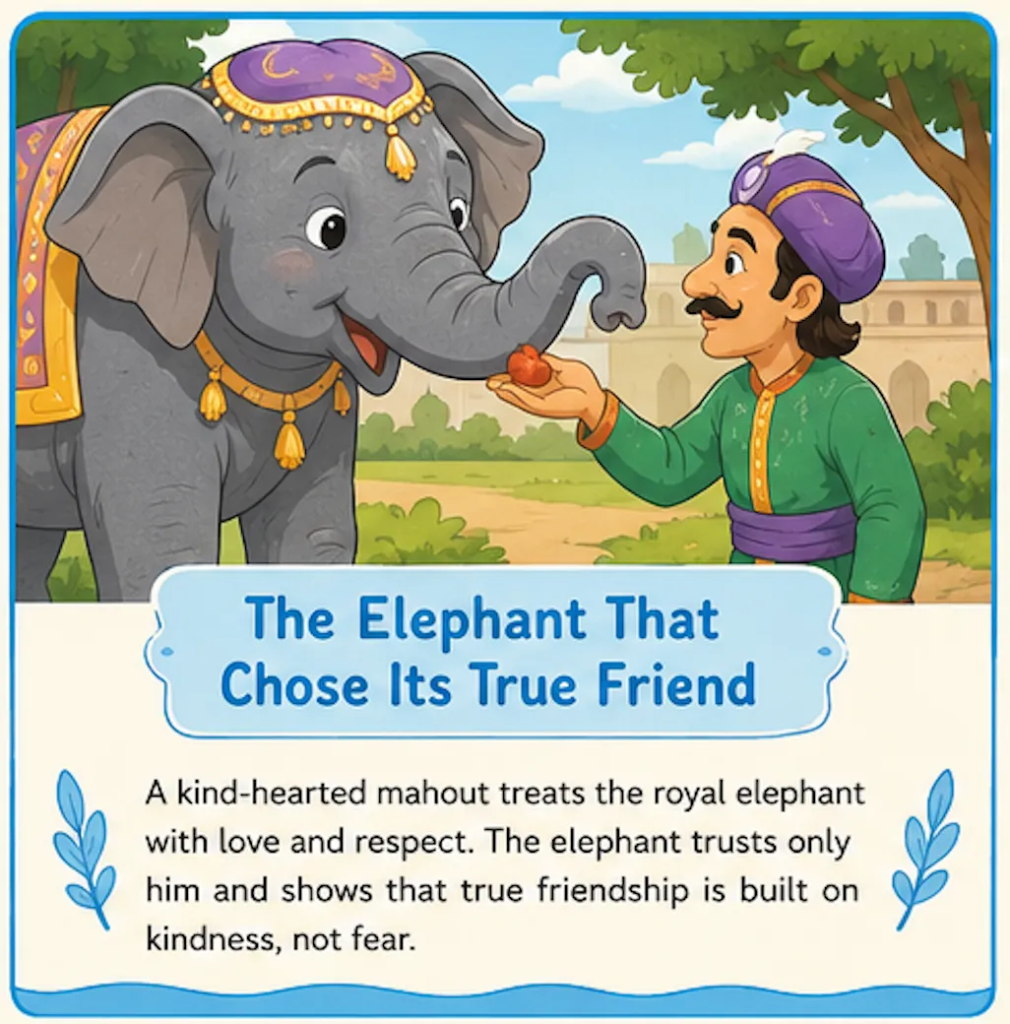
Emperor Akbar owned a magnificent elephant named Gajraj. Everyone in the palace admired him, but only his mahout, Ramu, treated him with true love and care. Ramu fed him on time, spoke kindly to him, and looked after him every day.
One day, Akbar wanted to know whether elephants remembered kindness. Birbal suggested a simple test. For a few days, different palace workers offered Gajraj tasty treats, while Ramu stayed away.
When Ramu finally returned, Gajraj trumpeted loudly with joy. He ignored the sweets from others and gently wrapped his trunk around Ramu as if giving him a warm hug. The elephant had chosen his true friend—not the people with gifts, but the one who had always shown him love.
Akbar smiled and understood Birbal’s lesson. “True friendship is built on care, trust, and kindness, not on expensive gifts.”
Moral: Real friendship is earned through love, care, and loyalty.
Birbal Solves the Mystery of the Missing Royal Elephant
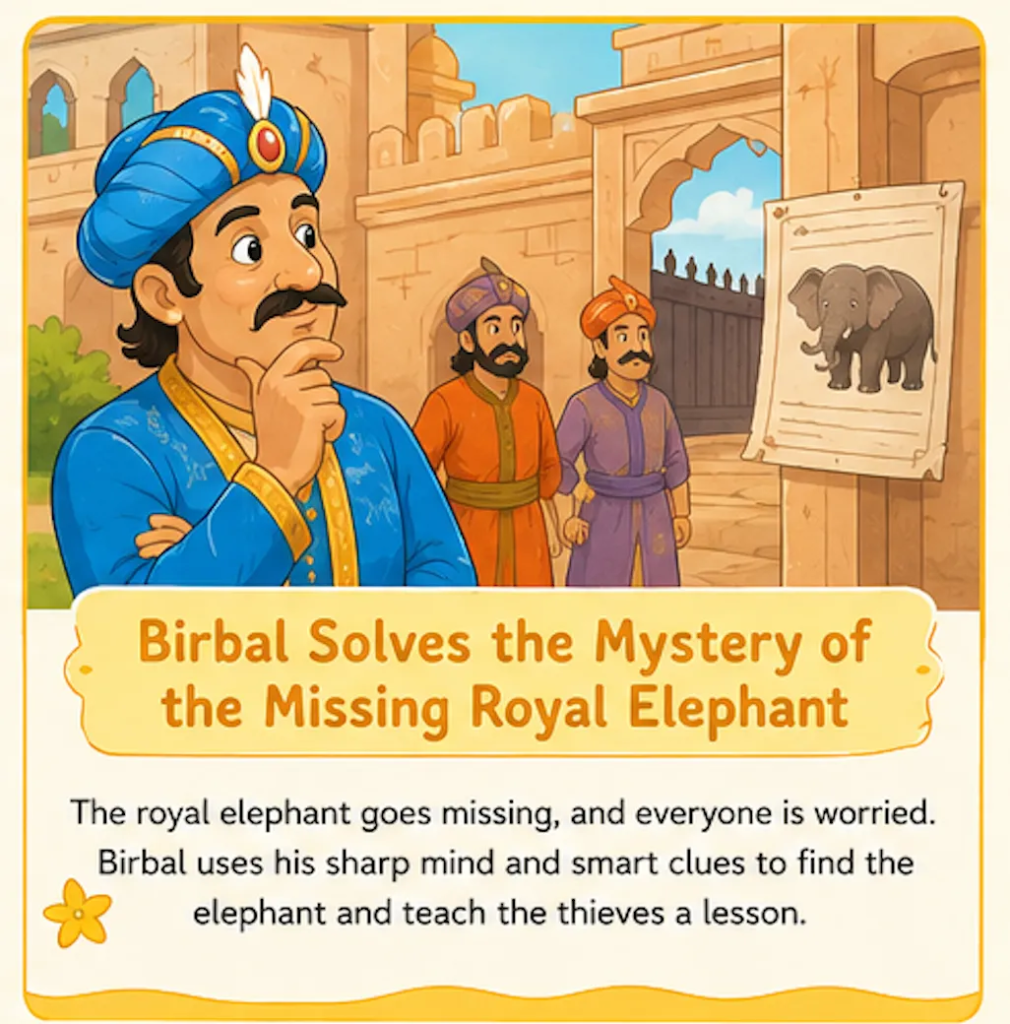
One morning, the royal elephant suddenly disappeared from Akbar’s palace. The guards searched everywhere but could not find him. Everyone was worried because the elephant was very valuable.
Akbar asked Birbal to solve the mystery. Birbal carefully looked around the elephant’s stable. He noticed large footprints leading toward a nearby forest. Along the path, he found broken branches and fresh sugarcane leaves. “The elephant has not been stolen,” Birbal said. “He has simply wandered away in search of food.”
Birbal asked the mahout to call the elephant using his special whistle. Soon, a loud trumpet echoed through the forest. The royal elephant happily walked back, carrying a bundle of sugarcane in his trunk.
Akbar praised Birbal for staying calm and observing every clue instead of making quick guesses. The palace guards also learned the importance of careful investigation.
Moral: Careful observation and logical thinking can solve even the most difficult mysteries.
Also Read:
How Birbal Calmed the Angry Elephant
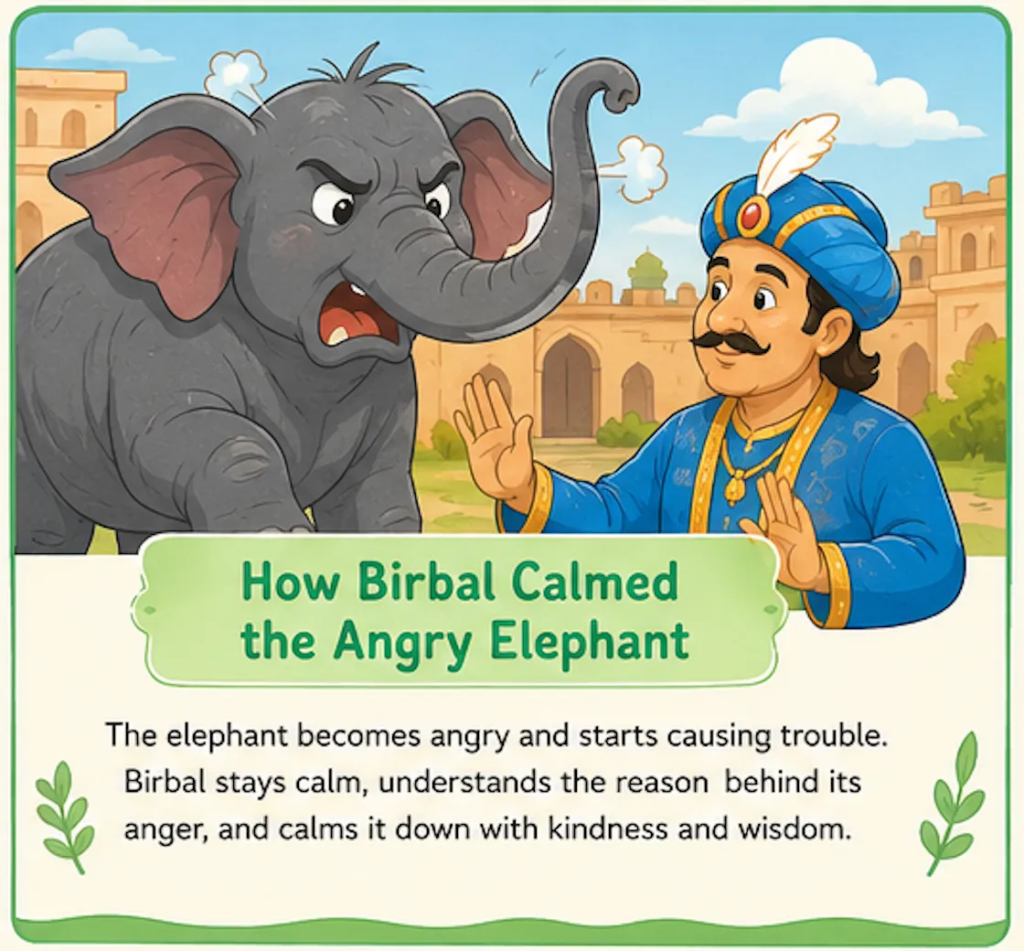
One afternoon, the royal elephant became frightened by a sudden clap of thunder. He started trumpeting loudly and ran around the palace courtyard, making everyone panic. The guards tried to stop him, but the elephant became even more upset.
Emperor Akbar called Birbal for help. Instead of shouting or using force, Birbal asked everyone to step back and remain quiet. He requested the elephant’s mahout to softly sing the gentle song he always sang while caring for the elephant.
Hearing the familiar voice, the elephant slowly stopped running. He recognized his trusted friend, walked toward him, and became calm. The mahout gently patted his head, and soon the elephant was peaceful again.
Akbar smiled and said, “Birbal, today you taught us that patience and kindness are stronger than fear and anger.”
Everyone in the palace learned an important lesson that day.
Moral: Kindness, patience, and understanding can calm even the strongest anger.
The Clever Elephant Who Saved the Palace Garden
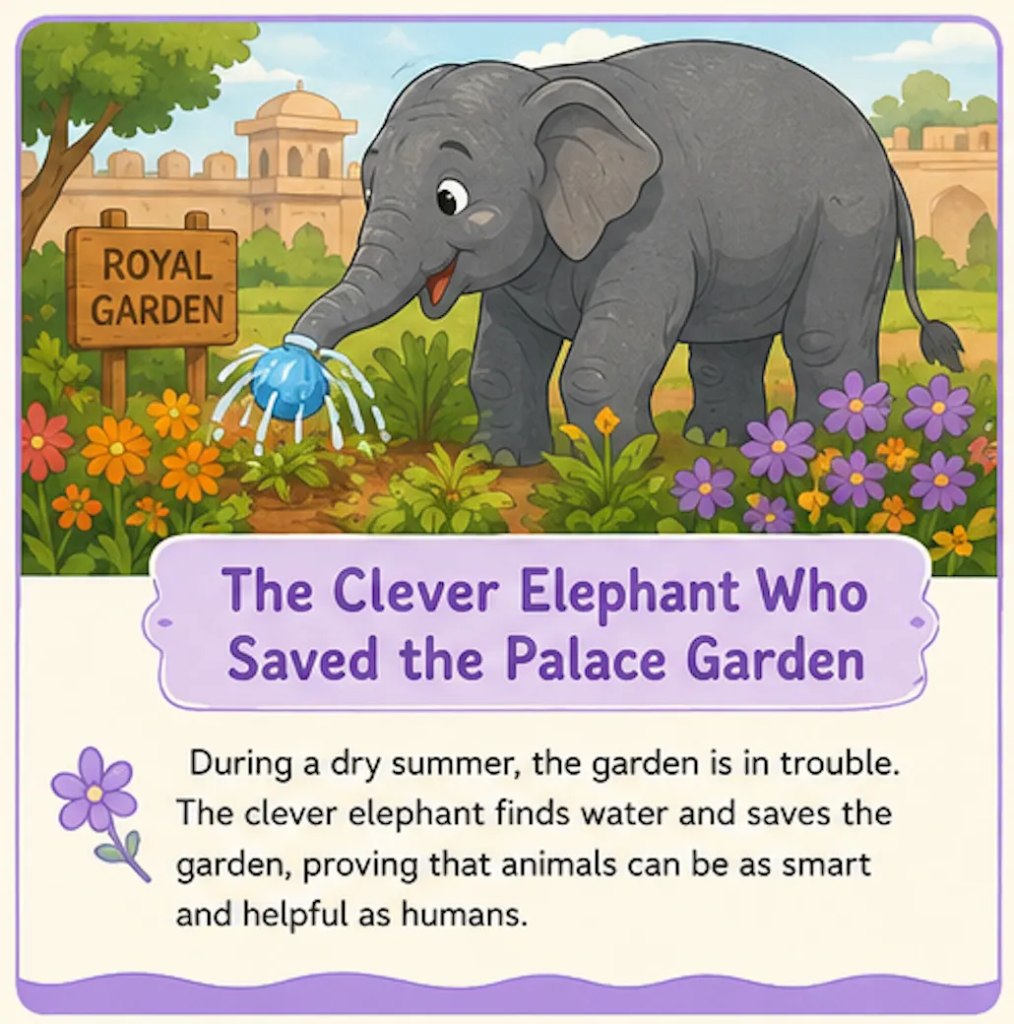
The palace of Emperor Akbar had a beautiful garden filled with colorful flowers, fruit trees, and singing birds. One night, a strong storm broke a large tree branch, blocking the small canal that carried water to the garden. By morning, the plants were beginning to dry.
The royal elephant, Gajraj, noticed the problem. Using his strong trunk, he carefully lifted the heavy branch and placed it aside. Water began flowing through the canal again, bringing life back to the flowers and trees.
When Akbar visited the garden, he was surprised to see everything safe. Birbal explained how Gajraj had saved the garden without anyone’s help.
Akbar gently patted the elephant and said, “True wisdom is using your strength to help others.”
From that day, everyone in the palace admired Gajraj not only for his power but also for his intelligence and kindness.
Moral: Real strength is shown by helping others with wisdom and kindness.
Akbar’s Test with the Gentle Giant
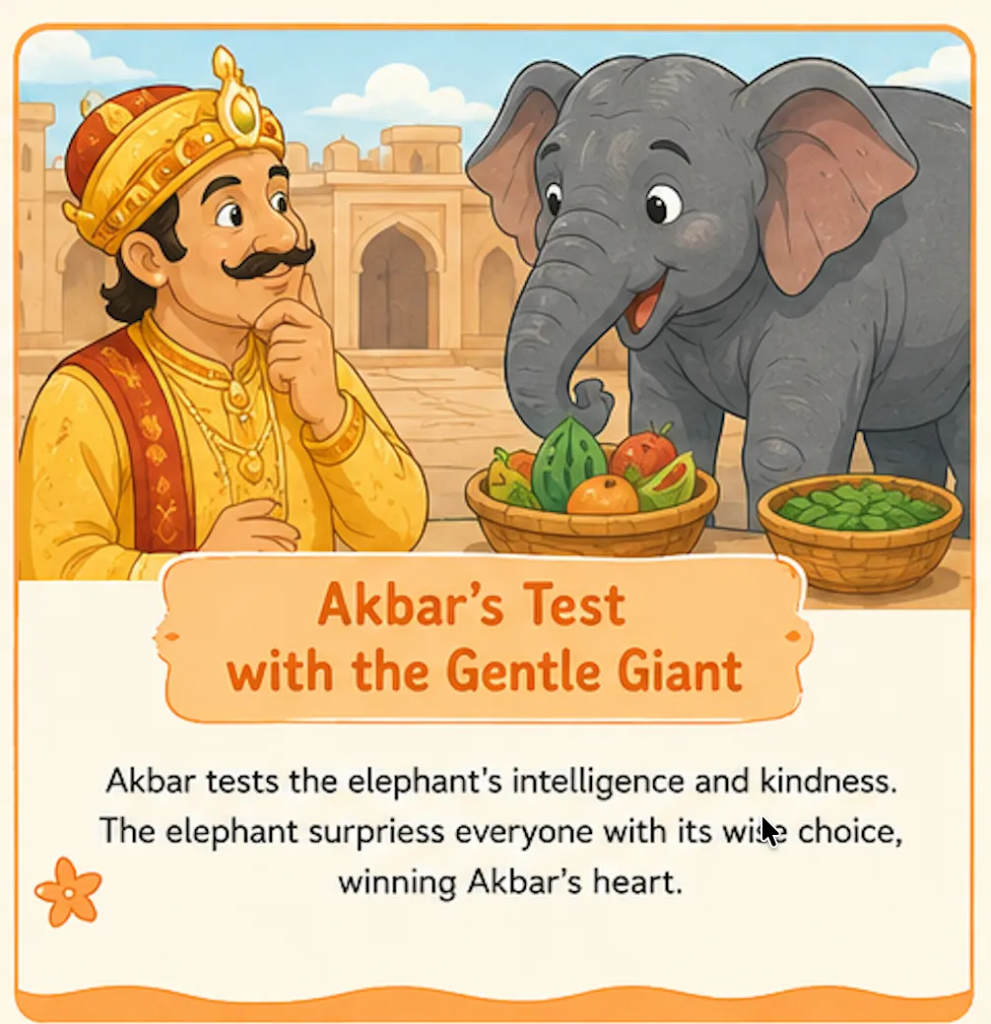
Emperor Akbar often praised the royal elephant, Gajraj, for being strong yet gentle. Some courtiers laughed and said, “A huge elephant cannot be truly gentle.”
Akbar asked Birbal to prove them wrong. The next day, Birbal placed a basket filled with ripe mangoes in the palace courtyard. Around it, several small rabbits were eating peacefully. Gajraj was then led toward the basket.
Everyone expected the elephant to scare the rabbits away. Instead, Gajraj carefully slowed his steps, walked around the little animals, and gently picked up the basket with his trunk without hurting a single rabbit.
The courtiers were amazed. Birbal smiled and said, “Gentleness is not about size. It is about self-control and kindness.”
Akbar nodded proudly and rewarded the elephant with fresh bananas and sugarcane. From that day, the courtiers never judged anyone by appearance alone.
Moral: True greatness is shown through kindness, patience, and self-control.
The Baby Elephant Who Was Afraid of Water
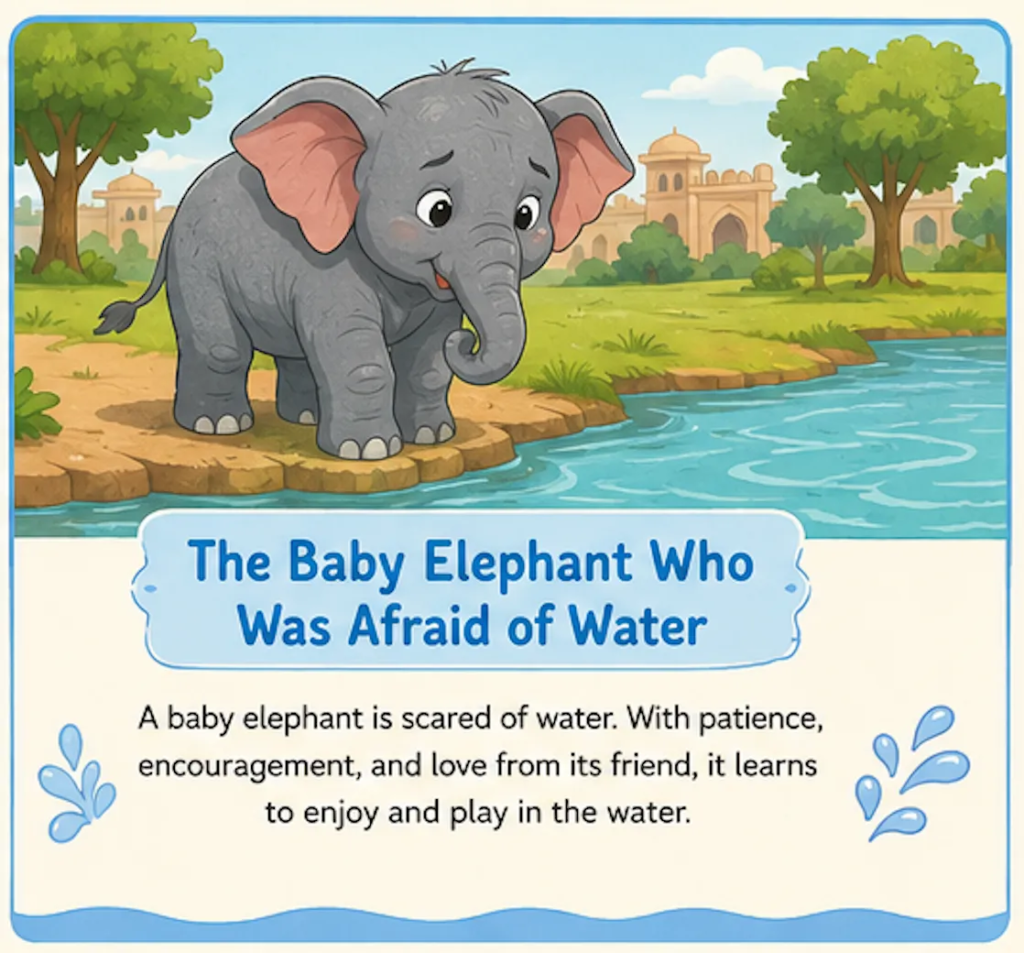
A young elephant named Chotu lived in the royal elephant stable. Although he was playful and friendly, he was afraid of crossing the small river near the palace. Every time he saw the flowing water, he stepped back in fear.
The mahout tried to encourage him, but Chotu would not move. Emperor Akbar asked Birbal for help. Birbal smiled and said, “Do not force him. Let him learn with confidence.”
The next day, the royal elephant Gajraj slowly walked into the river. Chotu watched as Gajraj calmly crossed the water without any trouble. Feeling safe beside his friend, Chotu took one small step, then another. Soon, he crossed the river happily.
Akbar praised Chotu for his courage and Birbal for his wise idea. Chotu realized that bravery is not about having no fear—it is about taking the first step despite being afraid.
Moral: Courage grows when we face our fears with patience and confidence.
Birbal Finds the Owner of the Lost Elephant
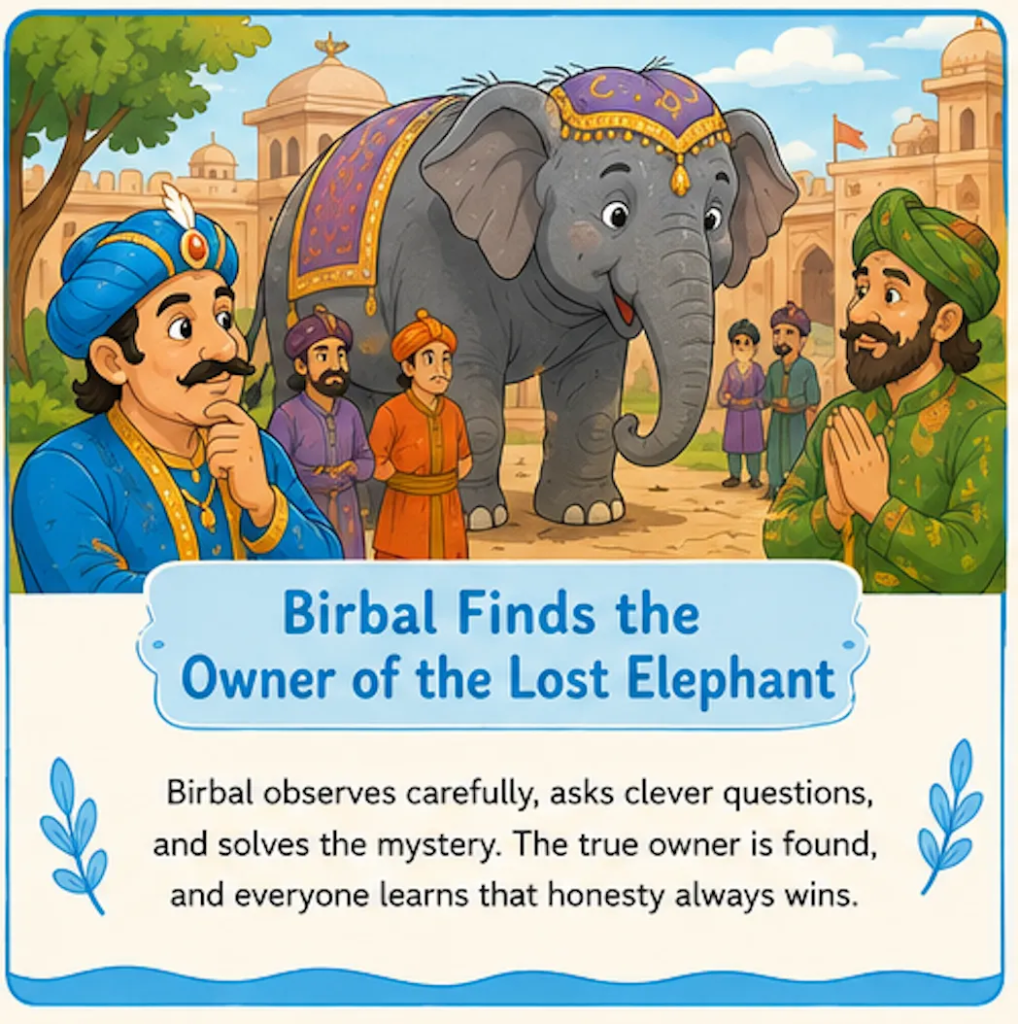
One day, a farmer brought a large elephant to Emperor Akbar’s court. “Your Majesty,” he said, “I found this elephant wandering near my village. Two men are claiming it belongs to them.”
Akbar asked Birbal to solve the dispute. Birbal called both men and asked them questions about the elephant, but their answers sounded similar. Then Birbal ordered the elephant to be brought into the court.
The first man loudly shouted commands, but the elephant did not move. The second man gently called the elephant by the name “Moti” and softly touched its trunk. The elephant happily trumpeted and stood beside him.
Birbal smiled and said, “Animals never forget the person who loves and cares for them.”
Akbar declared the second man the true owner and thanked the honest farmer for bringing the elephant safely to the palace.
Moral: Love and care always reveal the truth.
The Elephant That Refused to Bow
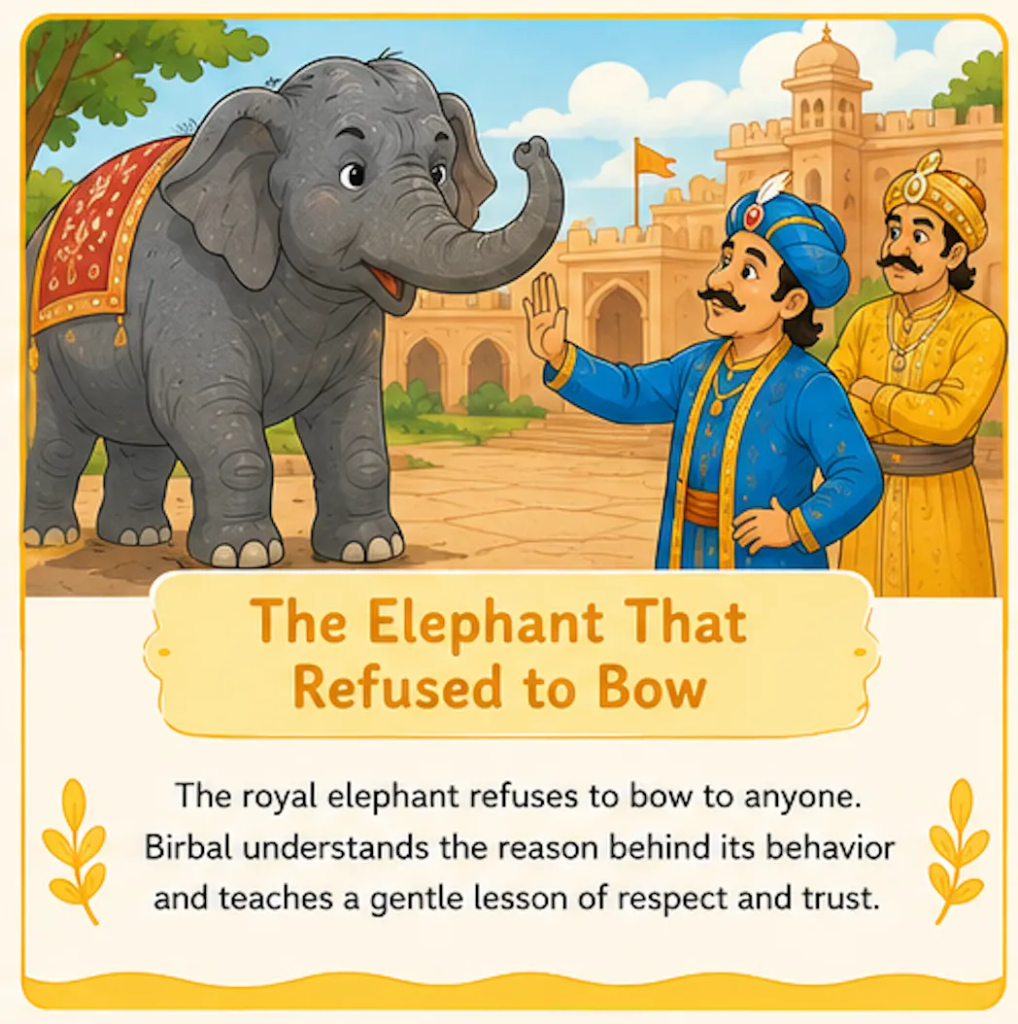
During a grand royal parade, Akbar noticed that the royal elephant, Gajraj, greeted everyone with a respectful bow. But when he reached one courtier, he refused to lower his head.
The courtier became angry and accused the elephant of being stubborn. Akbar asked Birbal to find the reason.
Birbal quietly questioned the elephant’s mahout. The mahout revealed that the courtier often teased the elephant and sometimes poked him with a stick when no one was watching.
Birbal explained the truth to Akbar. “Elephants have an excellent memory. Gajraj remembers both kindness and cruelty.”
The courtier felt ashamed and apologized. From that day onward, he treated all animals with respect. At the next parade, Gajraj happily bowed before him.
Akbar smiled and said, “Respect is earned through kindness.”
Moral: Treat every living being with kindness, and you will earn their respect.
The Greedy Merchant and the Royal Elephant
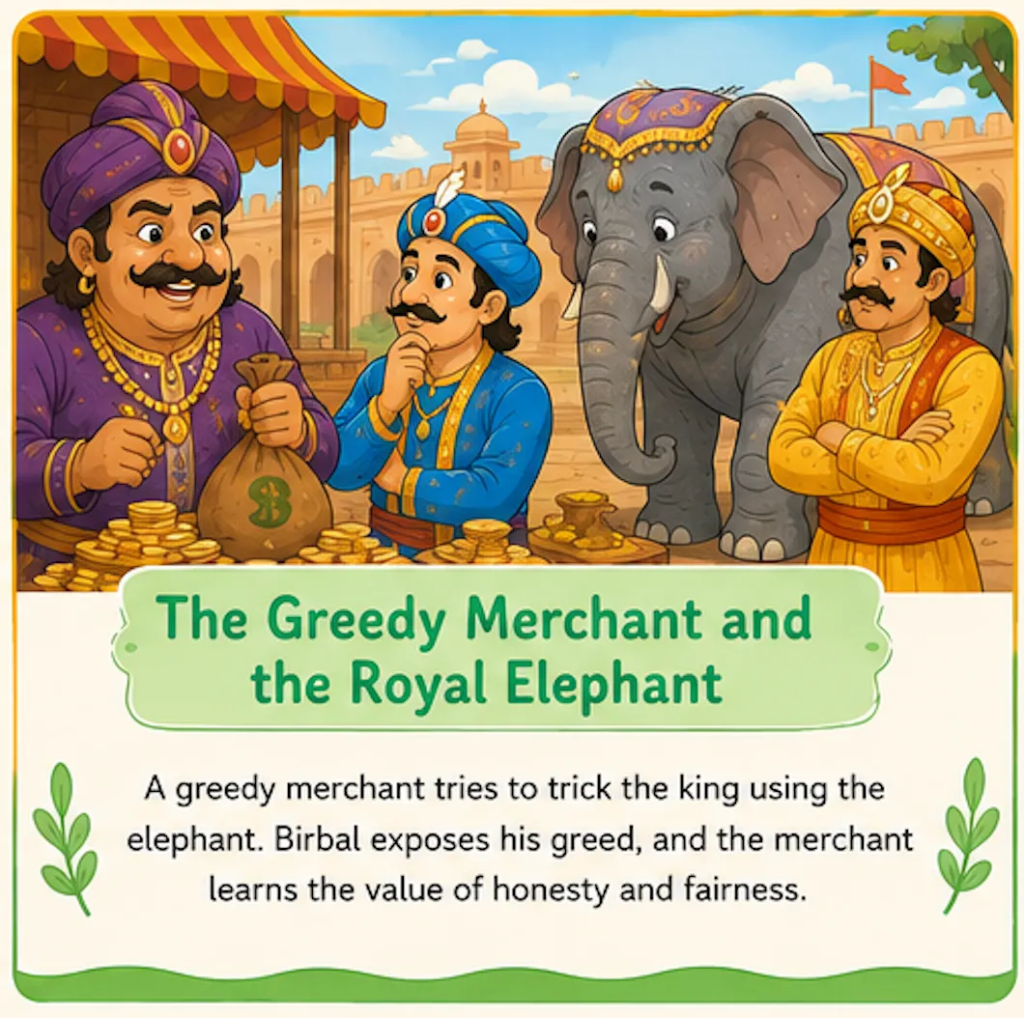
A rich merchant came to Emperor Akbar’s court with a clever plan. He offered expensive gifts and asked to borrow the royal elephant for a grand festival. His real intention was to charge people money to ride the famous elephant and earn a huge profit.
Akbar was unsure, so he asked Birbal for advice. Birbal agreed but secretly sent a palace guard to watch the merchant.
As expected, the merchant made people pay high fees while giving the elephant very little food or rest. The guard reported everything to Birbal.
The next day, Birbal presented the truth before Akbar. The emperor was disappointed and ordered the merchant to return all the money he had unfairly collected. He also made the merchant provide food and care for the elephant before leaving.
The merchant realized that greed had brought him shame instead of success.
Moral: Greed may bring quick gain, but honesty and kindness bring lasting respect.
Birbal Teaches Kindness Through an Elephant
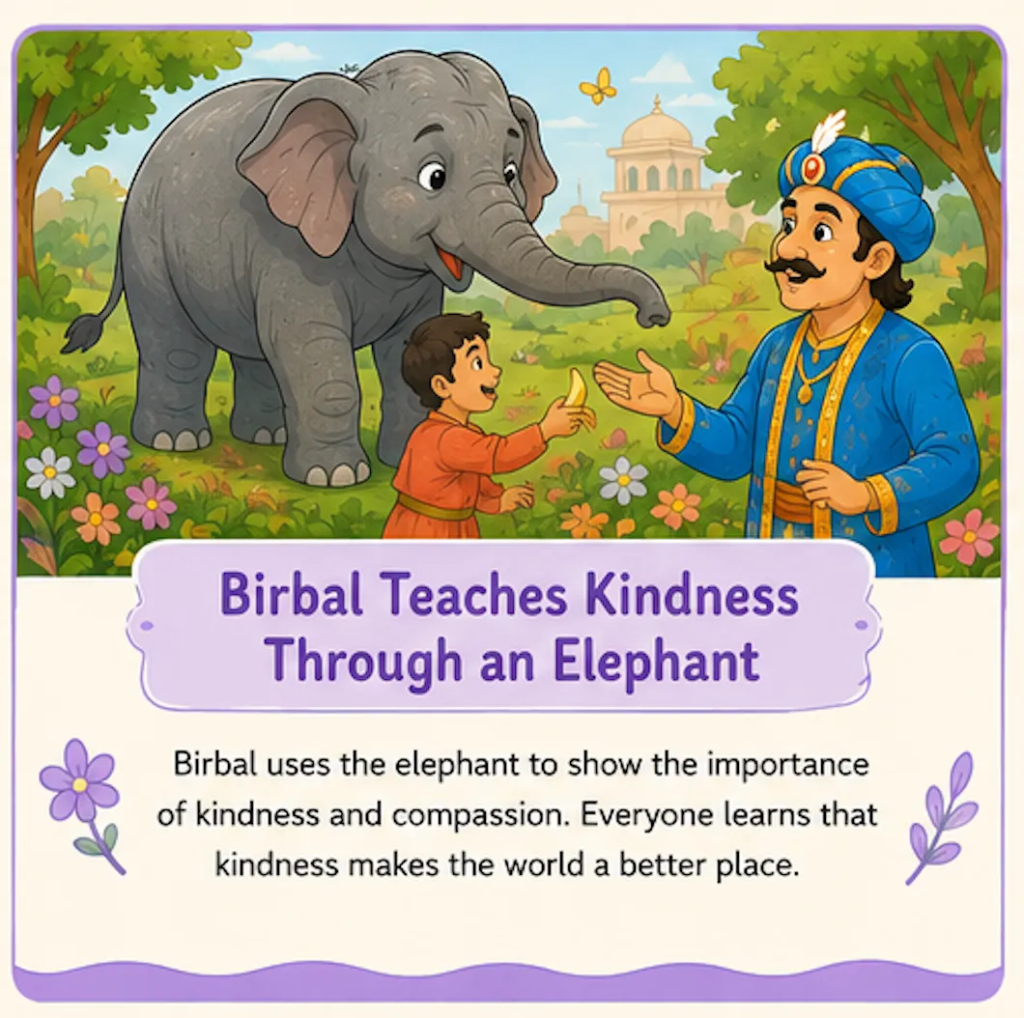
One day, Emperor Akbar noticed that some children in the palace were throwing small stones at the royal elephant, Gajraj, just for fun. Although the elephant stayed calm, Birbal knew this behavior had to be stopped.
The next morning, Birbal invited the children to the palace garden. He asked Gajraj’s mahout to feed the elephant with bananas. Gajraj happily accepted the fruit and then gently offered a flower to each child with his trunk.
The children were surprised. “We were unkind to him, but he is being kind to us,” one child said with tears in his eyes.
Birbal smiled and explained, “A kind heart does not return anger with anger. It teaches others through love.”
The children apologized to Gajraj and promised to treat all animals with care and respect.
Akbar praised Birbal’s lesson, saying that kindness has the power to change hearts.
Moral: Kindness inspires kindness and makes the world a better place.
The Elephant and the Broken Bridge
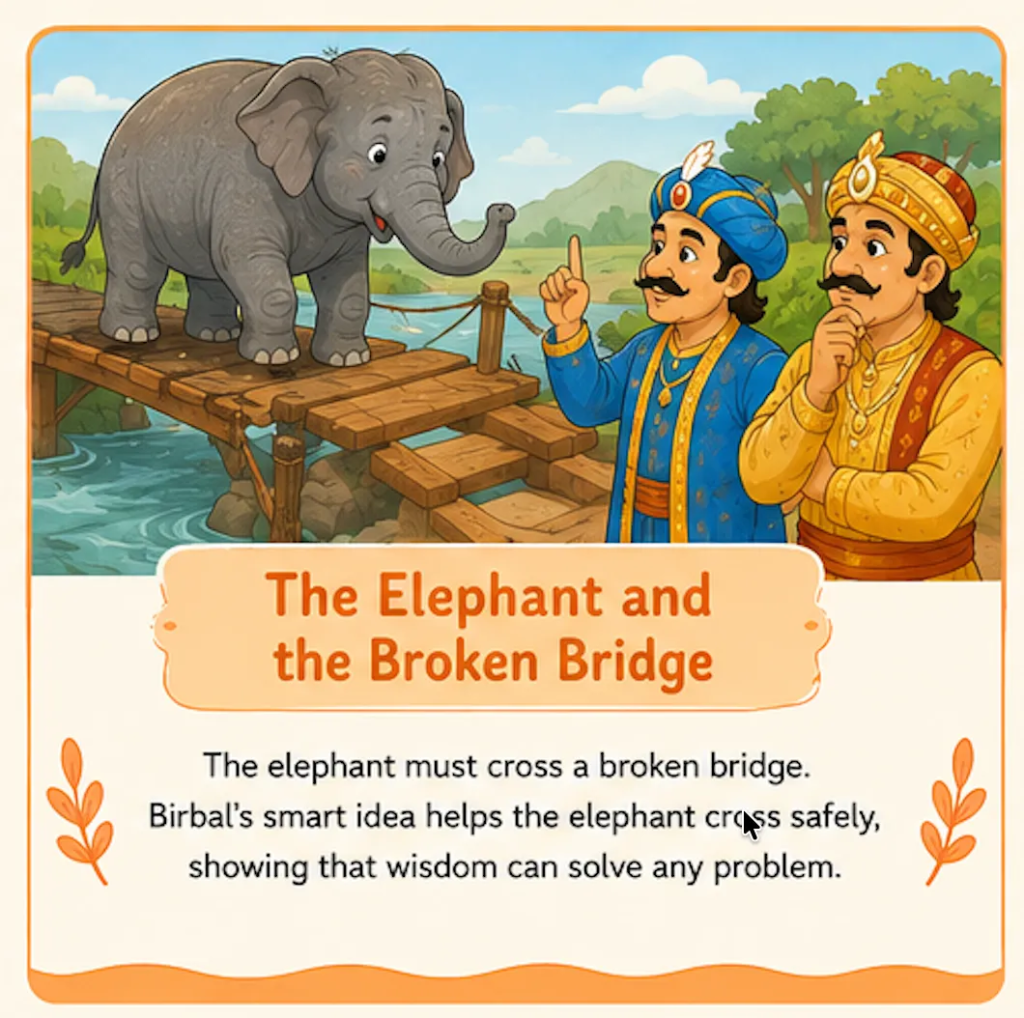
One rainy season, a wooden bridge near Emperor Akbar’s palace was damaged by heavy floods. The villagers could not cross the river to sell their crops or visit the market. Everyone worried about what to do.
Akbar asked Birbal for a solution. Birbal noticed that the royal elephant, Gajraj, was strong enough to help. Under the guidance of his mahout, Gajraj carried heavy logs and large stones to the riverbank. Skilled workers used these materials to repair the bridge.
Within a day, the bridge was safe again. The villagers crossed happily and thanked Akbar, Birbal, and Gajraj for their help.
Akbar smiled and said, “Strength becomes truly valuable when it is used to serve others.”
The people cheered for the gentle elephant, who had worked patiently without expecting any reward.
Moral: Use your strength and abilities to help others whenever you can.
Akbar’s Challenge: Count the Elephant’s Footsteps
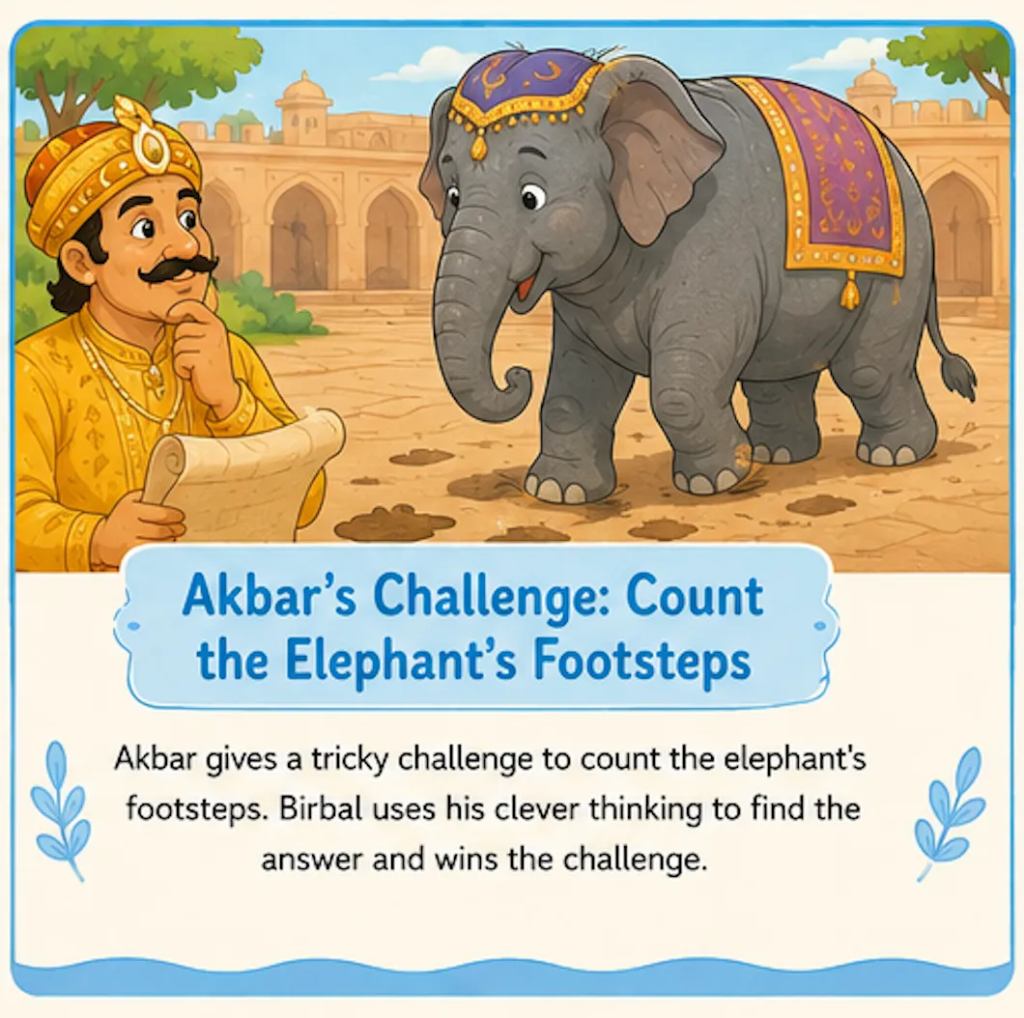
One day, Emperor Akbar asked his courtiers, “Can anyone tell me how many footsteps our royal elephant takes from the palace gate to the garden?” The courtiers argued, but no one knew the answer.
Birbal accepted the challenge. Instead of guessing, he asked the elephant’s mahout to walk Gajraj from the palace gate to the garden at a normal pace. Birbal carefully counted every step the elephant took.
When the elephant reached the garden, Birbal announced the exact number of footsteps. The courtiers were amazed.
Akbar smiled and asked, “How did you know the answer so quickly?”
Birbal replied, “Problems are solved by observation and action, not by arguments and guesses.”
Akbar praised Birbal’s practical thinking and rewarded him for his wisdom. The courtiers learned that even difficult questions become easy when approached with patience and the right method.
Moral: Careful observation and practical thinking lead to the correct solution.
The Wise Elephant and the Proud Soldier
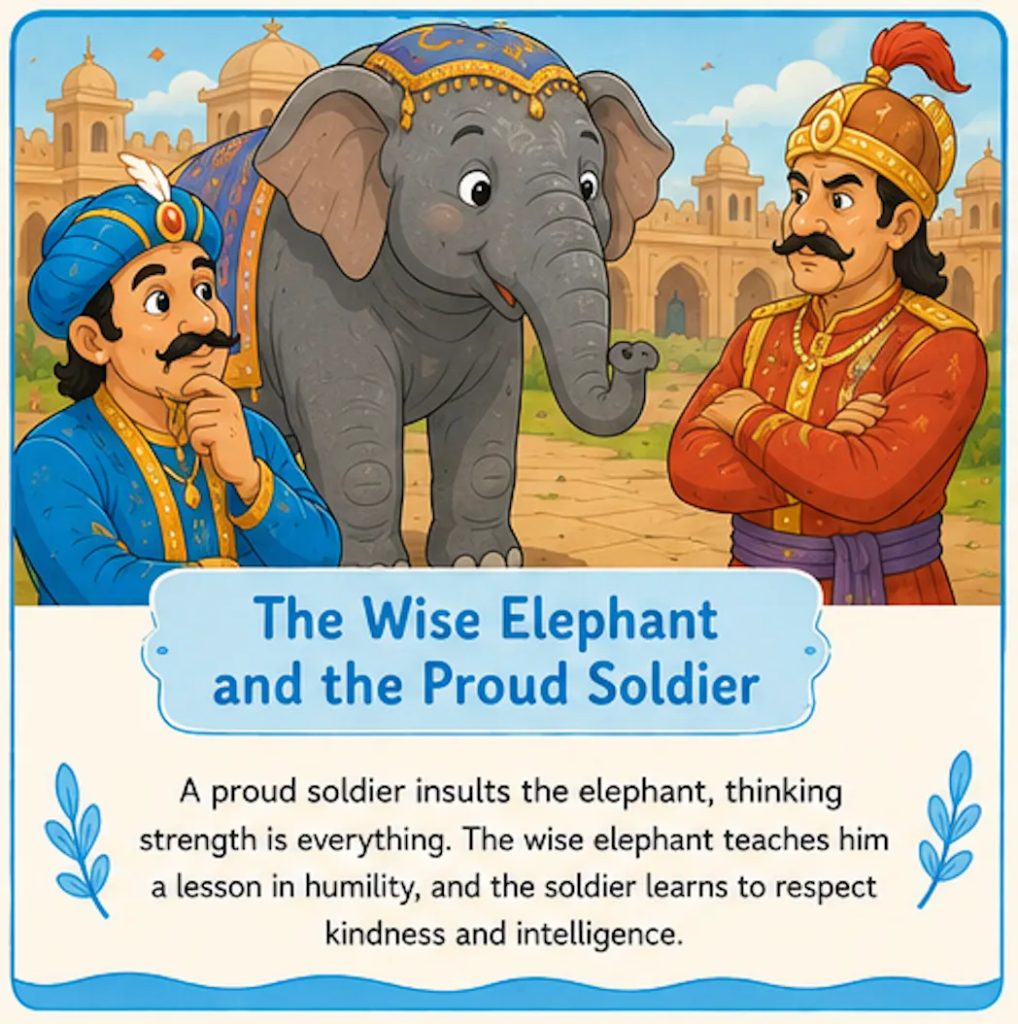
A brave soldier in Emperor Akbar’s army was proud of his strength. He often boasted, “No one is stronger or wiser than I am.” Hearing this, Birbal decided to teach him a lesson.
One day, the soldier was asked to lead the royal elephant, Gajraj, through a narrow palace gate. The soldier pulled the rope and shouted commands, but the elephant refused to move.
Birbal then called the elephant’s mahout. The mahout spoke gently, patted Gajraj’s trunk, and guided him calmly. The elephant obeyed at once and passed through the gate without any trouble.
The soldier was surprised. Birbal smiled and said, “Power alone cannot win hearts. Respect, patience, and understanding are far more effective.”
The soldier realized his mistake, apologized for his pride, and promised to treat both people and animals with kindness.
Moral: Humility and kindness are greater strengths than pride and force.
How Birbal Stopped an Elephant Race Argument
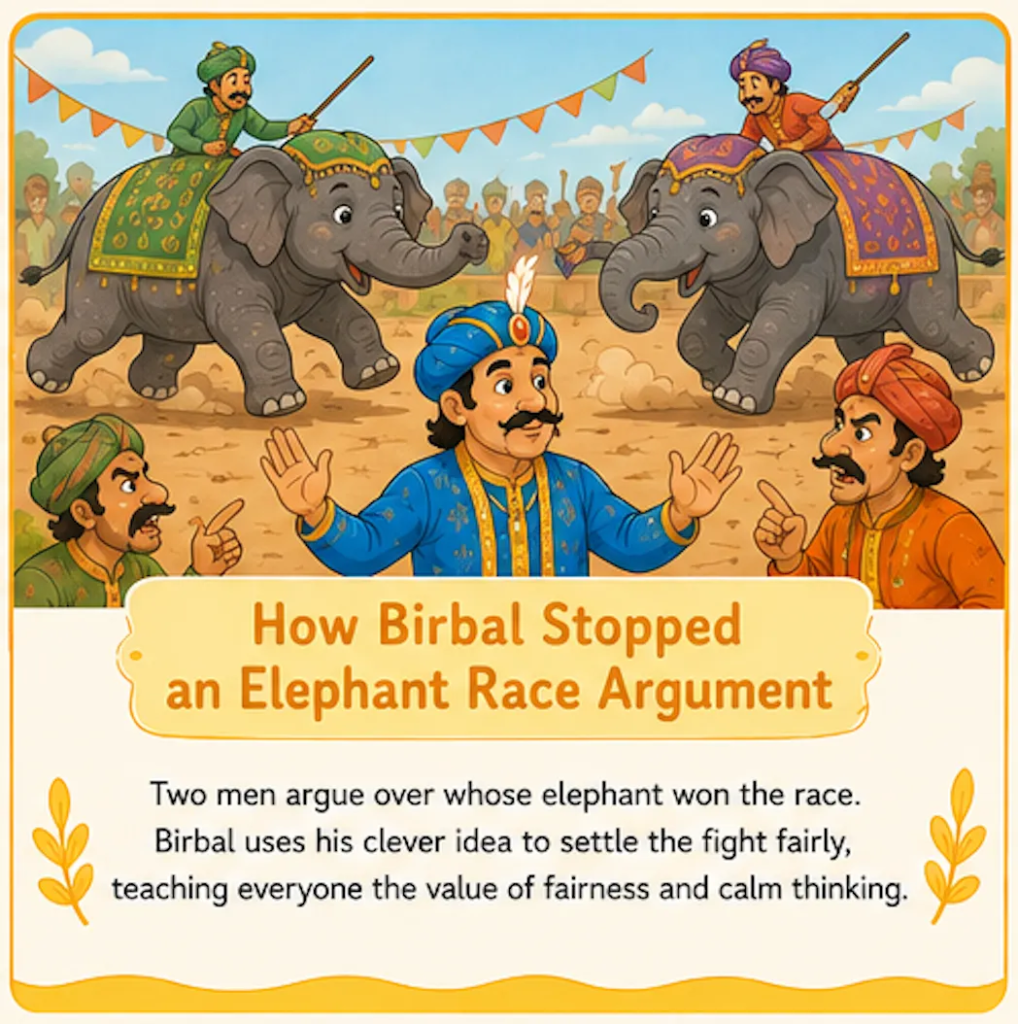
One day, Emperor Akbar organized a friendly elephant race for the royal festival. Two mahouts proudly claimed that their elephant was the fastest and deserved the winner’s prize. After the race, both insisted they had crossed the finish line first, and a loud argument began.
Akbar asked Birbal to settle the matter. Birbal calmly questioned the spectators, but everyone had a different opinion. Then he examined the finish line and noticed fresh footprints. He also asked the palace drummer when he had beaten the victory drum.
By matching the footprints with the drummer’s timing, Birbal discovered which elephant had truly crossed the line first. The honest winner was declared, and the other mahout accepted the decision.
Akbar praised Birbal for using facts instead of taking sides. The crowd cheered, and the race ended happily.
Moral: Fair decisions are made through careful observation and honesty, not arguments.
The Elephant That Remembered a Good Deed
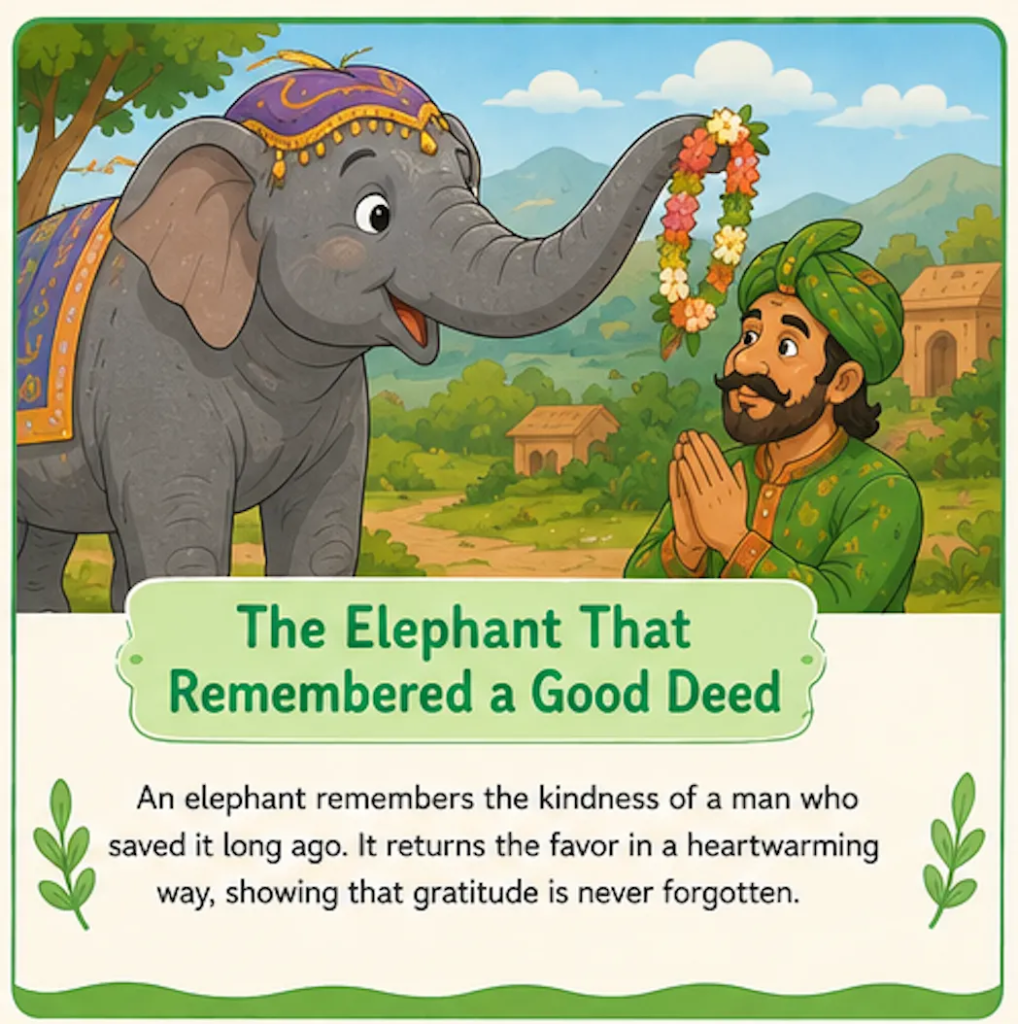
Many years ago, a young boy named Hari saw the royal elephant, Gajraj, with a painful thorn stuck in his foot. While others were afraid to go near the huge animal, Hari gently removed the thorn. Gajraj raised his trunk as if thanking the kind boy.
Years later, Hari visited Emperor Akbar’s palace as a gardener. One day, Gajraj saw him from across the courtyard. The elephant immediately walked toward Hari, gently wrapped his trunk around him, and happily trumpeted.
The palace guards were frightened at first, but Birbal smiled. “Do not worry,” he said. “Gajraj is greeting an old friend.”
Hari told everyone about the day he had helped the elephant. Akbar was amazed that Gajraj had remembered such a small act of kindness even after many years.
Akbar rewarded Hari and reminded everyone that no act of kindness is ever forgotten.
Moral: A single act of kindness can create a friendship that lasts a lifetime.
The Royal Elephant’s Birthday Surprise
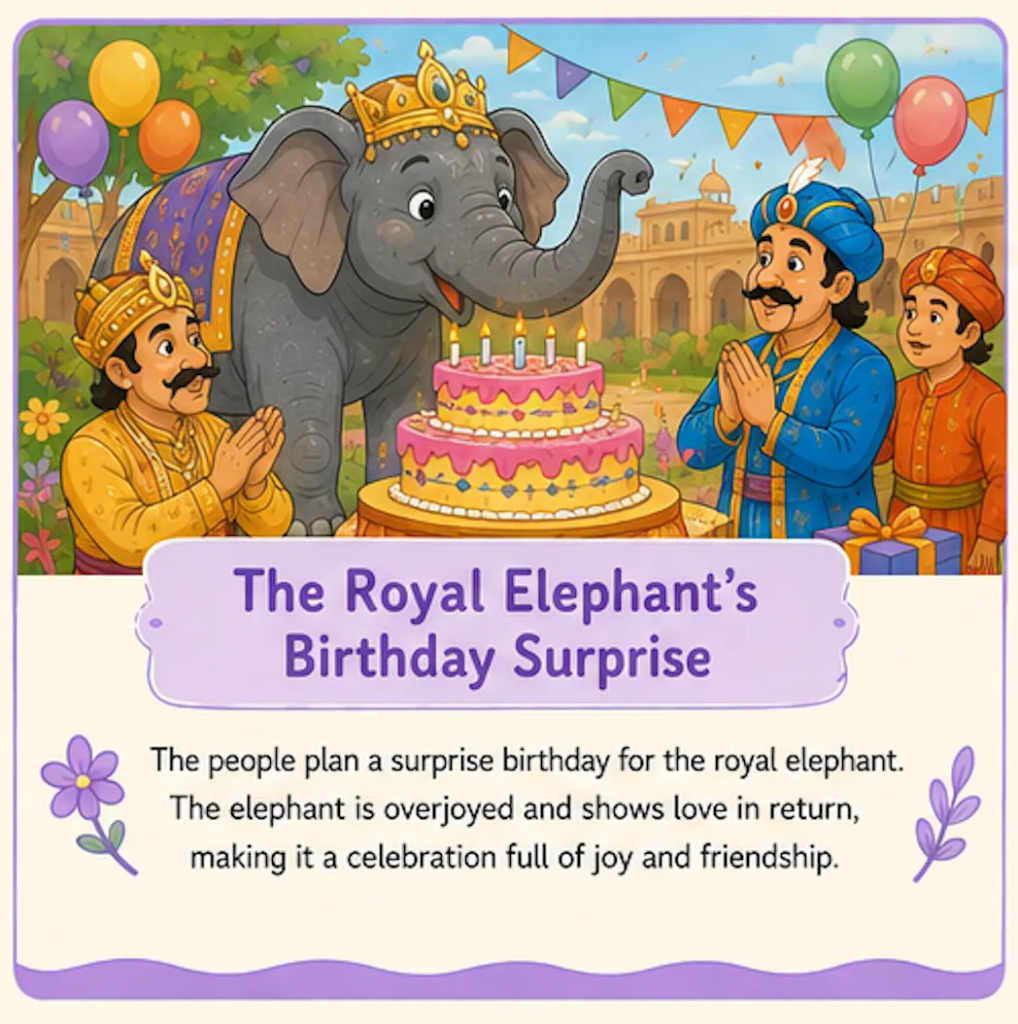
One morning, Birbal reminded Emperor Akbar that it was the royal elephant Gajraj’s birthday. Akbar decided to celebrate the occasion and invited the palace staff and nearby village children.
The children decorated Gajraj with colorful flower garlands instead of heavy ornaments. They sang cheerful songs while the palace cooks prepared his favorite treats—fresh bananas, sugarcane, and juicy watermelons. Gajraj happily trumpeted and gently accepted each gift with his trunk.
Birbal then suggested that everyone plant a tree in Gajraj’s honor. “This will be a gift that helps elephants, birds, and people for many years,” he said. Akbar loved the idea, and together they planted young trees around the palace.
The celebration ended with smiles, laughter, and a promise to protect nature and care for animals.
Akbar said, “The best celebrations are those that spread happiness to everyone.”
Moral: Celebrate with kindness, gratitude, and care for nature and all living beings.
Birbal Outsmarts a Trickster Using an Elephant
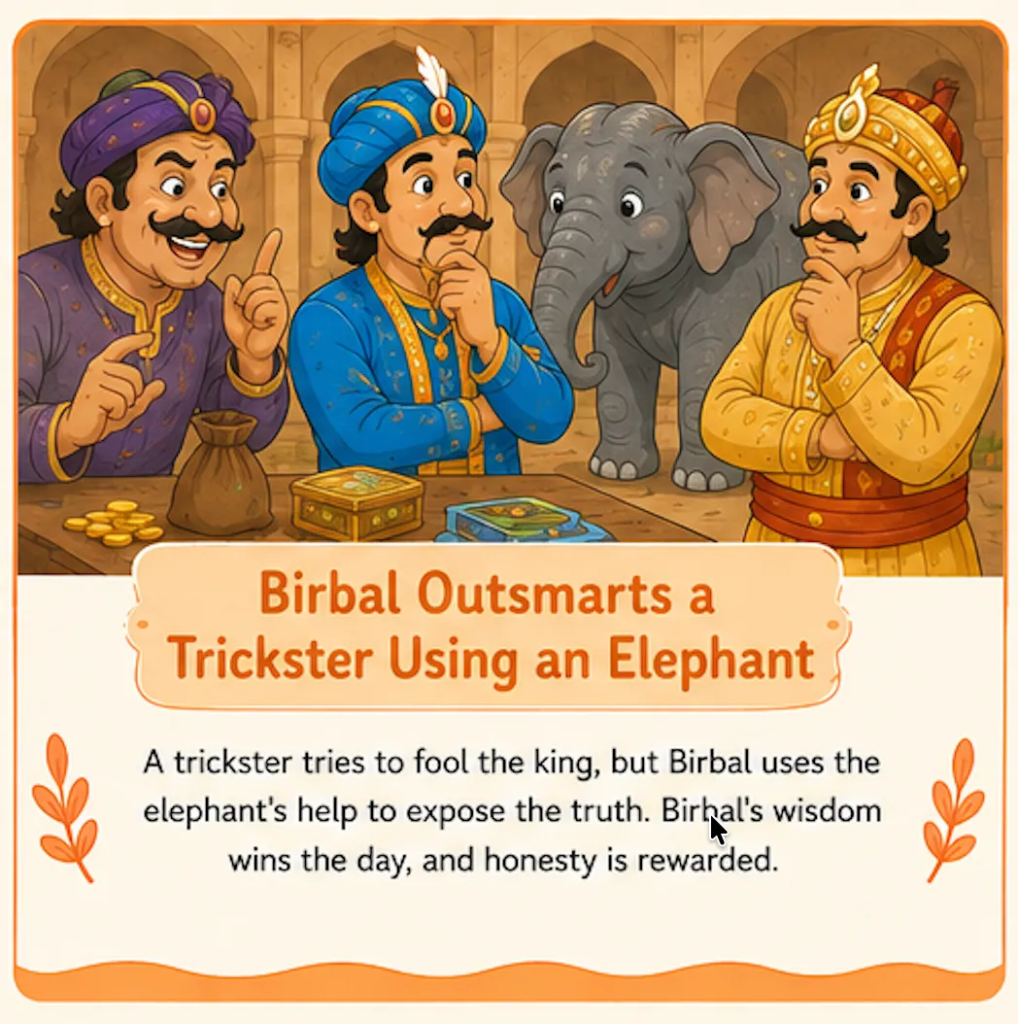
A clever trickster arrived at Emperor Akbar’s court claiming he could understand the language of elephants. He demanded a bag of gold, saying he would reveal the royal elephant’s secret thoughts.
Some courtiers believed him, but Birbal was suspicious. He whispered a plan to the elephant’s mahout. When the trickster stood before Gajraj, the mahout quietly gave the elephant a signal. Gajraj gently lifted the trickster with his trunk and placed him on a haystack nearby.
The frightened trickster shouted, “Please tell the elephant to put me down! I don’t understand what he is saying!”
The court burst into laughter. Birbal smiled and said, “If you truly understood elephants, you would have known what was about to happen.”
Ashamed, the trickster admitted he had lied to earn money. Akbar forgave him after he promised never to cheat people again.
Moral: Honesty is always wiser than pretending to know something you do not.
The Elephant Who Helped a Lost Child
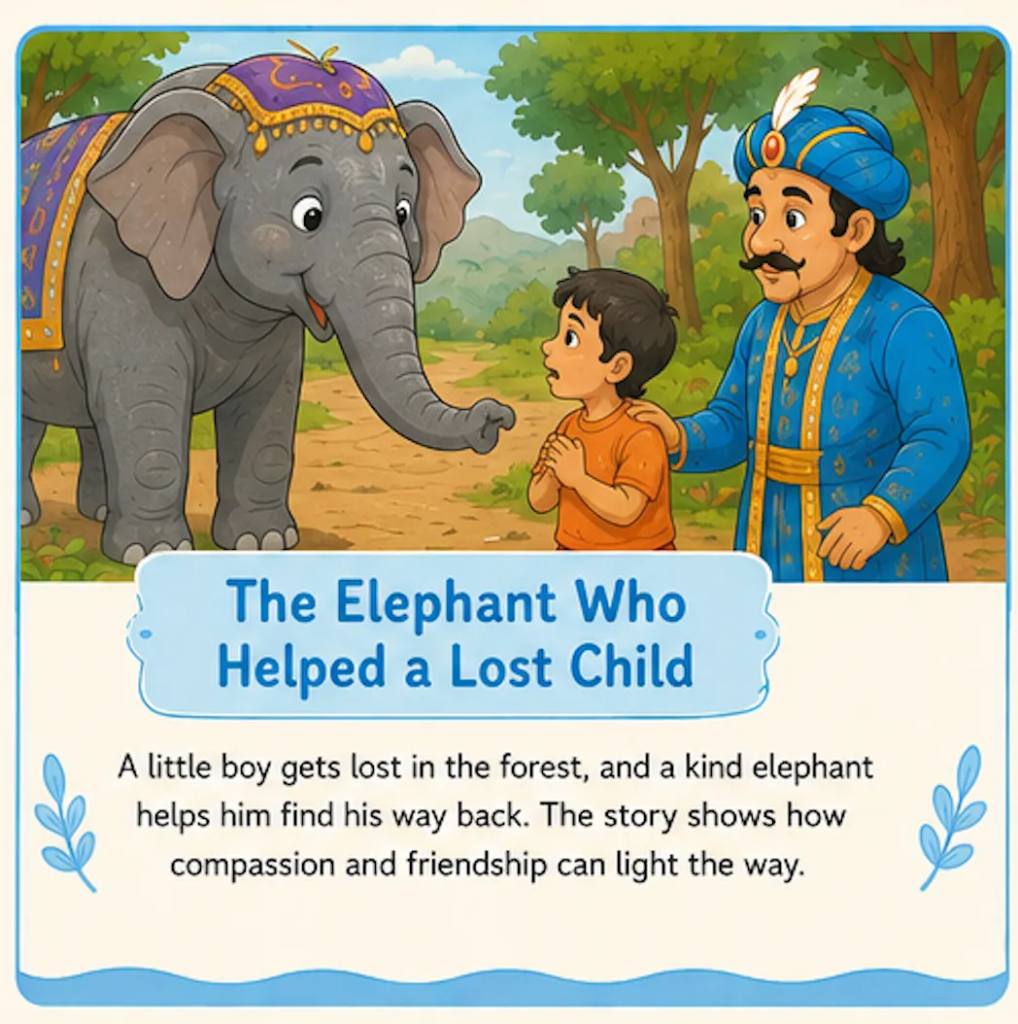
One busy market day, a little boy named Mohan became separated from his parents near Emperor Akbar’s palace. Frightened and crying, he wandered close to the royal elephant, Gajraj.
Instead of scaring the child, Gajraj gently touched Mohan’s shoulder with his trunk, as if comforting him. The elephant stayed beside the boy and would not let him wander away. Seeing this, the mahout informed Birbal.
Birbal asked the palace guards to announce that a lost child had been found. Soon, Mohan’s worried parents arrived. The little boy ran into their arms, and they thanked Gajraj for protecting him.
Akbar praised the gentle elephant and rewarded the mahout for taking such good care of him. Birbal smiled and said, “A kind heart helps others without expecting anything in return.”
Everyone applauded Gajraj, whose kindness had reunited a family.
Moral: Helping someone in need is one of the greatest acts of kindness.
Akbar Learns Why Every Elephant Is Different
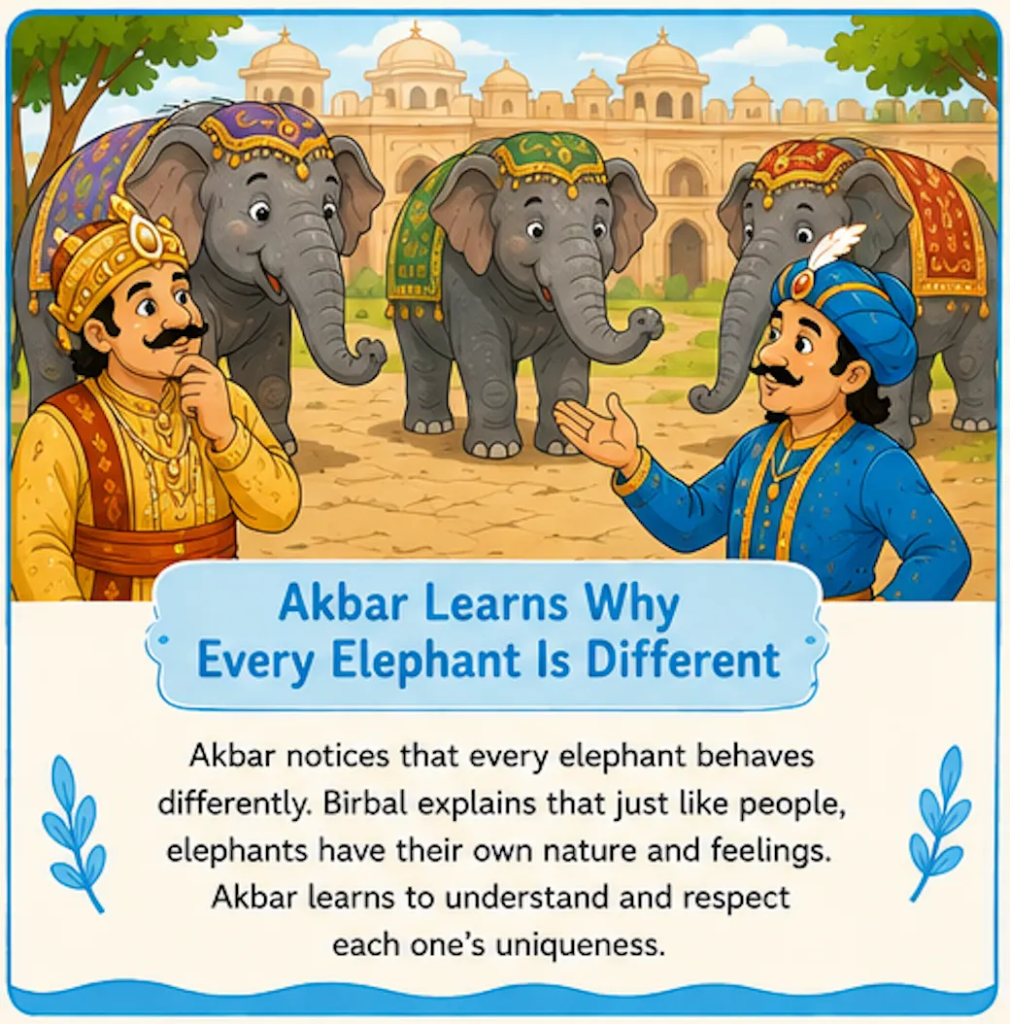
One day, Emperor Akbar noticed that one royal elephant loved carrying heavy logs, another enjoyed leading festival parades, and a young elephant preferred playing with children. Curious, he asked, “Why are they all so different?”
Birbal smiled and replied, “Let us watch them carefully.” For several days, they observed the elephants. Each one had its own nature, strengths, and favorite tasks. The strongest elephant worked well in construction, the calmest elephant carried royal guests, and the playful one brought joy to children.
Birbal said, “Just as people have different talents, animals do too. We should not expect everyone to be the same.”
Akbar understood the lesson. Instead of giving every elephant the same job, he assigned each one a role that matched its abilities. The elephants became happier, and the palace work was completed more efficiently.
Akbar thanked Birbal for another valuable lesson.
Moral: Everyone has unique talents, and respecting those differences helps everyone succeed.
The Elephant and the Basket of Mangoes
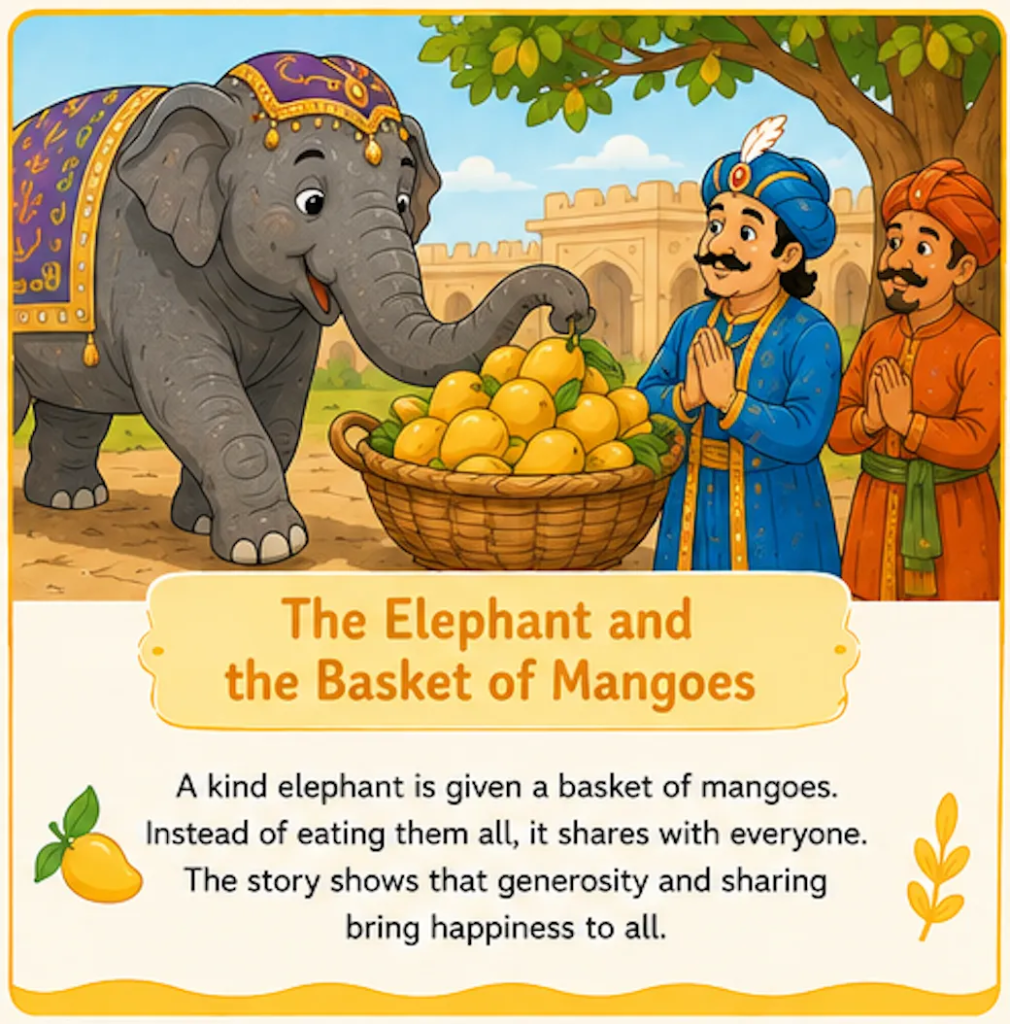
One summer afternoon, Emperor Akbar received a large basket of sweet mangoes as a gift. He asked the royal servants to carry it safely to the palace kitchen. On the way, the basket slipped from a servant’s hands, and the mangoes rolled across the courtyard.
The servants worried that the fruit would be crushed. Just then, the royal elephant Gajraj walked by. Instead of stepping on the mangoes, he carefully picked them up one by one with his trunk and gently placed them back into the basket.
Birbal, who had been watching, smiled and said, “See how carefully Gajraj uses his strength. Real power is guided by wisdom.”
Akbar praised the elephant and rewarded him with a few ripe mangoes for his thoughtful help. Everyone admired Gajraj’s gentle nature and learned that being careful is just as important as being strong.
Moral: True strength is shown by using power with care and wisdom.
Birbal’s Clever Plan to Rescue a Trapped Elephant
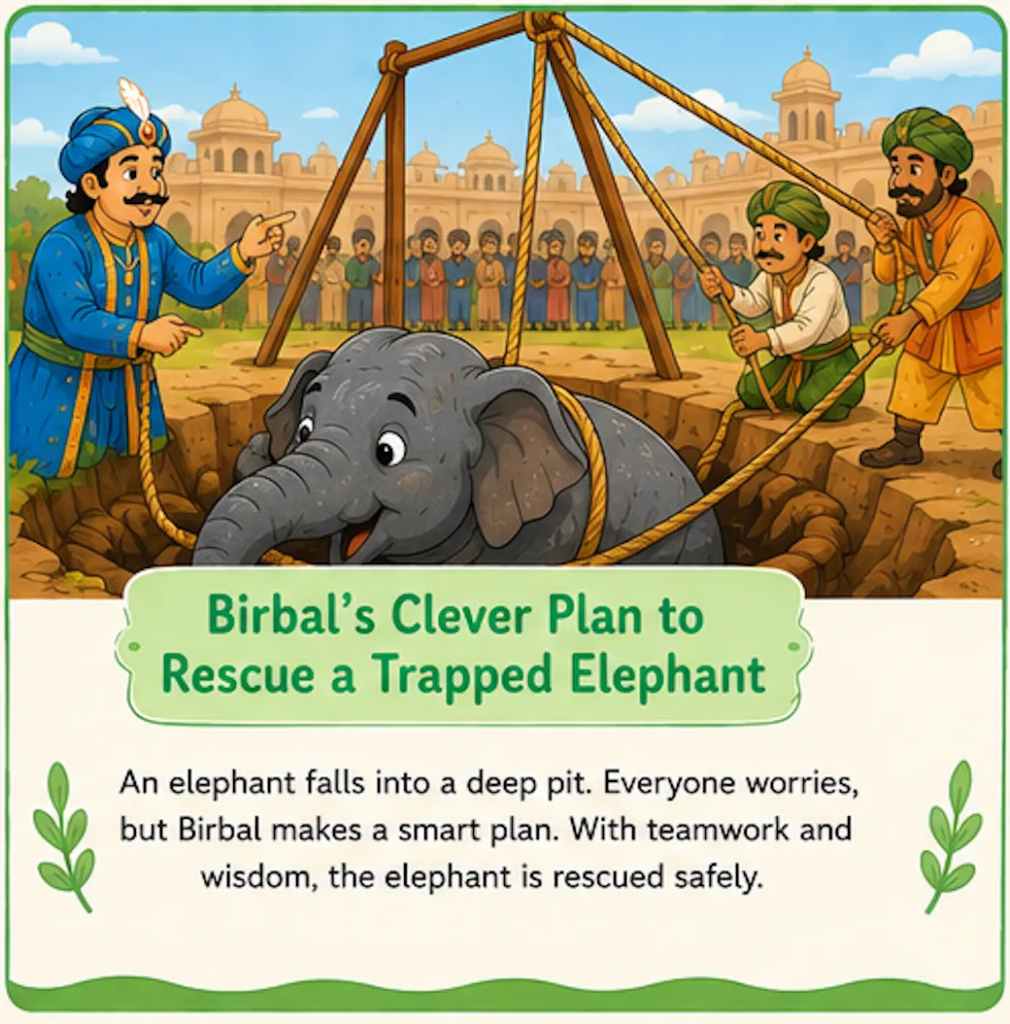
One morning, the royal elephant Gajraj accidentally slipped into a deep muddy pit while walking through the forest with his mahout. The more he struggled, the deeper he sank. The soldiers tried pulling him out with ropes, but nothing worked.
When Emperor Akbar heard the news, he asked Birbal for help. Birbal carefully looked at the pit and said, “Do not frighten the elephant. We must help him calmly.”
Birbal ordered the workers to fill one side of the pit with soil, stones, and wooden logs, creating a gentle slope. The mahout stood at the top, calling Gajraj in a soft, familiar voice. Feeling safe, the elephant slowly climbed up the slope and came out of the pit.
Everyone cheered with joy. Akbar praised Birbal for solving the problem with wisdom instead of force.
Moral: Patience, smart thinking, and teamwork can overcome even the biggest challenges.
The Honest Mahout and the Royal Elephant
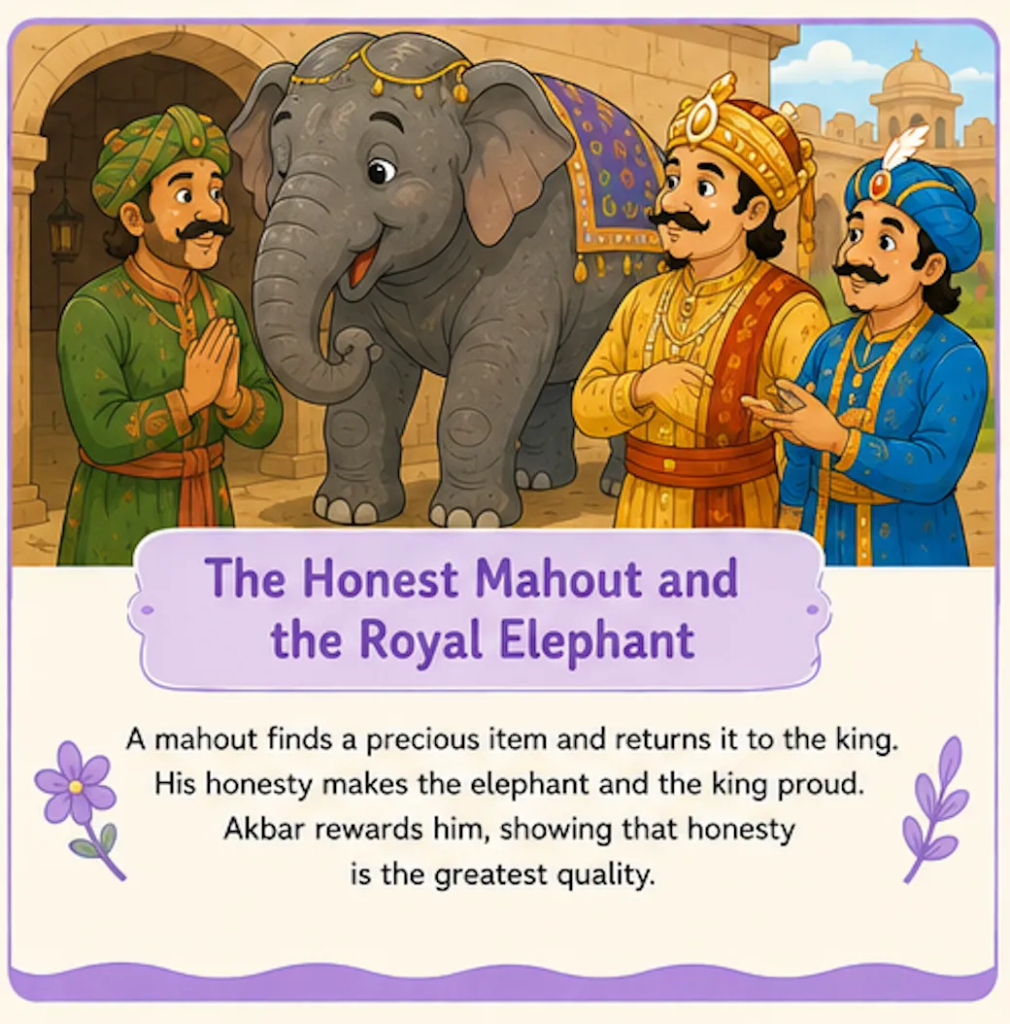
One day, Emperor Akbar gave the royal elephant’s mahout a pouch of gold coins to buy the finest food and medicine for Gajraj. On his way to the market, the mahout found another pouch filled with precious jewels lying on the road.
Instead of keeping it, the honest mahout took the pouch to Birbal and said, “This does not belong to me. Someone must be worried.”
Birbal announced the discovery throughout the city. Soon, an old trader arrived and correctly described the pouch and the jewels inside. Birbal returned it to him.
The grateful trader offered a reward, but the mahout politely refused. Akbar praised his honesty and rewarded him with a new robe and extra gold for his good character.
Gajraj gently touched the mahout with his trunk, as if thanking him for being a kind and truthful person.
Moral: Honesty always earns respect and brings true rewards.
The Elephant Who Taught the Value of Patience
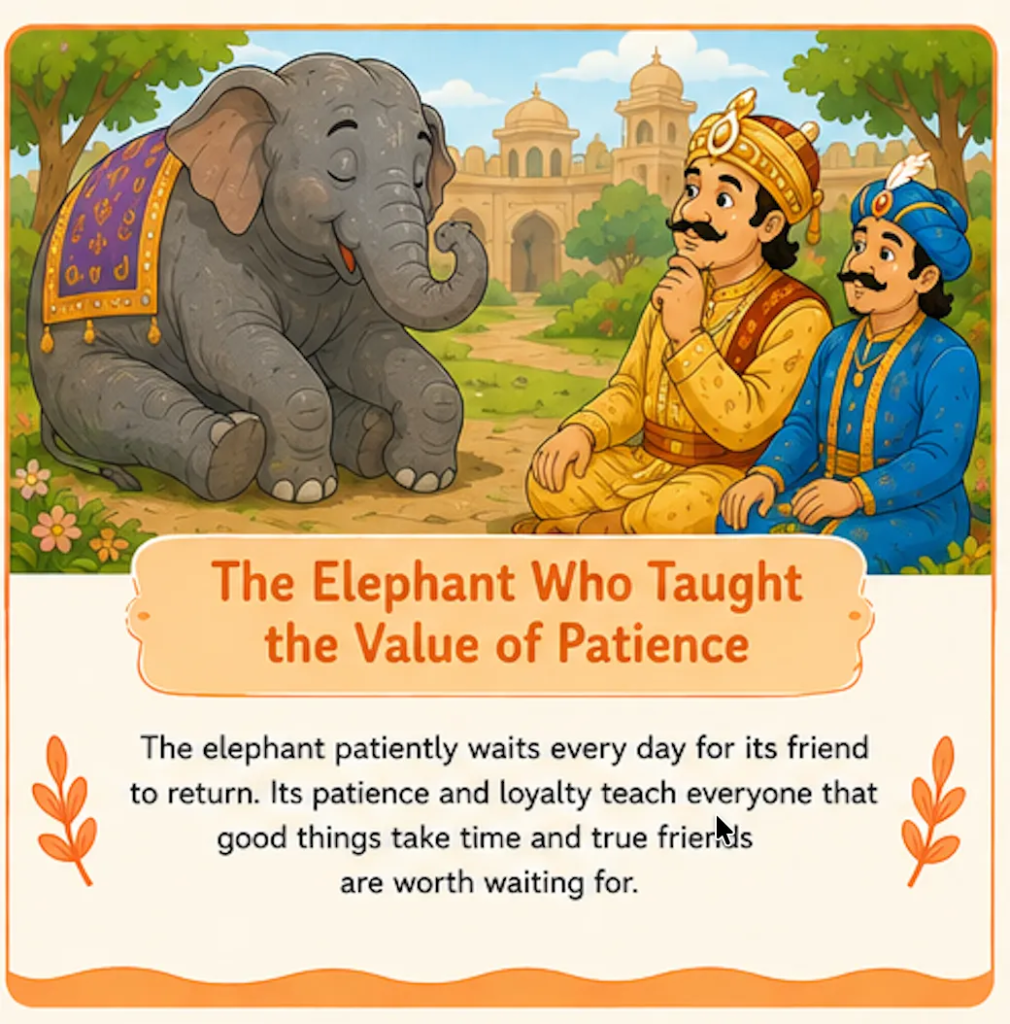
One hot afternoon, Emperor Akbar’s royal elephant, Gajraj, became very thirsty after a long journey. When he reached the village well, many people were already waiting to fill their pots with water.
Some palace guards wanted to push everyone aside for the elephant, but Birbal stopped them. “Let us see what Gajraj does,” he said.
To everyone’s surprise, the gentle elephant stood quietly under a shady tree and waited without making any noise. He did not frighten the villagers or demand to be served first. When everyone had filled their pots, the villagers happily brought buckets of water for Gajraj. The elephant drank peacefully and raised his trunk as if thanking them.
Akbar smiled and said, “Even the strongest can show patience.”
Birbal added, “Patience earns love and respect, while impatience often creates trouble.”
Everyone admired Gajraj’s calm behavior and learned an important lesson.
Moral: Patience brings respect, kindness, and better results than rushing.
Akbar and Birbal’s Lesson from the Kind Elephant
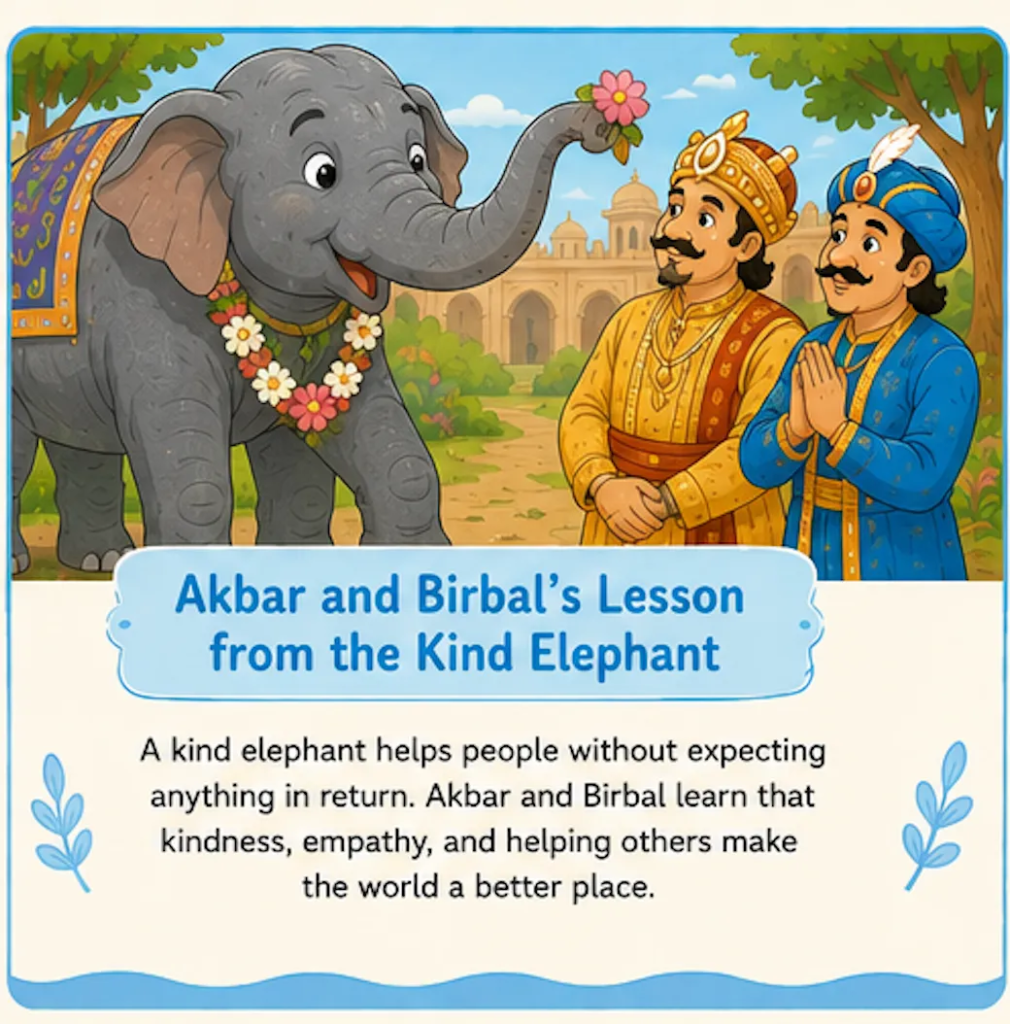
One day, Emperor Akbar and Birbal were walking through the royal gardens when they saw Gajraj, the royal elephant, carrying heavy logs for palace repairs. On the way, a tiny bird had built its nest on the path. Instead of stepping forward, Gajraj carefully stopped and gently moved around the nest without disturbing it.
Akbar was amazed. “Such a huge animal was careful not to harm a tiny bird,” he said.
Birbal smiled and replied, “True kindness is shown by those who protect the weak, even when they have the power to do otherwise.”
Akbar gathered the courtiers and shared what he had learned. “If a mighty elephant can show compassion to a small bird, we should also treat every person and every living creature with care and respect.”
From that day, everyone in the palace became more thoughtful toward animals and nature.
Moral: Real greatness is measured by kindness, compassion, and respect for all living beings.
40 simple vocabulary words that kids can learn from the Akbar and Birbal Elephant Stories
| Vocabulary | Simple Meaning |
|---|---|
| Emperor | A king who rules an empire |
| Court | The king’s royal hall |
| Palace | A king’s home |
| Royal | Belonging to the king |
| Elephant | A large land animal with a trunk |
| Mahout | A person who takes care of an elephant |
| Trunk | The long nose of an elephant |
| Tusk | A long, pointed tooth of an elephant |
| Gentle | Kind and calm |
| Brave | Showing courage |
| Courage | Strength to face fear |
| Patience | Waiting calmly |
| Kindness | Being caring and helpful |
| Friendship | A close and caring relationship |
| Loyalty | Staying faithful to someone |
| Honesty | Always telling the truth |
| Respect | Treating others politely |
| Wisdom | Good judgment and understanding |
| Clever | Smart and quick-thinking |
| Observe | To watch carefully |
| Clue | Something that helps solve a problem |
| Mystery | Something unknown or puzzling |
| Rescue | To save someone from danger |
| Protect | To keep someone safe |
| Trust | Believing someone is reliable |
| Gratitude | Being thankful |
| Compassion | Caring about others’ feelings |
| Helpful | Ready to help others |
| Teamwork | Working together |
| Responsibility | Taking care of duties |
| Greedy | Wanting more than needed |
| Humble | Not proud or boastful |
| Forgive | To stop being angry with someone |
| Celebrate | To enjoy a special event |
| Festival | A joyful celebration |
| Village | A small community |
| Garden | A place where plants and flowers grow |
| Journey | A trip from one place to another |
| Reward | A prize for good work |
| Moral | The lesson a story teaches |
These words help children improve their reading, speaking, writing, and comprehension skills while also learning values such as honesty, kindness, patience, courage, teamwork, empathy, and respect.
These Akbar and Birbal Elephant Stories (100–200 words each) are best suited for the following age groups and school classes:
| Age Group | School Class | Suitable? | Why |
|---|---|---|---|
| 4–5 years | Preschool, UKG | ⭐ With adult help | Simple stories can be read aloud with pictures. |
| 5–7 years | Class 1–2 | ⭐⭐⭐⭐⭐ Excellent | Short sentences, easy vocabulary, and clear moral lessons. |
| 7–9 years | Class 3–4 | ⭐⭐⭐⭐⭐ Excellent | Children can read independently and understand the lessons. |
| 9–11 years | Class 5–6 | ⭐⭐⭐⭐ Very Good | Useful for improving reading fluency, vocabulary, and values. |
| 11–13 years | Class 7–8 | ⭐⭐⭐ Good | Better for quick reading, moral education, and storytelling activities. |
Best Audience
- Primary Age: 5–10 years
- Best Classes: Class 1 to Class 5
These stories are ideal for:
- Bedtime reading
- Moral education
- English reading practice
- Vocabulary building
- Reading comprehension exercises
- Classroom storytelling
- Speech and recitation practice
- Parent-child reading sessions
- School library books
- Homeschool learning
Kids can learn patience from these Akbar and Birbal elephant stories in many simple ways:
- Waiting Calmly – Stories like The Elephant Who Taught the Value of Patience show that waiting without getting angry often leads to better results.
- Thinking Before Acting – Birbal solves problems by observing carefully instead of making quick decisions. Children learn to pause and think first.
- Controlling Emotions – In How Birbal Calmed the Angry Elephant, the elephant becomes calm with kindness, teaching children to control their feelings.
- Practicing Step by Step – In The Baby Elephant Who Was Afraid of Water, Chotu learns that courage grows slowly. Patience helps us improve little by little.
- Listening Carefully – Many stories show Akbar listening to Birbal before making a decision. Children learn that listening patiently helps them understand others.
- Never Giving Up – Stories like Birbal’s Clever Plan to Rescue a Trapped Elephant teach that difficult problems can be solved with patience and smart thinking.
- Being Kind While Waiting – The gentle elephant stays calm and respectful even when others are ahead, showing that patience and kindness go together.
- Understanding That Good Things Take Time – The stories remind children that learning, growing, and solving problems cannot always happen instantly.
Activities for Parents and Teachers
- Ask children, “Which character showed the most patience?”
- Discuss what happened because the character stayed calm.
- Encourage children to share a time when they waited patiently.
- Practice taking deep breaths before reacting when something goes wrong.
- Praise children whenever they show patience in daily life, such as waiting for their turn or finishing a task carefully.
These stories help children understand that patience is not just waiting—it is staying calm, thinking wisely, and doing the right thing even when it takes time.
How Kids Can Learn Moral Values from These Akbar and Birbal Elephant Stories
These stories teach important life lessons through simple characters, interesting situations, and meaningful endings. Here are some of the moral values children can learn:
- Honesty – Always tell the truth, even when it is difficult.
- Kindness – Be caring and helpful to people and animals.
- Patience – Stay calm and wait without getting angry.
- Respect – Treat everyone with politeness and dignity.
- Friendship – True friends are loyal, caring, and trustworthy.
- Courage – Face fears with confidence and never give up.
- Empathy – Understand and care about the feelings of others.
- Responsibility – Take good care of your duties and belongings.
- Gratitude – Be thankful for the help and kindness you receive.
- Teamwork – Working together makes difficult tasks easier.
- Humility – Stay humble and never be proud or boastful.
- Fairness – Make honest decisions without taking sides.
- Problem-Solving – Think carefully before making decisions, just like Birbal.
- Compassion – Protect and care for people, animals, and nature.
- Self-Control – Control your anger and emotions in difficult situations.
Tips for Parents and Teachers
- Read one story each day and discuss its moral.
- Ask questions such as, “What would you do if you were Birbal?” or “What did the elephant do that was kind?”
- Encourage children to apply one lesson in their daily lives, such as helping a friend or waiting patiently.
- Praise children when they show good values like honesty, kindness, or responsibility.
- Let children retell the story in their own words to reinforce the lesson.
These stories help children understand that good values are not just words—they are habits that make us kind, wise, and responsible people.
Conclusion
Every Akbar Birbal Elephant Story ends with a meaningful lesson that children can use in their everyday lives. Through Birbal’s wisdom, Akbar’s curiosity, and the gentle nature of the royal elephants, young readers learn that true strength comes from kindness, honesty, patience, and helping others. These short stories are enjoyable for children, parents, and teachers alike, making learning both fun and memorable. We hope these stories encourage kids to think wisely, act with compassion, and build good habits that will stay with them as they grow.
