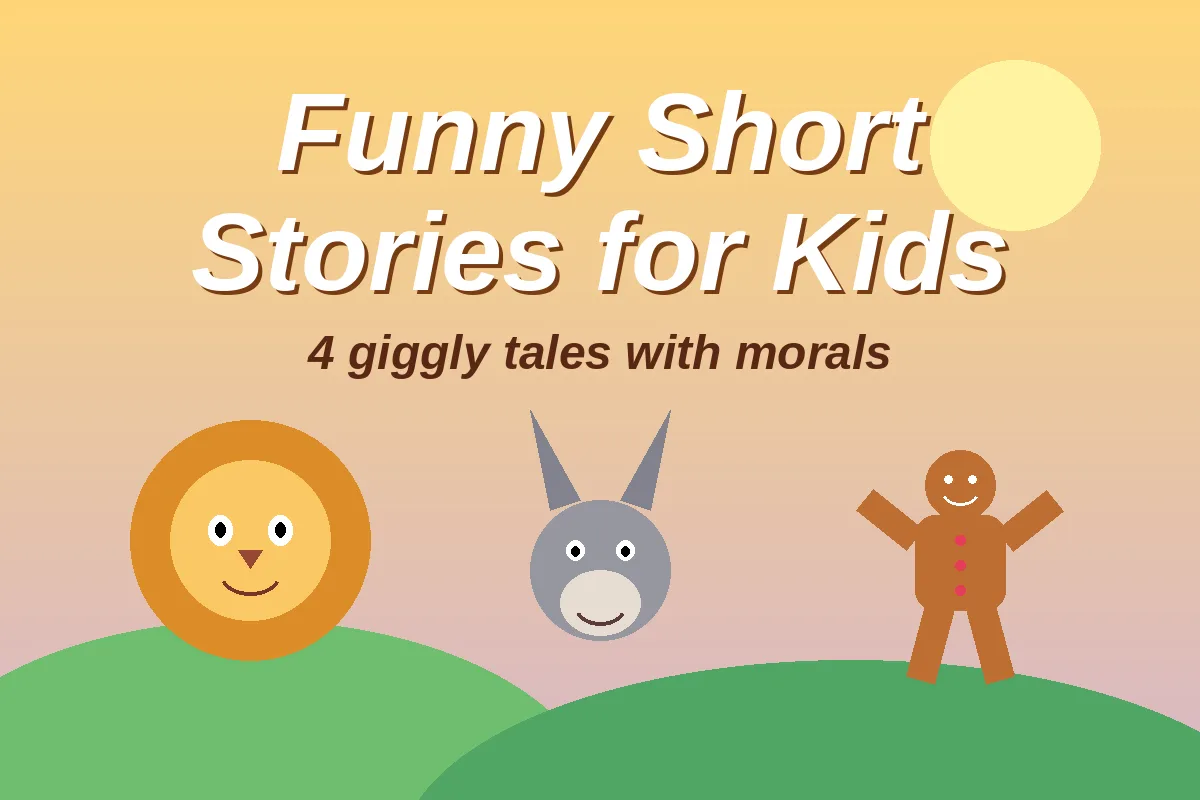
Everybody loves a good giggle, and a funny story is the quickest way to get one. This page has four funny short stories for kids, all retold in simple words so that a parent can read them aloud in a few minutes and a young reader can enjoy them alone. Each one comes from a well known folk tale or a fable that has made children laugh for hundreds of years.
If your little one likes a calmer tale before sleep, try our funny bedtime stories for kids. For clever and witty tales from India, read these funny Akbar and Birbal stories. You can also browse our short stories for kids in English and the easy short stories for kids for more reading fun.
Every story ends with a short moral, so the laughter always comes with a small lesson to talk about together. Let us begin with a donkey who wanted to be a lion.
The Donkey in the Lion’s Skin
Long ago, a washerman had a donkey who worked very hard every day. Each morning the donkey carried heavy bundles of clothes down to the river, and each evening he carried them home again. By night he was tired, and he was also hungry, because his master gave him very little to eat.
The washerman had an idea. One day he found an old lion skin lying near the forest. It was big and golden, with a thick mane. He draped it over his donkey’s back and said, “Now you will look so fearsome that no farmer will chase you away. Go to the green fields at night and eat as much as you like!”
That night the donkey walked out to a farmer’s field in his new coat. The farmers saw a huge shape moving between the crops, and they were frightened. “A lion!” they cried. “Run, run, run!” Nobody dared to go near him. The donkey ate and ate until his tummy was round like a drum.
Every night after that, the same thing happened. The donkey munched in peace, and the farmers hid in their houses. The donkey grew fatter, happier and very proud of himself. He began to hum little tunes as he chewed.
But one night, a clever farmer had a plan. He did not run. He crept to the edge of his field and watched the lion very closely. The lion did not roar. The lion did not hunt. The lion only chewed and chewed and hummed softly to himself, and the farmer thought, “That is a strange lion indeed.”
Then something wonderful happened for the farmer. In the dark, the donkey heard another donkey braying far away in the next village. He was so excited to hear a friend that he forgot everything. He lifted his head, opened his mouth wide and shouted, “Hee-haw! Hee-haw! Hee-haw!”
The farmer burst out laughing. “That is no lion! That is a donkey in a costume!” He called all his neighbours. They ran out with sticks and ropes, and the poor donkey galloped back to his master as fast as his legs could carry him. The lion skin fell off on the way, and his master had to wash a great many more clothes without him for a day.
The washerman scratched his head. “My dear donkey,” he said, “if you had stayed quiet, nobody would have known. But a loud bray always tells the truth.” The donkey hung his head, and the children of the village still laugh about him today.
Moral: Pretending to be someone you are not will never last. Sooner or later, the truth comes out, so it is best to be yourself.
The Gingerbread Man
Once upon a time, a kind old woman and her husband lived in a small cottage at the edge of a village. They had no children, and they often felt a little lonely. One rainy morning, the old woman said, “Today I shall bake a gingerbread boy to keep us company.”
She mixed flour, butter, sugar and ginger. She rolled the dough flat and cut out a little man with two arms, two legs, a round head and a happy smile. She gave him raisin eyes and three candy buttons down his tummy. Then she slid him into the warm oven and shut the door.
After a while, she opened the door to see if he was ready. Out jumped the gingerbread man, as quick as a cricket! He ran right across the kitchen floor and out of the open door, laughing as he went. “Run, run, as fast as you can! You can’t catch me, I’m the Gingerbread Man!”
The old woman and her husband ran after him, but they were far too slow. Soon the gingerbread man passed a cow in a meadow. “Stop, little man! I want to eat you!” mooed the cow. But the gingerbread man only giggled and sang, “I ran away from an old woman and an old man, and I can run away from you, I can!” Off he sped.
Next he passed a horse. The horse galloped after him, but he was left far behind in a cloud of dust. Then the gingerbread man ran through a field of busy farmers. They dropped their rakes and chased him too, but the gingerbread man was faster still. Behind him now ran a long line of people and animals, all puffing and panting.
At last he came to a wide, shining river. He could not swim, because he was made of cake, and he stopped with a gasp. A sly fox was sitting on the bank, and the fox smiled in the nicest way. “Don’t worry, little friend,” said the fox. “I will carry you across on my back. Hop on!”
The gingerbread man was nervous, but the chasing crowd was coming closer. He climbed on the fox’s tail. As the fox began to swim, the water got deeper. “Climb on my back, so you do not get wet,” said the fox. The gingerbread man did so. “The water is deep, so hop onto my nose,” said the fox. And the gingerbread man hopped onto the fox’s nose.
Snap! The clever fox tossed his head, opened his mouth, and that was the end of the gingerbread man. The fox licked his lips, and the crowd on the bank sighed and walked home.
Some people tell this tale with a gentler ending, where the gingerbread man is rescued at the last moment. Either way, the fun is in the chase and the cheeky song, which children love to chant along with the story.
Moral: Do not be too proud or too sure of yourself, and do not trust everyone who speaks sweetly. Listen carefully before you believe a stranger.
The Three Wishes
A woodcutter and his wife lived in a tiny house deep in a forest. They worked hard, but they were always a little poor, and they often grumbled about it. One day the woodcutter was chopping a huge old oak tree when he heard a tiny voice cry, “Please stop! Please do not cut this tree!”
Out of the trunk popped a small fairy with silver wings. “This tree is my home,” she said. “If you spare it, I will grant you three wishes, one for each time you speak to me again.” The woodcutter was delighted. He put down his axe and ran home to tell his wife the news.
That evening they sat by the fire, wondering what to ask for. Should they wish for a fine house? A bag of gold? A magic cow that gave sweet milk? They talked and talked, and the woodcutter’s tummy began to rumble. “Oh, I am so hungry,” he said with a sigh. “I wish we had a plump, juicy sausage for dinner right now.”
Pop! A long, sizzling sausage appeared on the table. The wife was furious. “You silly man!” she cried. “We had three wishes and you wasted one on a sausage! I wish it was stuck on the end of your nose, you foolish fellow!”
Whoosh! The sausage flew through the air and stuck to the woodcutter’s nose, hanging down like a long pink moustache. He pulled it and tugged it. He pushed it and twisted it. It would not budge. The wife could not help it. She began to giggle, and then she laughed until tears rolled down her cheeks.
The woodcutter looked so funny that he started laughing too. But soon they both stopped. They only had one wish left. They could wish for gold, but how would the woodcutter eat or kiss his wife with a sausage on his nose? They could keep the sausage and wish for riches, but what use is a fortune if you look so silly?
They thought for a long time. At last the woodcutter said softly, “My dear, I would rather have my nose back than any treasure in the world.” So they used the final wish, and the sausage dropped off with a plop onto the plate.
They had no gold and no fine house. But they cooked the sausage and shared it for dinner, and they laughed about their silly wishes for the rest of their lives. They also stopped quarrelling, and that was the best wish of all.
Moral: Think carefully before you speak or wish. Kind words and a happy heart are worth more than any treasure.
The Silly Lion and the Clever Rabbit
In a deep green jungle lived a mighty lion named Bhasuraka. He was very strong, but he was not very wise. Every day he hunted the poor animals of the forest, and soon they were all frightened and tired of running away from him.
One morning the animals held a meeting. “If this goes on, there will be none of us left,” said the old deer. “Let us make a deal. Each day we will send one animal to the lion’s den by ourselves. Then he need not hunt, and the rest of us can live in peace.” The lion agreed, and for many days one animal went to him each morning.
At last it was the turn of a small, quick rabbit. The rabbit did not want to be dinner. He walked very slowly to the den, taking his time, and he arrived late in the afternoon. The lion was roaring with hunger. “Why are you so late? And why did they send only a tiny rabbit?” he thundered.
The rabbit bowed low and answered in a shaky voice. “Oh, great king, it is not my fault. Five of us were coming to you, but on the way another lion jumped out. He said he is the true king of this jungle and that you are only a cheat. He took my four friends away!”
The lion’s mane stood on end. “Another lion? Show me where he lives, and I will teach him a lesson!” The rabbit led him through the trees to a deep, old well. “He hides in there, great king,” whispered the rabbit. “He is afraid of you now, so he stays in his fort.”
The lion marched up to the well and peered over the edge. Down in the water, he saw a fierce lion glaring right back at him. “Grrr!” said the lion. “Grrr!” said the echo from the well. The lion roared louder, and the echo roared louder too. The silly lion thought the other lion was making fun of him.
In a rage, he leaped into the well to fight his rival. Splash! The lion sank into the deep water, and he could not climb out. The rabbit danced all the way home and told the animals the good news. The jungle was safe again, and everyone cheered for the smart little rabbit.
Moral: Brains are stronger than muscles. A clever and calm mind can solve even the biggest problems.
What Kids Learn From Funny Stories
Funny stories are more than a quick laugh. When children giggle at a donkey in a costume or a sausage on a nose, they are also learning how to think about choices and their results. Here are some of the best lessons from the four tales above:
- Be yourself. The donkey was happy until he pretended to be something else, and then his bray gave him away.
- Do not trust sweet talk too quickly. The gingerbread man should have asked himself why the fox was being so friendly.
- Think before you speak. The woodcutter and his wife wasted two wishes because they spoke in a hurry.
- Use your brain. The little rabbit beat the big lion with a clever idea instead of strength.
- Laugh together. A shared joke can end an argument and bring a family closer.
After reading, you can ask your child a few easy questions. Which part was the funniest? What would you have done in the donkey’s place? What would you wish for if you had three wishes? These talks turn story time into a lovely chance to learn.
For more animal tales with morals, visit our animal stories for kids page, and for more lessons in short form, try the moral stories for kids in English.
Tips for Reading Funny Stories Aloud
A funny story comes alive when you read it with feeling. These small tricks help parents and teachers make the laughs bigger:
- Use a different voice for each character. A deep growl for the lion and a squeaky voice for the rabbit always works.
- Pause before the punchline. A short silence makes the funny part even funnier.
- Add sound effects. Say hee-haw, plop and splash loudly, and let your child join in.
- Let your child finish the famous lines. In the gingerbread tale, kids love to shout the song.
- Keep it short. Funny stories work best in five minutes or less, so everyone stays happy.
Frequently Asked Questions
What makes a short story funny for kids?
Children laugh at surprise, silly mistakes, funny sounds and clever tricks. A character who gets caught in a harmless, silly situation, like a donkey in a lion costume, is perfect for young readers.
Which age group are these funny short stories for?
These stories suit children from about 4 to 10 years old. Younger kids enjoy hearing them read aloud, and older kids can read them on their own and talk about the morals.
Are these stories original?
They are original retellings in our own words of well known folk tales and old fables that belong to everyone. The characters and the main events are traditional, but the writing is new.
How can I use these stories at home or in class?
Read one story a day, then ask your child to retell it and say the moral in their own words. Teachers can also ask students to act out a story or draw their favourite scene.
Final Thoughts
Funny stories fill a home with laughter, and the best ones also leave a small thought behind. The donkey teaches us to be ourselves, the gingerbread man reminds us to be careful, the woodcutter shows that wishes need thought, and the rabbit proves that a clever mind beats a loud roar.
Read one of these tales tonight, and see which one makes your family giggle the most. For more reading fun, explore the rest of our story collection on How Creator, and come back often, because new tales are always on the way.
