Akbar Birbal funny stories are a wonderful combination of humor, wisdom, and valuable life lessons that children and adults have enjoyed for generations.
These entertaining tales feature Emperor Akbar and his clever advisor, Birbal, who use intelligence, quick thinking, and kindness to solve funny problems in the royal court.
From mischievous monkeys and talking parrots to clever tricks and hilarious misunderstandings, every story keeps young readers engaged while teaching important values.
These stories are written in simple language, making them perfect for bedtime reading, classroom activities, and family storytelling.
They help children improve their reading skills, expand their vocabulary, and understand morals in a fun and memorable way.
24 Best Akbar Birbal Funny Stories for Kids with Moral
Birbal and the Talking Parrot
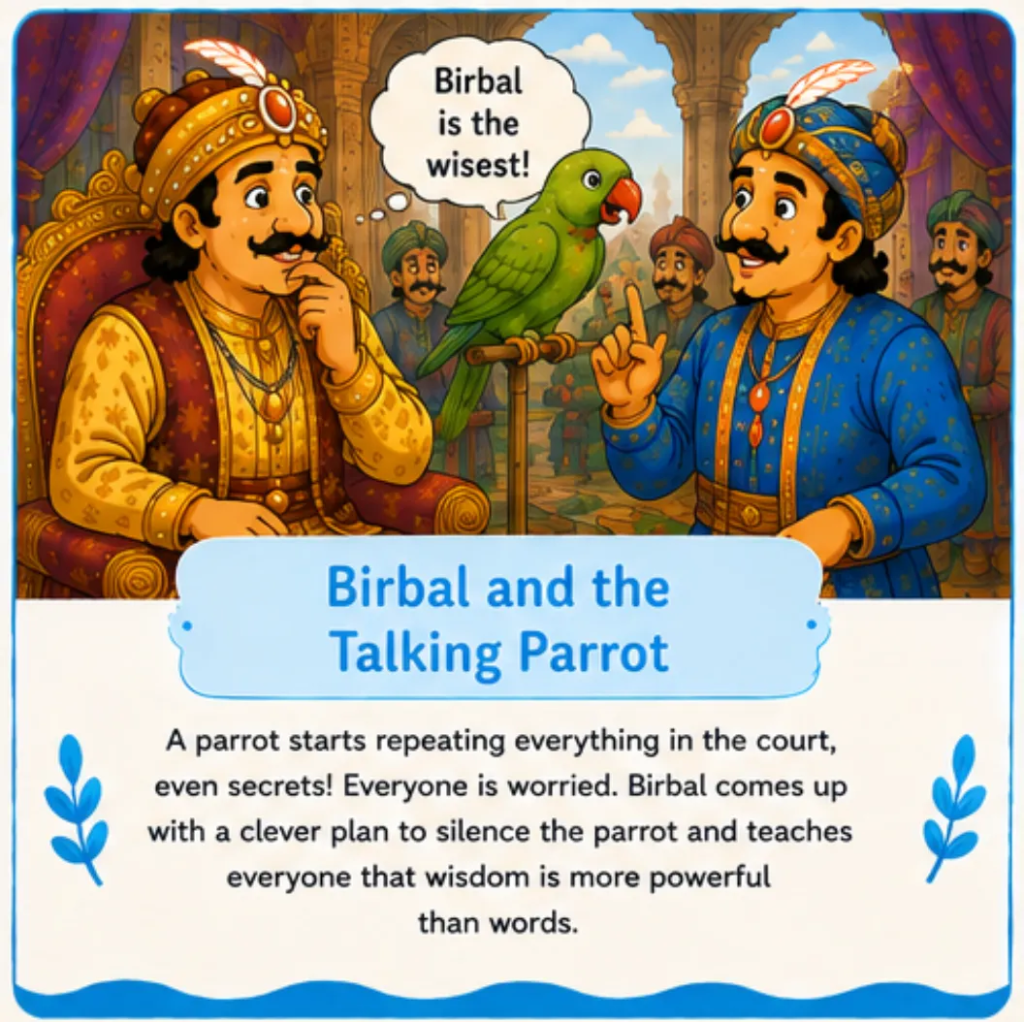
One morning, Emperor Akbar received a bright green parrot as a gift. The bird surprised everyone because it could repeat almost anything it heard. Soon, the parrot began copying the voices of the palace guards, ministers, and even Akbar himself. Whenever someone spoke proudly, the parrot repeated their words in a funny way, making the whole court burst into laughter.
One day, a minister proudly announced, “I am the wisest man in the kingdom!” The parrot quickly squawked, “The wisest? Are you sure?” Everyone laughed, and the minister turned red with embarrassment.
Akbar wondered if anyone could stop the mischievous bird. Birbal smiled and gently taught the parrot a new sentence: “Kind words make happy hearts.” From then on, whenever someone argued or boasted, the parrot repeated those cheerful words instead. The palace became a happier place, and even the proud minister learned to laugh at himself.
Moral: A little humor mixed with kindness can teach valuable lessons and bring people closer together.
Akbar’s Funny Beard Challenge
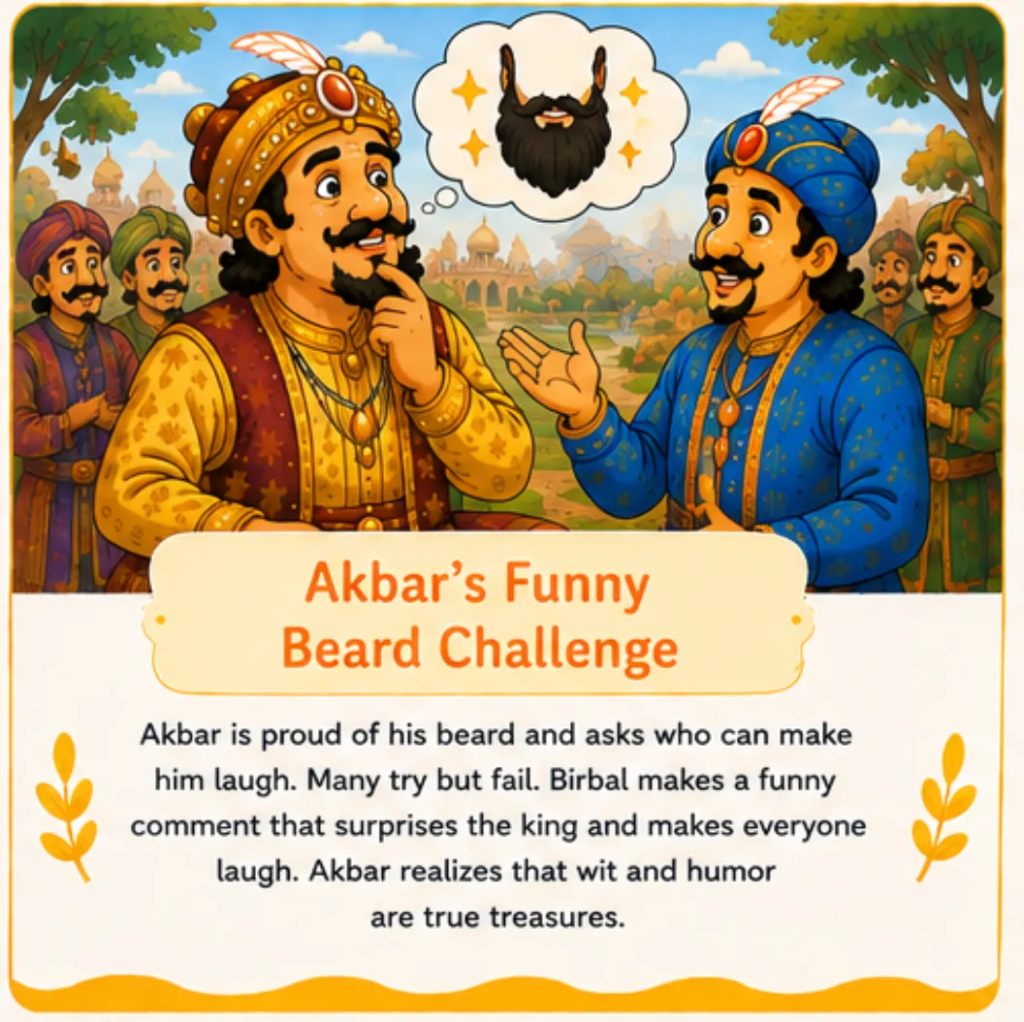
One day, Emperor Akbar looked at his long, well-kept beard in the royal mirror and jokingly asked, “Who among you can make me laugh without touching my beard?” The courtiers eagerly tried. One told jokes, another made funny faces, and a third danced around the court. Akbar smiled a little but did not laugh.
Then Birbal stepped forward with a small comb. He bowed and said, “Your Majesty, your beard is so royal that even the comb is afraid to touch it without permission!” Akbar chuckled.
Birbal continued, “If your beard grows any longer, we may have to appoint it as the newest minister because it already looks wiser than all of us!” The entire court burst into laughter. Even Akbar laughed so hard that tears rolled down his cheeks.
Akbar happily declared Birbal the winner of the challenge and rewarded him with a bag of gold coins.
Moral: A clever joke shared with respect can spread happiness and brighten everyone’s day.
Also Read
The Royal Pillow Mystery
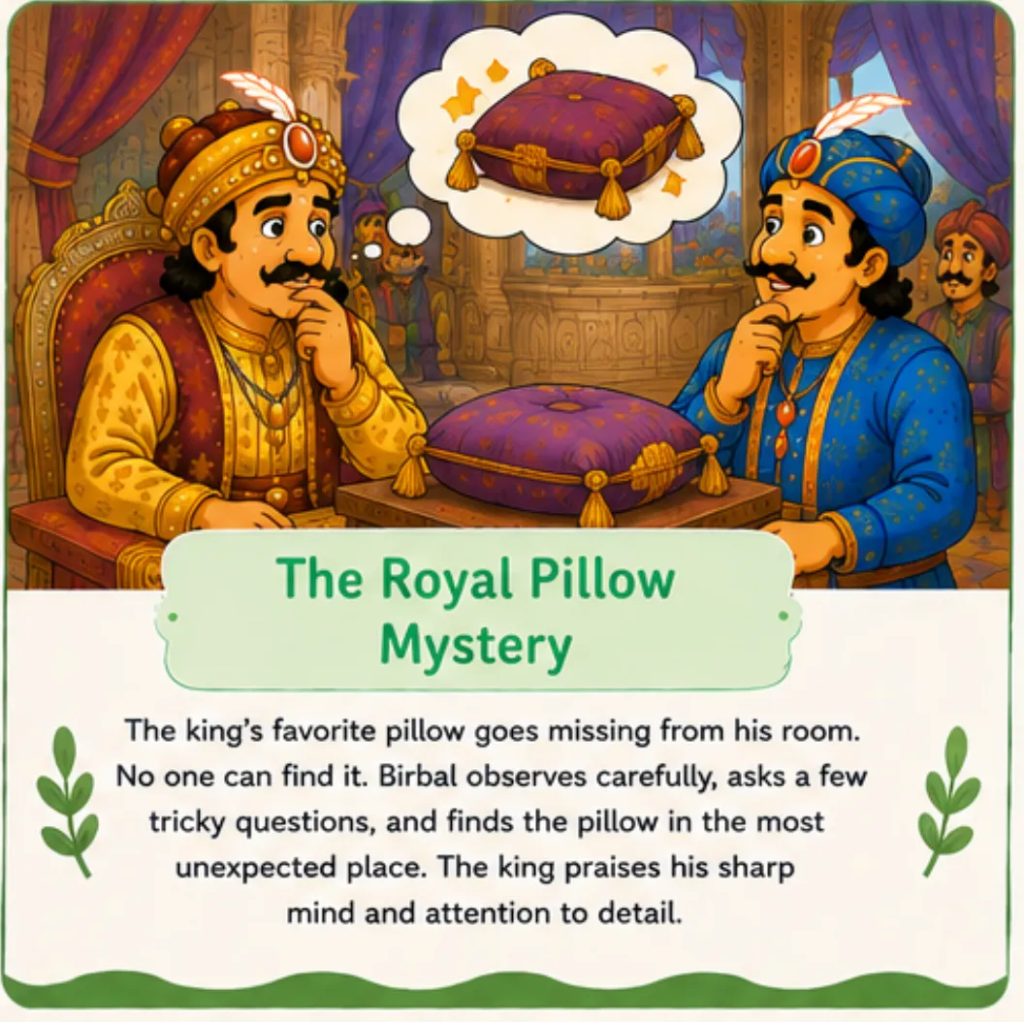
One morning, Emperor Akbar woke up and discovered that his favorite silk pillow had disappeared. The palace guards searched every room, but they could not find it. Soon, everyone in the royal court began making wild guesses. One minister blamed the palace cat, while another suspected the servants. The more they argued, the funnier the situation became.
Akbar asked Birbal to solve the mystery. Birbal quietly looked around the royal bedroom and noticed a trail of tiny white feathers leading toward the garden. He followed the feathers and found two playful monkeys happily jumping from tree to tree with the soft pillow. They had pulled it apart to make a cozy nest.
The guards carefully collected the pillow, and everyone laughed at the mischievous monkeys. Akbar praised Birbal for observing the smallest clues instead of making careless accusations.
Moral: Careful observation and calm thinking can solve problems better than making quick guesses.
Birbal and the Missing Mangoes
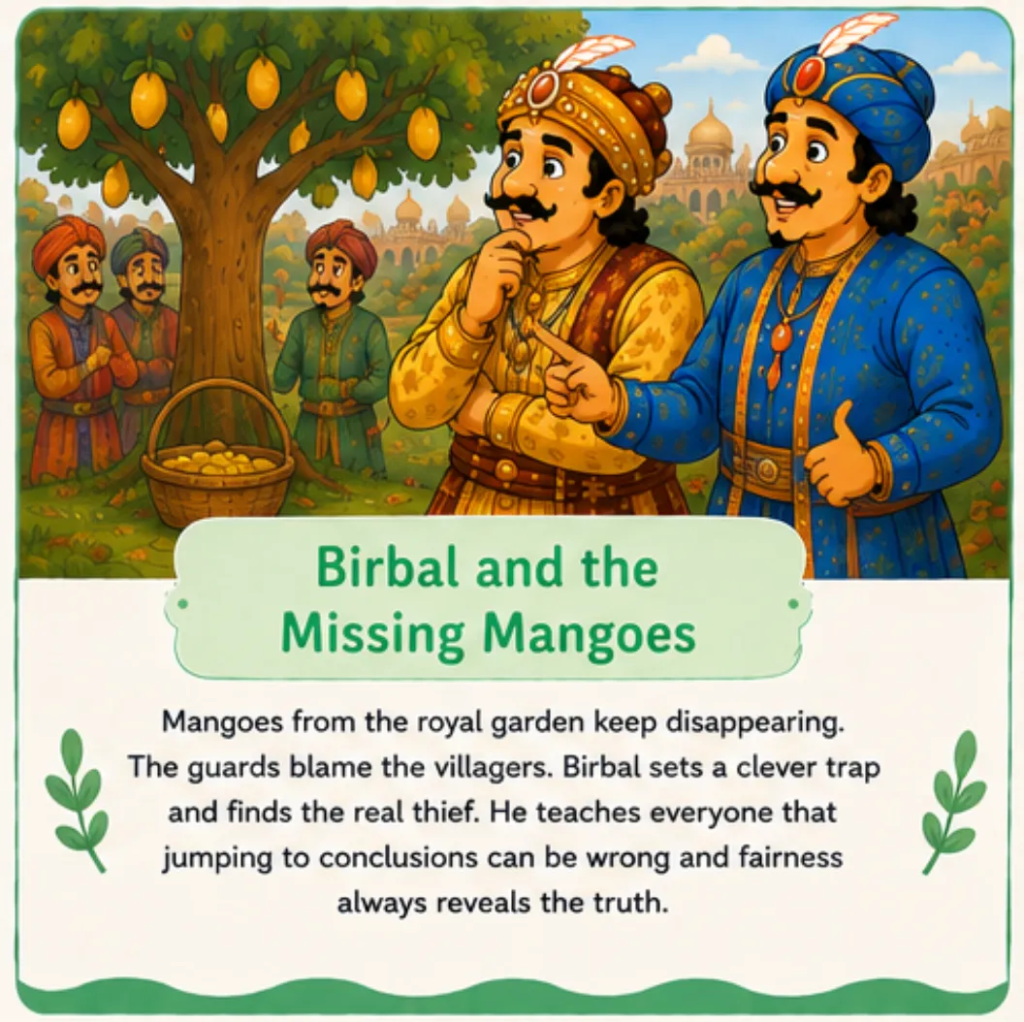
One summer, Emperor Akbar received a basket of the sweetest mangoes in the kingdom. He asked the royal cook to keep them safe until dinner. But when it was time to serve the fruit, the basket was empty!
The ministers began blaming one another. “The guards must have eaten them!” said one. “No, the cook is guilty!” said another. Soon, the entire court was arguing.
Birbal looked around and noticed sticky mango juice on the whiskers of the palace cat. Curious, he followed the cat into the garden. There, he found a group of naughty monkeys happily enjoying the last few mangoes. They had sneaked into the kitchen through an open window and carried the fruit away.
Everyone laughed at the clever monkeys. Akbar thanked Birbal for solving the mystery without accusing innocent people. The emperor ordered another basket of mangoes and made sure the kitchen windows stayed closed.
Moral: Never blame others without knowing the truth. Careful thinking leads to the right answer.
Also Read
The Emperor Who Couldn’t Stop Sneezing
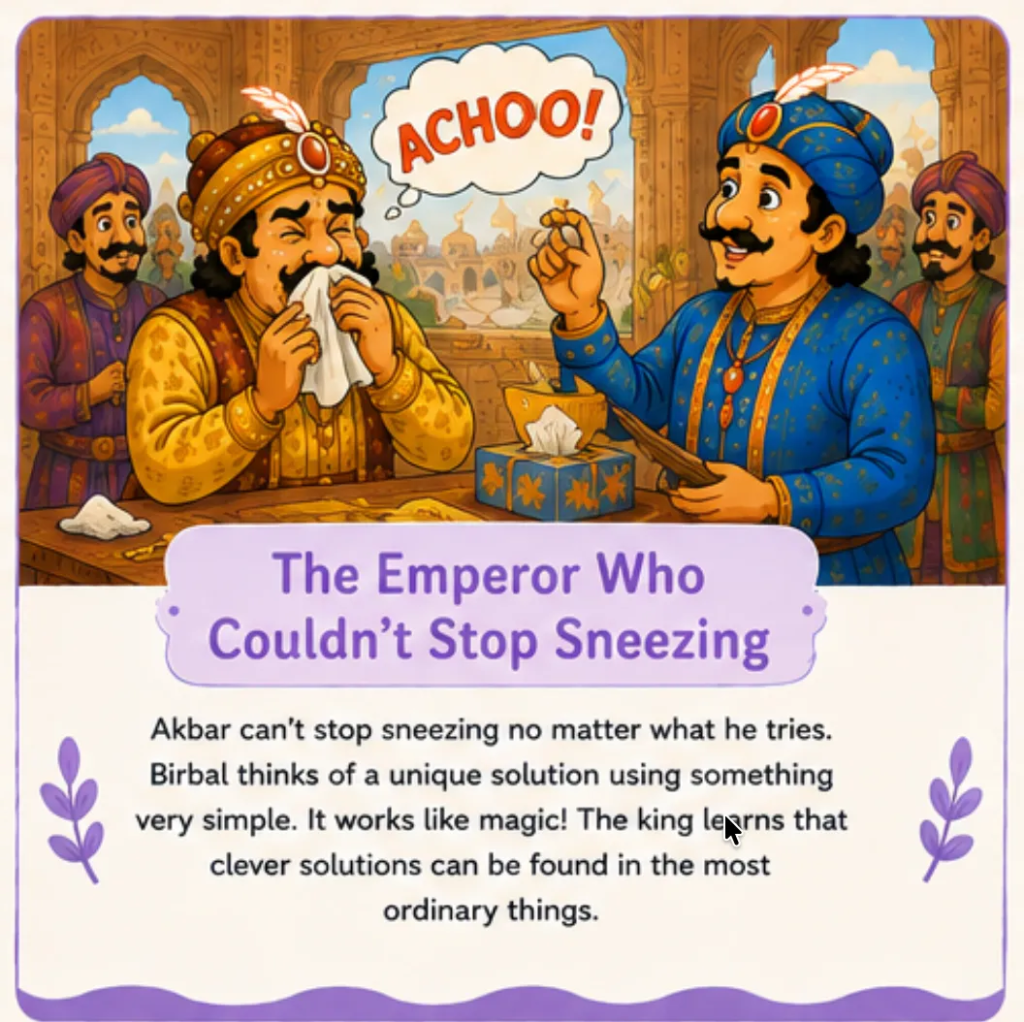
One chilly morning, Emperor Akbar arrived in the royal court with a loud sneeze. “Achoo!” he sneezed again and again. Every time he tried to speak, another sneeze interrupted him. The ministers tried all kinds of funny ideas. One suggested smelling flowers, another offered spicy soup, and a third even claimed that counting to one hundred would stop the sneezing. Nothing worked, and the whole court struggled to hide their laughter.
Birbal stepped forward with a warm cup of ginger and honey drink. “Your Majesty,” he said kindly, “sometimes the simplest remedy works best.” Akbar slowly sipped the warm drink and rested for a few minutes. His sneezing became less frequent, and soon he felt much better.
Smiling, Akbar said, “Today I learned that wise advice is more useful than strange tricks.” The court laughed happily, and Birbal was praised for his calm and practical thinking.
Moral: Simple and sensible solutions are often the best, and kindness is the greatest medicine.
Birbal’s Upside-Down Donkey Ride
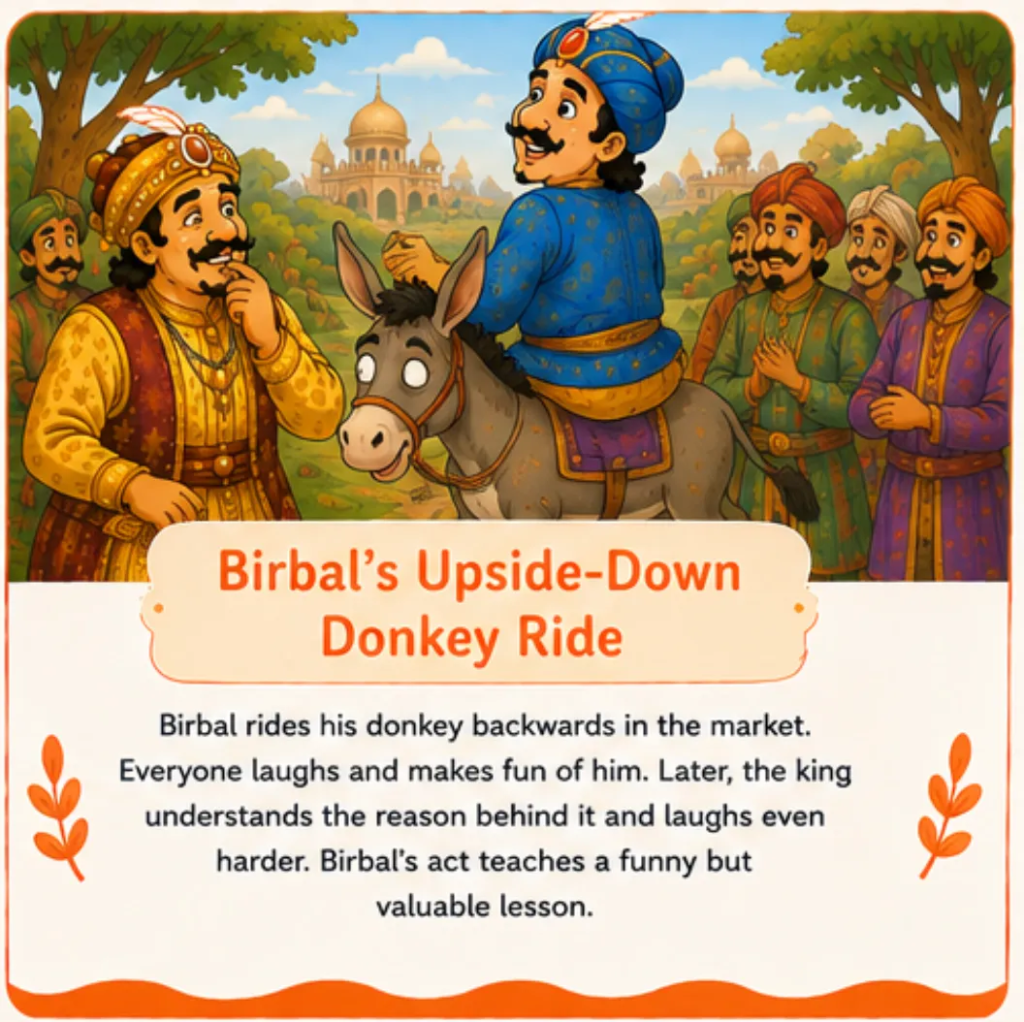
One morning, Birbal rode into the royal court sitting backward on his donkey. Instead of facing the donkey’s head, he faced its tail. The people in the market laughed loudly and followed him all the way to the palace.
When Birbal entered the court, Emperor Akbar smiled and asked, “Birbal, have you forgotten how to ride a donkey?”
Birbal bowed and replied, “Not at all, Your Majesty. If I face forward, my friends behind me cannot see my face. If I turn backward, I can greet everyone while still reaching the palace. This way, no one feels ignored.”
The courtiers laughed at Birbal’s clever answer. Akbar admired his quick wit and said, “You always find a unique way to teach us something.”
From that day, whenever people saw someone doing something unusual, they remembered Birbal and thought before judging.
Moral: Never judge someone by appearances. There may be a smart reason behind what they do.
The Monkey That Stole the Crown
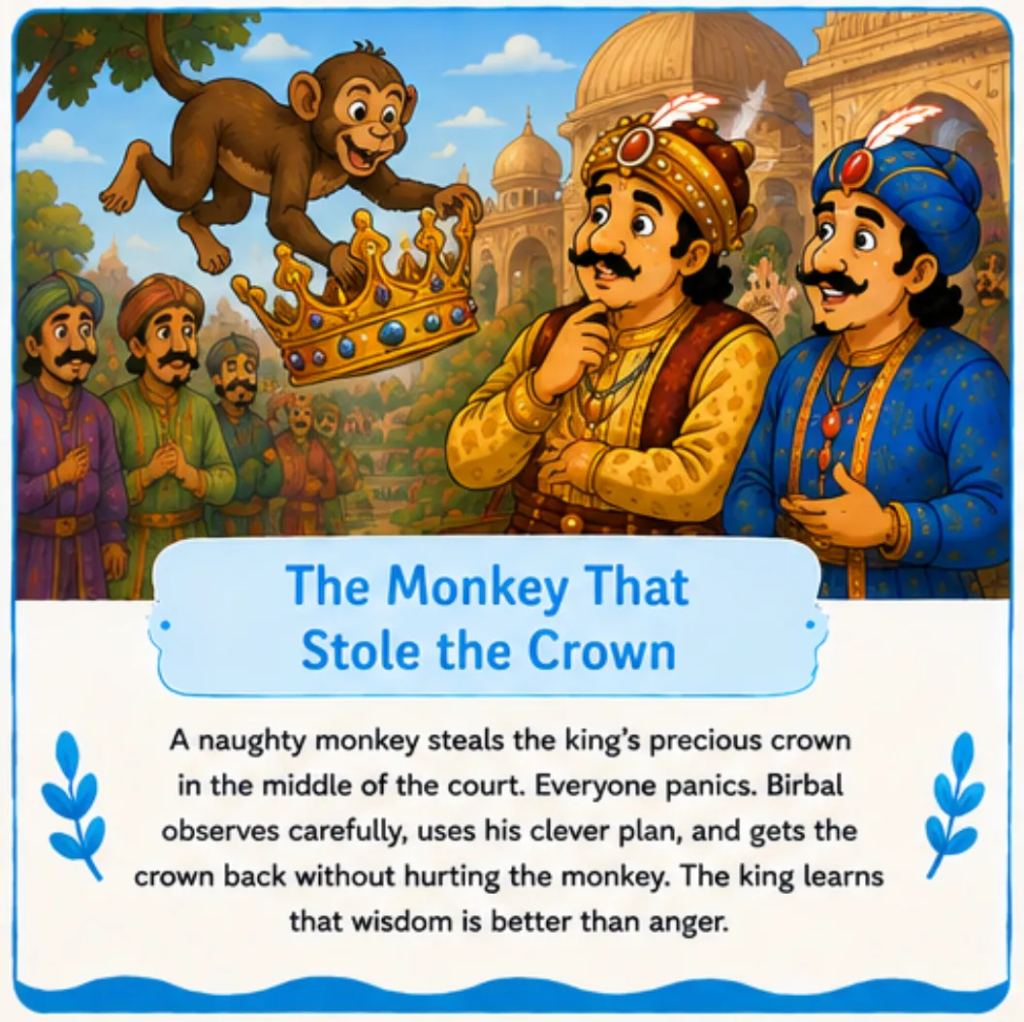
One sunny afternoon, Emperor Akbar was walking through the palace garden wearing his sparkling royal crown. Suddenly, a naughty monkey jumped from a tree, grabbed the crown, and raced to the top of a tall branch. The guards chased the monkey, but it was too quick. The monkey wore the crown proudly, making funny faces at everyone below. The whole court could not stop laughing.
Akbar called Birbal for help. Instead of chasing the monkey, Birbal picked up a shiny brass bowl and placed it on his own head like a crown. Curious, the monkey watched him carefully. Thinking it was a game, the monkey removed Akbar’s crown and dropped it to copy Birbal.
A guard quickly caught the crown before it touched the ground. Akbar laughed and praised Birbal’s clever idea. “You won without using force,” he said. Even the monkey happily jumped away into the trees.
Moral: Intelligence and patience can solve problems better than anger or force.
Akbar’s Giant Pumpkin Contest
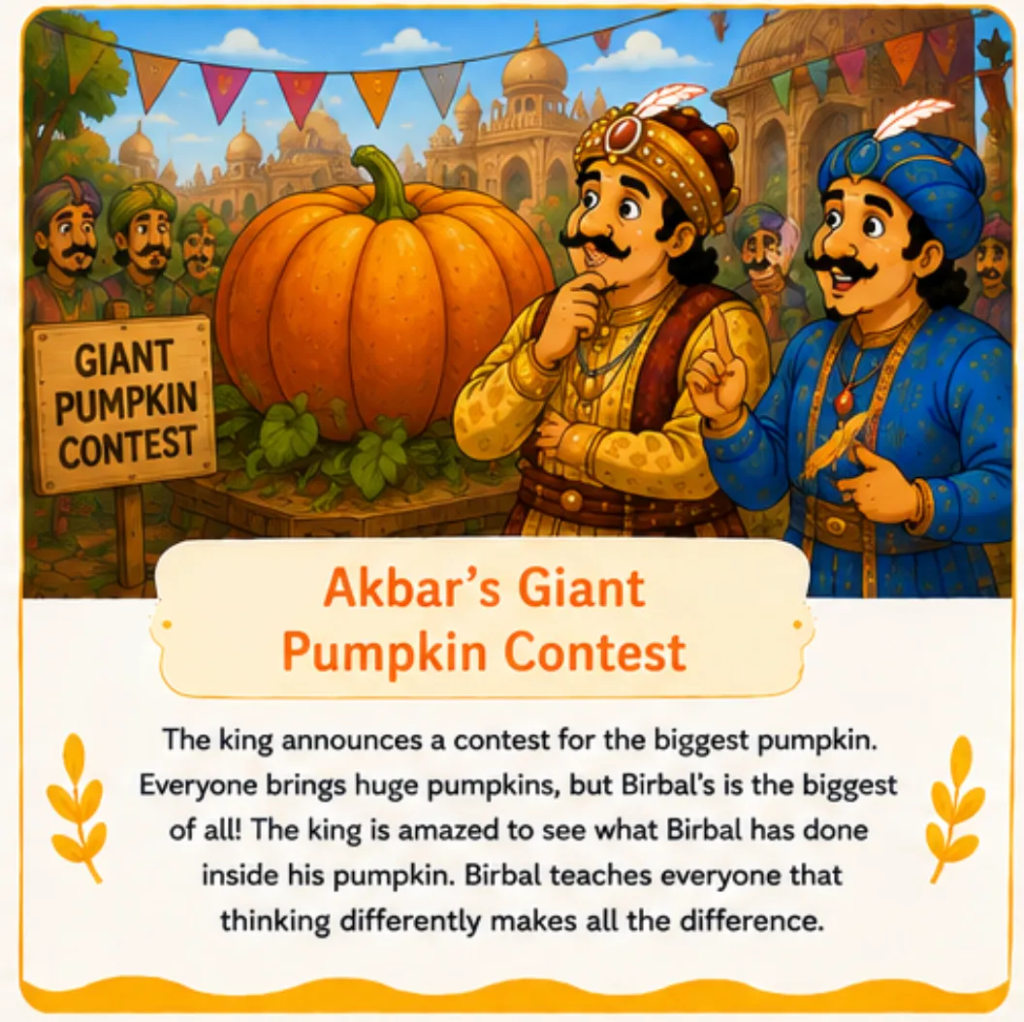
One autumn, Emperor Akbar announced a fun contest. “Whoever grows the biggest pumpkin will receive a bag of gold coins!” Farmers from all over the kingdom brought huge pumpkins to the royal court. Some were round, some were tall, and others were so heavy that four people had to carry them.
The ministers proudly pointed to the largest pumpkin, but Birbal noticed something strange. The pumpkin looked perfect on the outside, yet it felt unusually light.
With Akbar’s permission, Birbal gently tapped it. To everyone’s surprise, the pumpkin was hollow! A clever man had cut it open, removed the inside, and joined the pieces together to make it look much bigger.
The crowd laughed at the trick. The honest farmer with the next biggest pumpkin was declared the winner. Akbar praised Birbal for looking beyond appearances and rewarded the truthful farmer.
Moral: Honesty is more valuable than cheating, and the truth always comes to light.
Birbal and the Laughing Camel
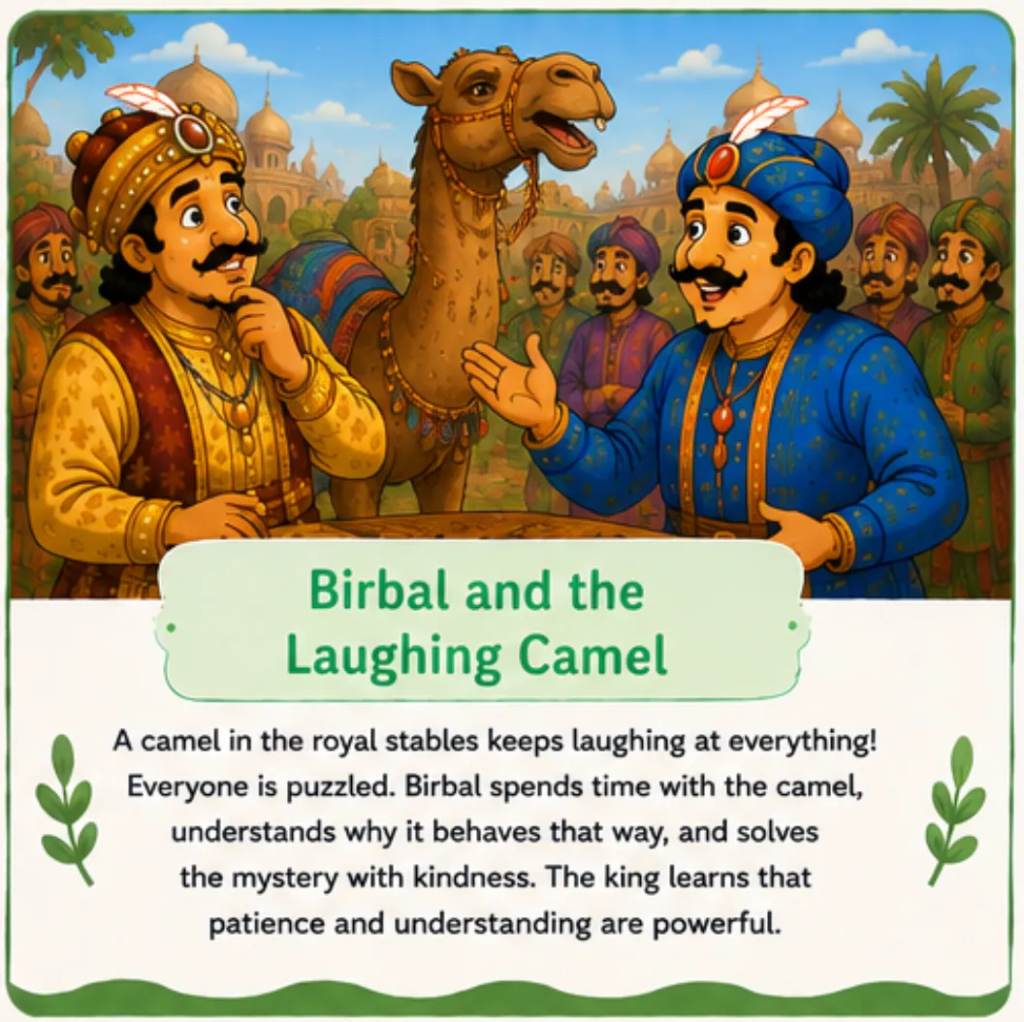
One day, a traveler brought a tall camel to Emperor Akbar’s court. As soon as the camel saw the royal ministers in their colorful clothes and tall turbans, it made a funny sound that sounded like loud laughter. The whole court began laughing too.
One proud minister became upset and said, “This camel is laughing at me!” Another minister insisted it was laughing at Akbar’s royal robe. Soon, everyone started arguing about the reason.
Akbar smiled and turned to Birbal. “Can you solve this mystery?”
Birbal gently patted the camel and said, “Your Majesty, the camel is not laughing at anyone. It is simply happy because it has never seen such a grand and colorful court before. Sometimes we imagine that everything is about us.”
The ministers realized their mistake and laughed at themselves. Akbar appreciated Birbal’s wise and humorous answer, and the cheerful camel became the favorite guest of the day.
Moral: Do not take everything personally. A cheerful heart brings smiles to everyone.
The Royal Cook’s Spicy Surprise
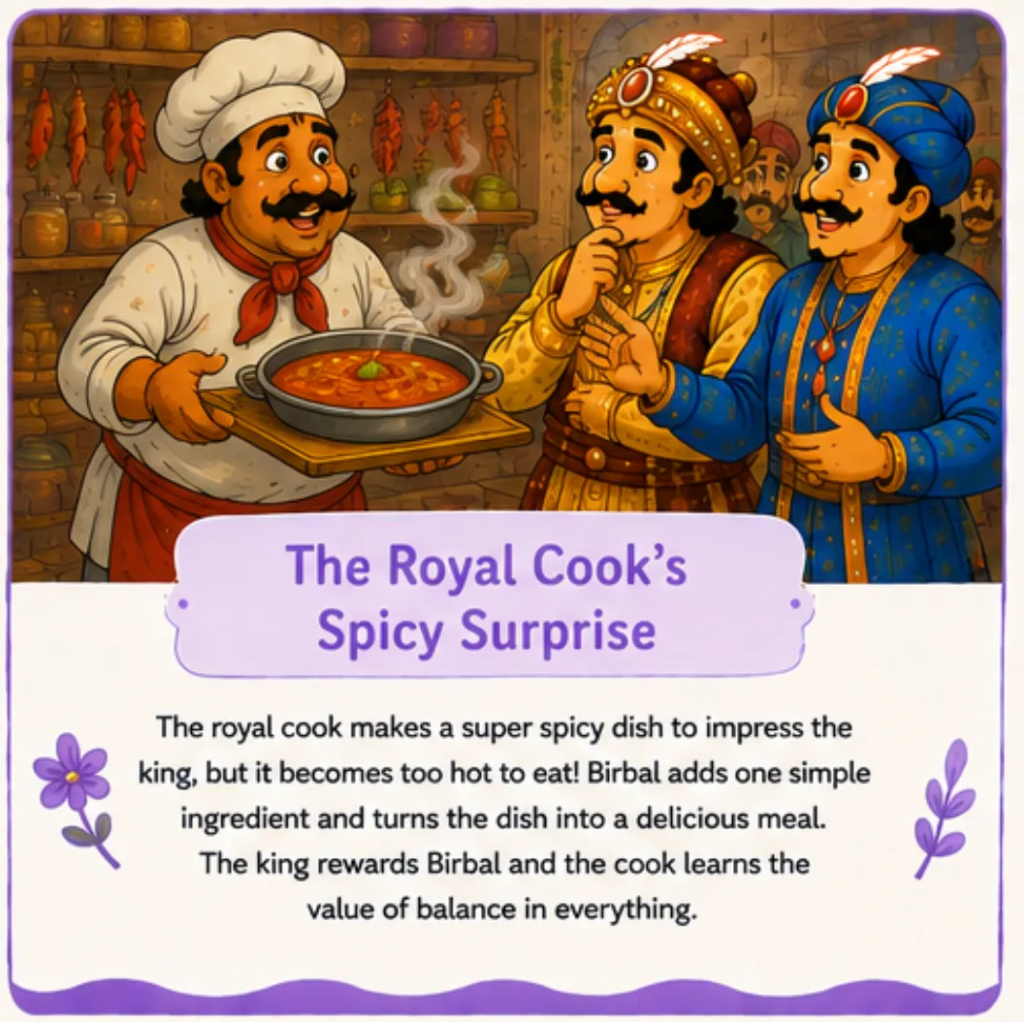
One afternoon, the royal cook prepared a delicious feast for Emperor Akbar and his court. Among the many dishes was a new vegetable curry that looked rich and colorful. As soon as Akbar took the first bite, his eyes widened. “This is very spicy!” he exclaimed.
The ministers quickly began pretending that the curry was perfect. Even though their eyes watered and their noses turned red, they smiled bravely because they were afraid to disagree with one another. The sight of everyone trying not to cough made the whole court look very funny.
Birbal calmly tasted the curry and smiled. “Your Majesty,” he said, “the cook has worked hard, but this dish needs a little less chili.” The cook thanked Birbal for his honest words and prepared a milder version. This time, everyone enjoyed the meal with happy faces instead of watery eyes.
Akbar praised Birbal for speaking the truth politely.
Moral: Honest words spoken with kindness help everyone improve.
Akbar’s Invisible Guest
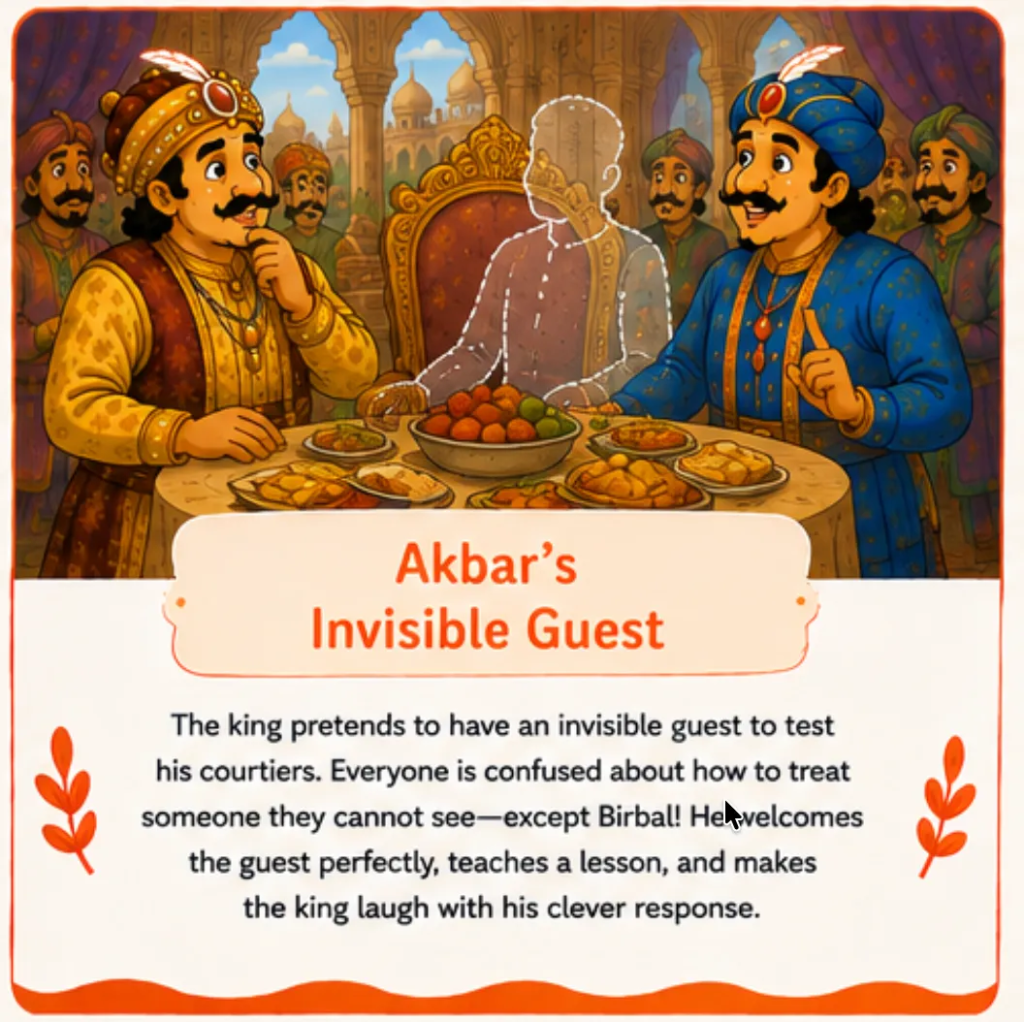
One morning, Emperor Akbar announced with a smile, “Today, we have a very special guest in the royal court. But there is one problem—you cannot see the guest!”
The ministers looked around in confusion. Not wanting to appear foolish, they began bowing, smiling, and greeting the “invisible guest.” One even offered an empty chair and started praising the guest’s wisdom. The court became funnier with every passing minute.
Birbal quietly watched the scene. Then he smiled and said, “Your Majesty, I believe the invisible guest is our imagination. It has made everyone behave without thinking.”
Akbar laughed loudly. “Exactly, Birbal! I wanted to see who would pretend to know something they did not.”
The ministers realized their mistake and laughed at themselves. From that day on, they promised to speak honestly instead of pretending to understand everything.
Moral: It is better to admit what you do not know than to pretend to know everything.
Birbal’s Clever Kite Competition
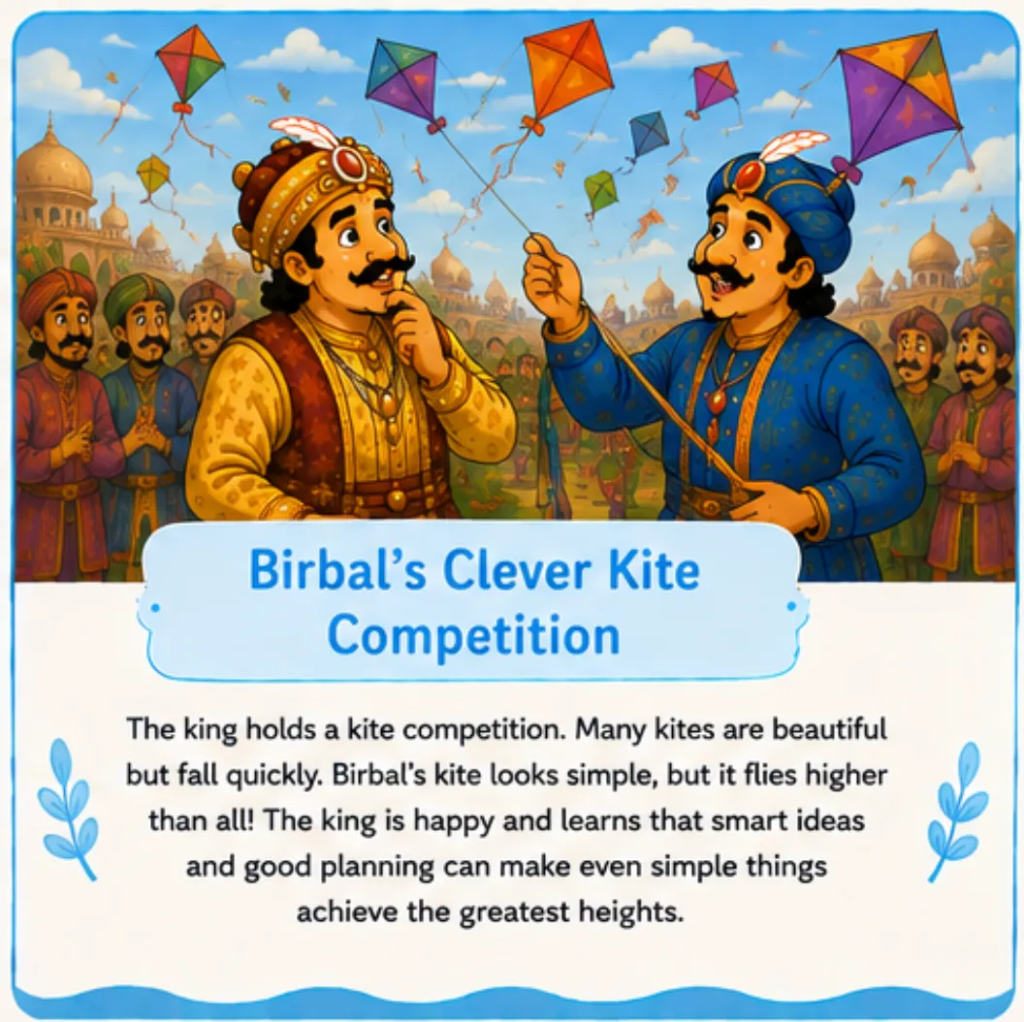
One windy afternoon, Emperor Akbar organized a kite-flying competition in the palace garden. Colorful kites filled the sky, and the ministers proudly tried to fly the biggest and brightest ones. Soon, their kites became tangled, and many crashed into the trees. Everyone blamed the wind, making the crowd laugh.
Birbal arrived with a small, simple kite. Some ministers laughed and said, “That tiny kite will never fly high!”
Birbal smiled and waited patiently for the strongest breeze. He carefully controlled the string, and his kite rose higher and steadier than all the others. It danced gracefully across the blue sky while the larger kites struggled.
Akbar clapped with delight. “Birbal has shown that success comes from skill, not size,” he said.
The ministers congratulated Birbal and learned that careful planning and patience are more important than showing off.
Moral: Intelligence, patience, and practice are more valuable than having the biggest or fanciest things.
The Case of the Singing Rooster
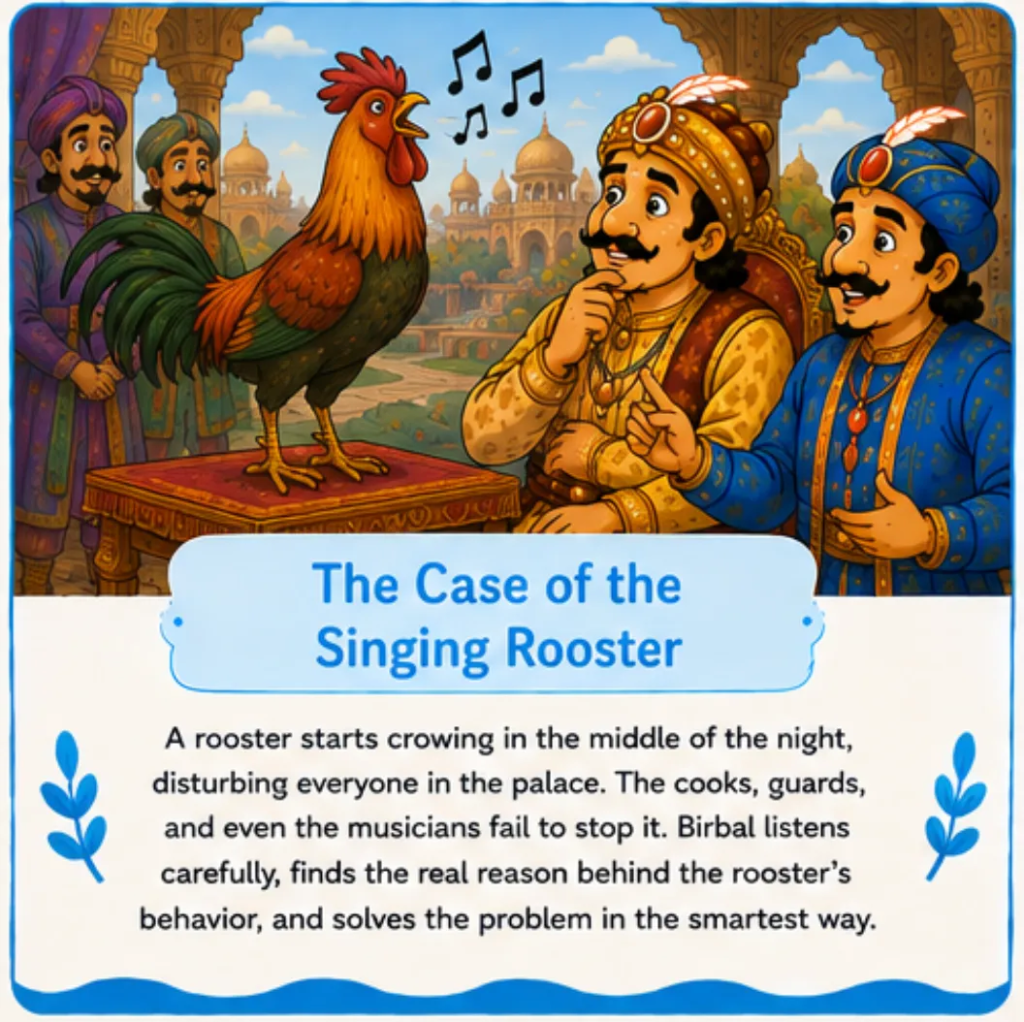
Early one morning, the peaceful royal court was disturbed by a rooster that crowed so loudly it sounded as if it were singing. “Cock-a-doodle-doo!” echoed through the palace again and again. The ministers covered their ears and complained that the noisy bird should be sent away.
Emperor Akbar turned to Birbal and asked, “Can you find out why this rooster is making so much noise?”
Birbal walked into the palace garden and watched carefully. He soon noticed that the rooster was trying to call its little chicks, which had wandered into the bushes while chasing butterflies.
Birbal gently gathered the chicks and brought them back to their mother. The rooster immediately stopped crowing and happily led its family around the garden.
Akbar smiled and said, “We almost blamed the poor bird without knowing the real reason.”
The ministers laughed at their mistake and praised Birbal’s patience and careful observation.
Moral: Before judging others, try to understand the reason behind their actions.
Akbar and the Bottomless Sweet Box
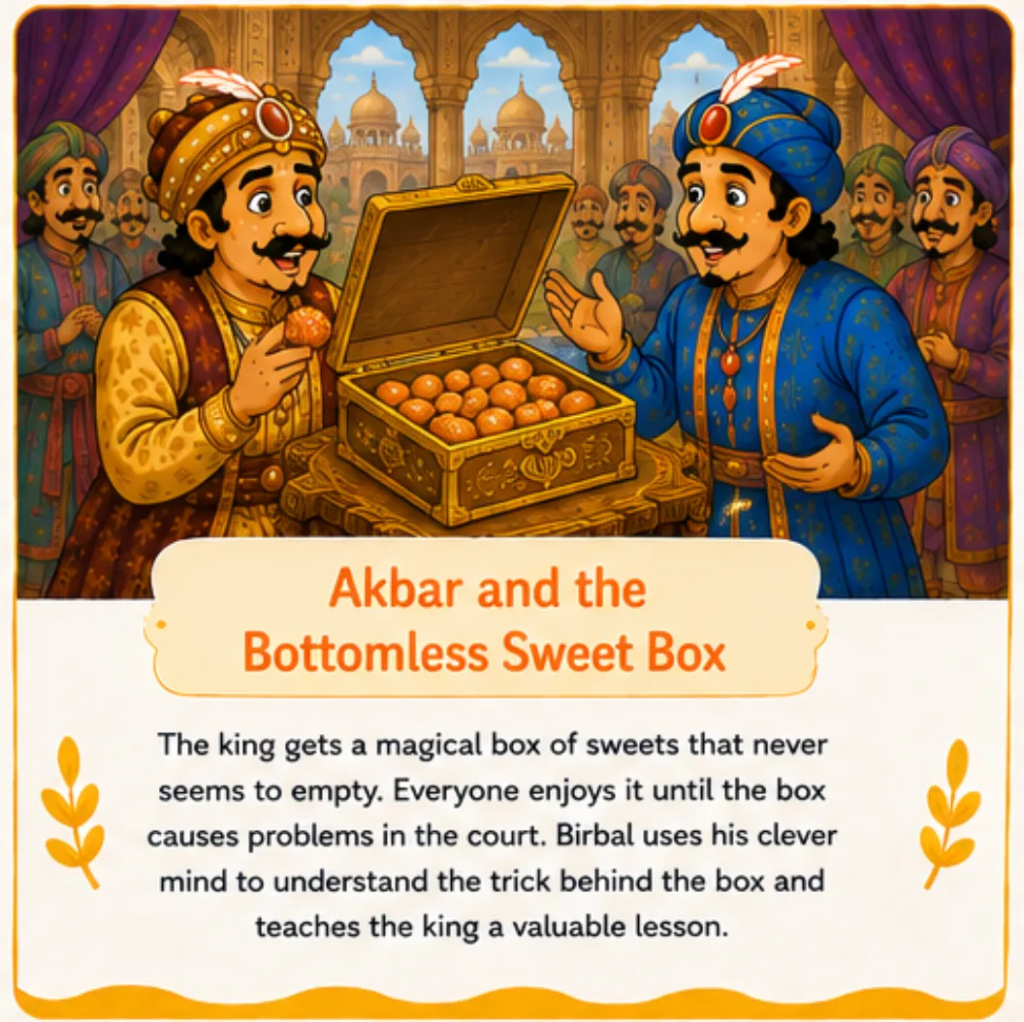
One festive evening, Emperor Akbar received a beautiful wooden box filled with delicious sweets. Every time someone opened the box, it still seemed full. The ministers were amazed and whispered, “This must be a magical box!”
Curious, Akbar asked everyone to guess its secret. Some believed it was enchanted, while others thought palace magicians had cast a spell on it.
Birbal quietly picked up the box and examined it from every side. Then he smiled and turned it upside down. Hidden inside was a small sliding compartment that slowly released more sweets whenever the box was moved.
The court burst into laughter. “So the magic was only a clever design!” Akbar exclaimed.
The emperor praised Birbal for using observation instead of imagination. He rewarded the craftsman who had made the clever box and shared the sweets with everyone in the palace.
Moral: Careful observation and logical thinking reveal the truth behind surprising things.
Birbal’s Magical Mirror Trick
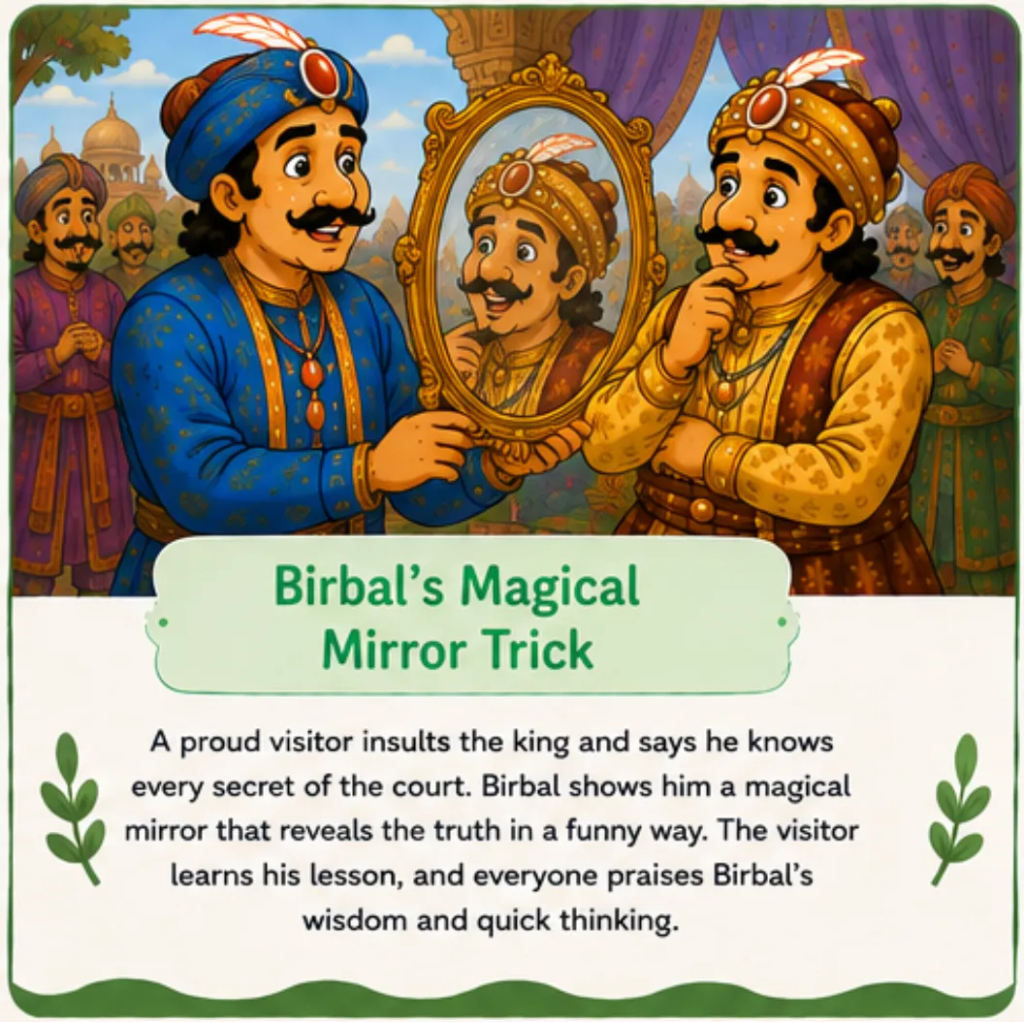
One day, Emperor Akbar bought a large, shiny mirror from a traveling merchant. The merchant proudly claimed, “This is a magical mirror. It only shows the face of truly wise people!”
The ministers rushed to look into it. Afraid of being called foolish, each one quickly declared, “Yes, I can see myself clearly!” Even those who looked confused pretended that everything was normal.
Akbar smiled and asked Birbal for his opinion. Birbal looked into the mirror for a moment and laughed. “Your Majesty, this is an ordinary mirror. The only magic here is that it makes people afraid to tell the truth.”
The court fell silent, and then everyone burst into laughter. The merchant admitted that it was only a clever trick to impress people.
Akbar praised Birbal for his honesty and rewarded him for exposing the truth without insulting anyone.
Moral: True wisdom means being honest, even when others are pretending.
The Emperor’s Crooked Turban
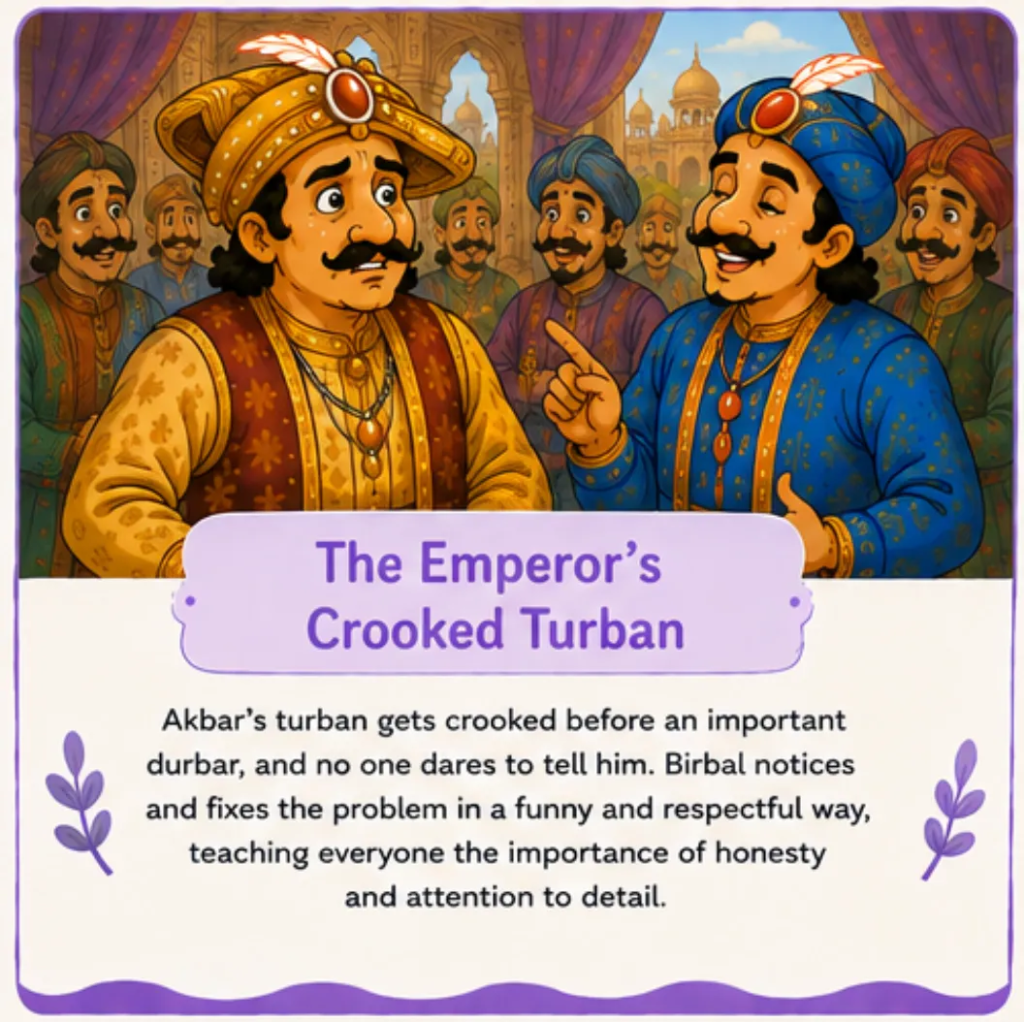
One busy morning, Emperor Akbar hurried to the royal court wearing his magnificent turban. In his rush, he did not notice that it was tied slightly crooked. The ministers saw it immediately, but no one dared to say anything. Instead, they praised it, saying, “Your Majesty, this is the finest style we have ever seen!”
Birbal entered the court, greeted the emperor, and smiled. “Your Majesty,” he said politely, “your wisdom is always perfectly balanced, but today your turban seems to be leaning toward one side.”
Akbar touched his turban and realized it was indeed crooked. He laughed heartily while the ministers lowered their heads in embarrassment.
“You praised a mistake instead of telling me the truth,” Akbar said. “A true friend speaks honestly with respect.”
The emperor adjusted his turban and thanked Birbal for his courage and sincerity. The ministers learned that honest advice is more valuable than false praise.
Moral: Speak the truth kindly, even when it is difficult. Honest friends help us improve.
Birbal and the Noisy Shoes
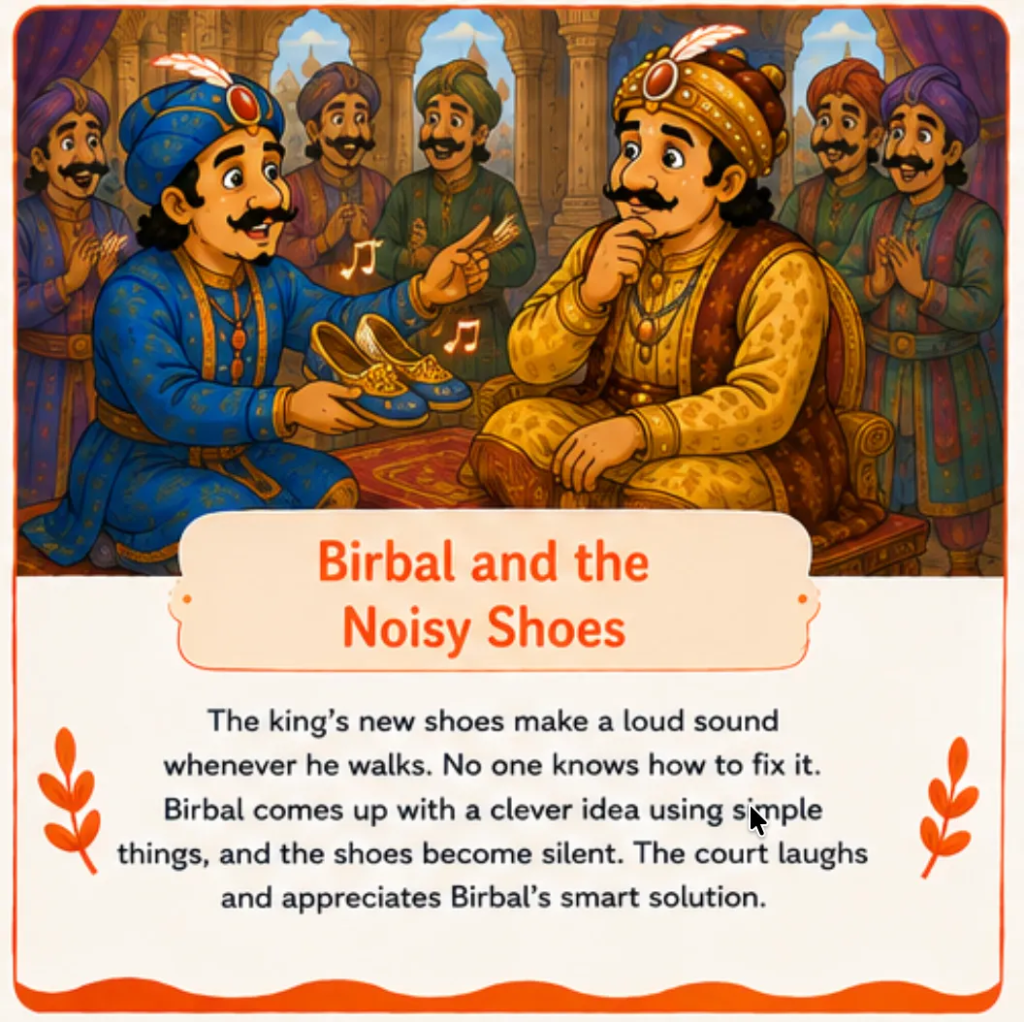
One morning, Emperor Akbar noticed a strange sound echoing through the palace corridors. “Tap! Tap! Squeak! Squeak!” The noise grew louder as the ministers entered the royal court. Everyone looked around, wondering where it was coming from.
One minister blamed the palace floors, while another suspected a mischievous mouse. The guards searched every corner but found nothing.
Birbal quietly watched the ministers walk. Soon, he noticed that one minister’s new leather shoes made a loud squeaking sound with every step. The minister had polished them with too much oil, causing the funny noise.
Birbal smiled and said, “Your Majesty, the mystery is solved. The palace is innocent—it is the shoes that are singing!”
The whole court burst into laughter. Even the embarrassed minister laughed at himself and promised to use less polish next time.
Akbar praised Birbal for solving the mystery with careful observation instead of making wild guesses.
Moral: Pay attention to small details before jumping to conclusions.
The Palace Cat Who Became a Hero
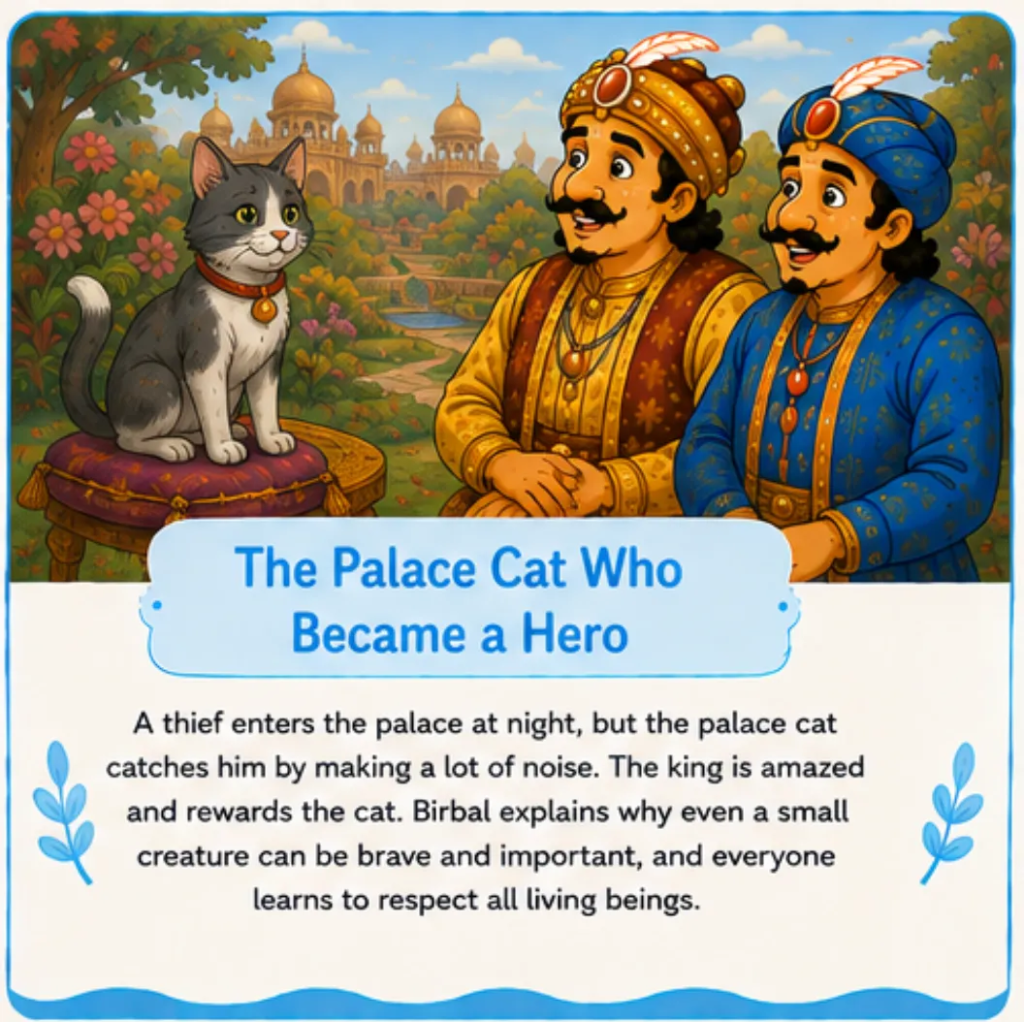
One afternoon, the royal court was enjoying a peaceful meeting when a tiny mouse suddenly ran across the floor. The ministers jumped onto their chairs in surprise, and one even dropped his scroll. Emperor Akbar tried not to laugh, but the scene was too funny.
Just then, the palace cat sprang into action. It quietly chased the mouse through the hall, around the pillars, and under the royal table. After a quick dash, the clever cat caught the mouse without knocking over a single vase.
The court cheered, and Akbar smiled proudly. “Our smallest guard has saved the day,” he said.
Birbal gently stroked the cat and added, “A true hero is not always the biggest or the strongest. Sometimes, courage comes in a small package.”
The ministers laughed at their own fear and thanked the brave little cat for restoring peace to the palace.
Moral: Courage and quick action matter more than size or strength.
Akbar’s Funny Painting Competition
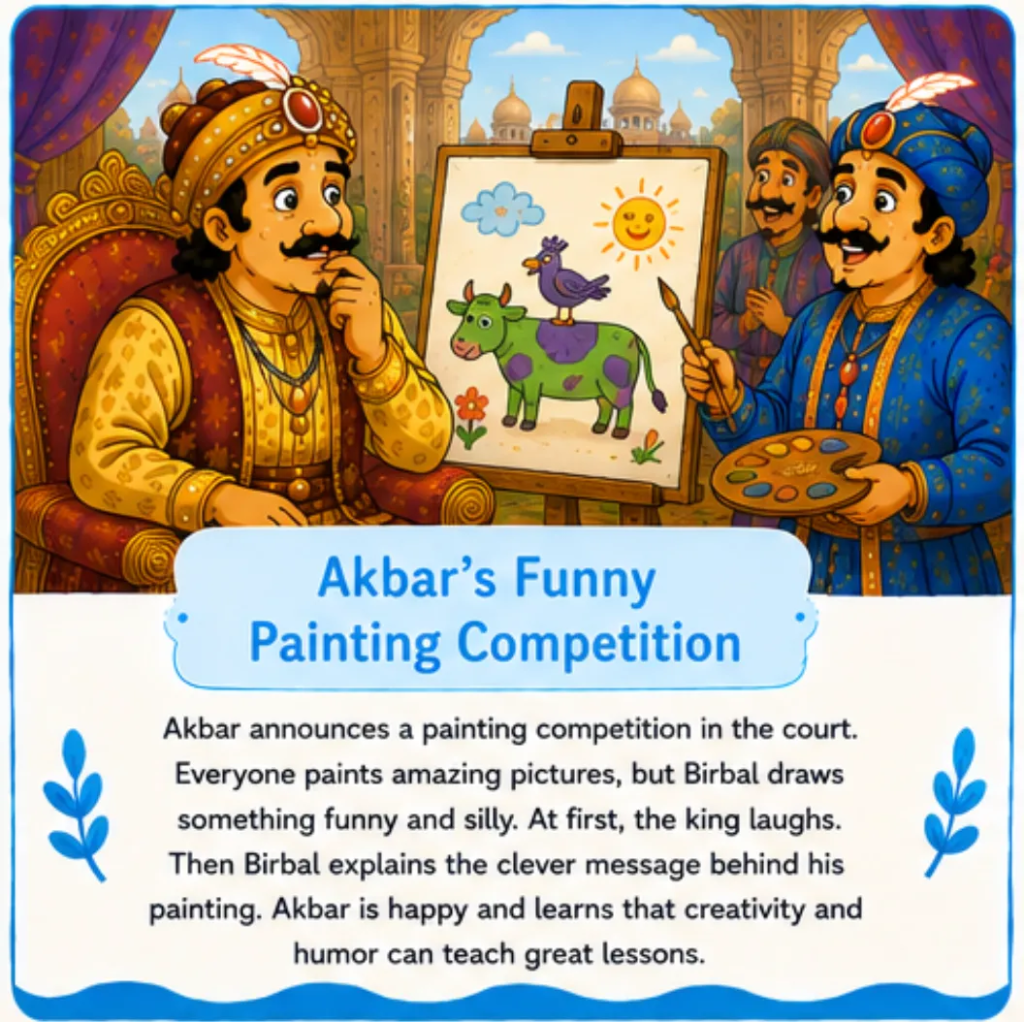
One day, Emperor Akbar announced a painting competition in the royal court. “The funniest painting will win a bag of gold coins,” he declared. Artists from across the kingdom arrived with colorful paintings. Some showed dancing elephants, while others painted cats wearing royal crowns. Everyone laughed at the creative artwork.
When it was Birbal’s turn, he unveiled a painting of a donkey dressed as a proud minister, wearing a grand turban and holding a bundle of papers. The donkey looked so serious that the entire court burst into laughter.
A few ministers looked embarrassed and asked, “Why is the donkey dressed like us?”
Birbal smiled and replied, “The painting is only a reminder that fancy clothes and important titles do not make a person wise. Good thoughts and kind actions do.”
Emperor Akbar laughed the loudest and declared Birbal the winner. The ministers also laughed and accepted the lesson with good humor.
Moral: True wisdom comes from character, not from appearance or position.
Birbal and the Sleepy Elephant
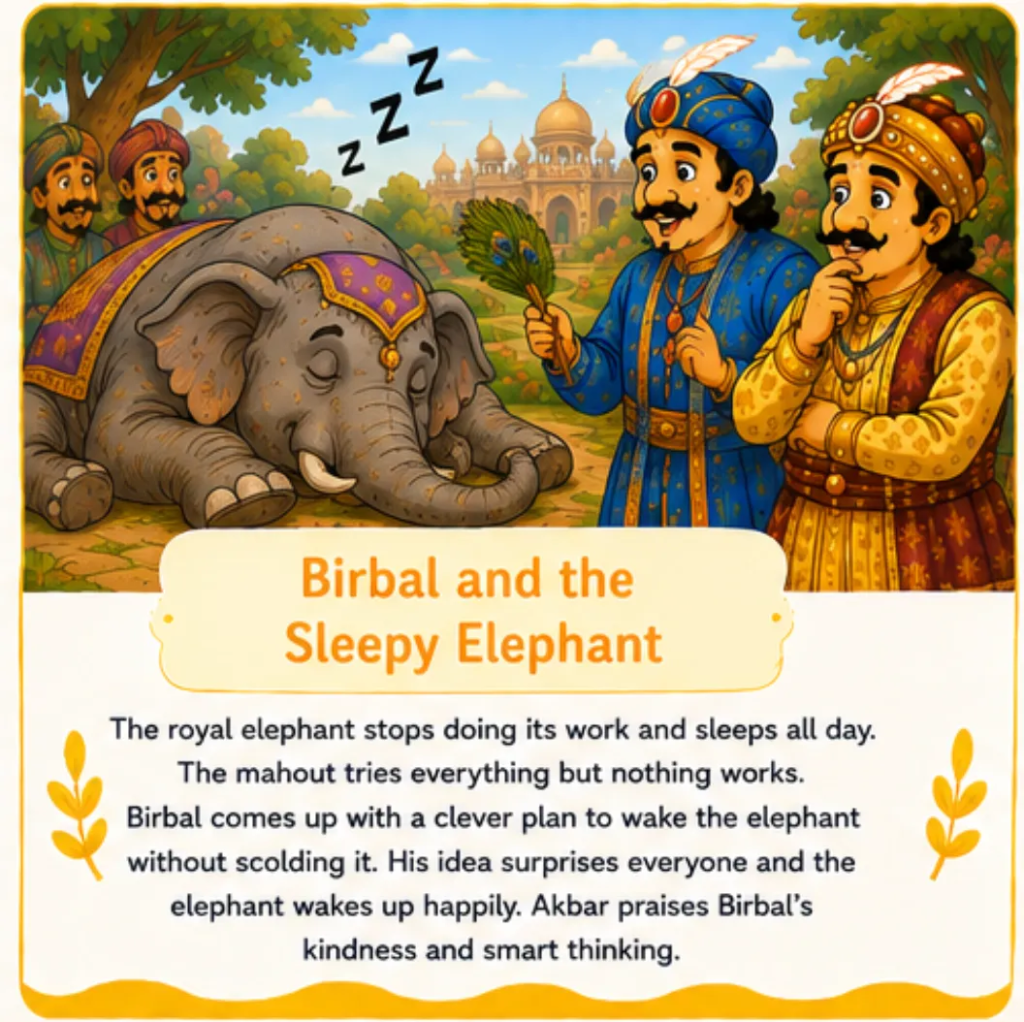
One hot afternoon, Emperor Akbar planned a grand parade through the city. But the royal elephant, Gajraj, had just finished a big meal and fell fast asleep under a shady tree. The mahouts tried clapping, singing, and even playing drums, but the sleepy elephant refused to wake up. The court could not stop laughing at the giant snoring peacefully.
Akbar turned to Birbal for help. Birbal whispered something into the elephant keeper’s ear. The keeper brought a basket of fresh sugarcane and waved it gently in front of Gajraj’s trunk.
The elephant’s nose twitched. It slowly opened one eye, smelled the sweet sugarcane, and stood up happily. Everyone laughed as the elephant eagerly followed the basket, ready for the parade.
Akbar smiled and said, “Birbal knows that kindness and understanding work better than shouting.”
The parade began on time, and Gajraj proudly led the way.
Moral: Understanding someone’s needs is often the best way to solve a problem.
The Royal Drum That Wouldn’t Stay Quiet
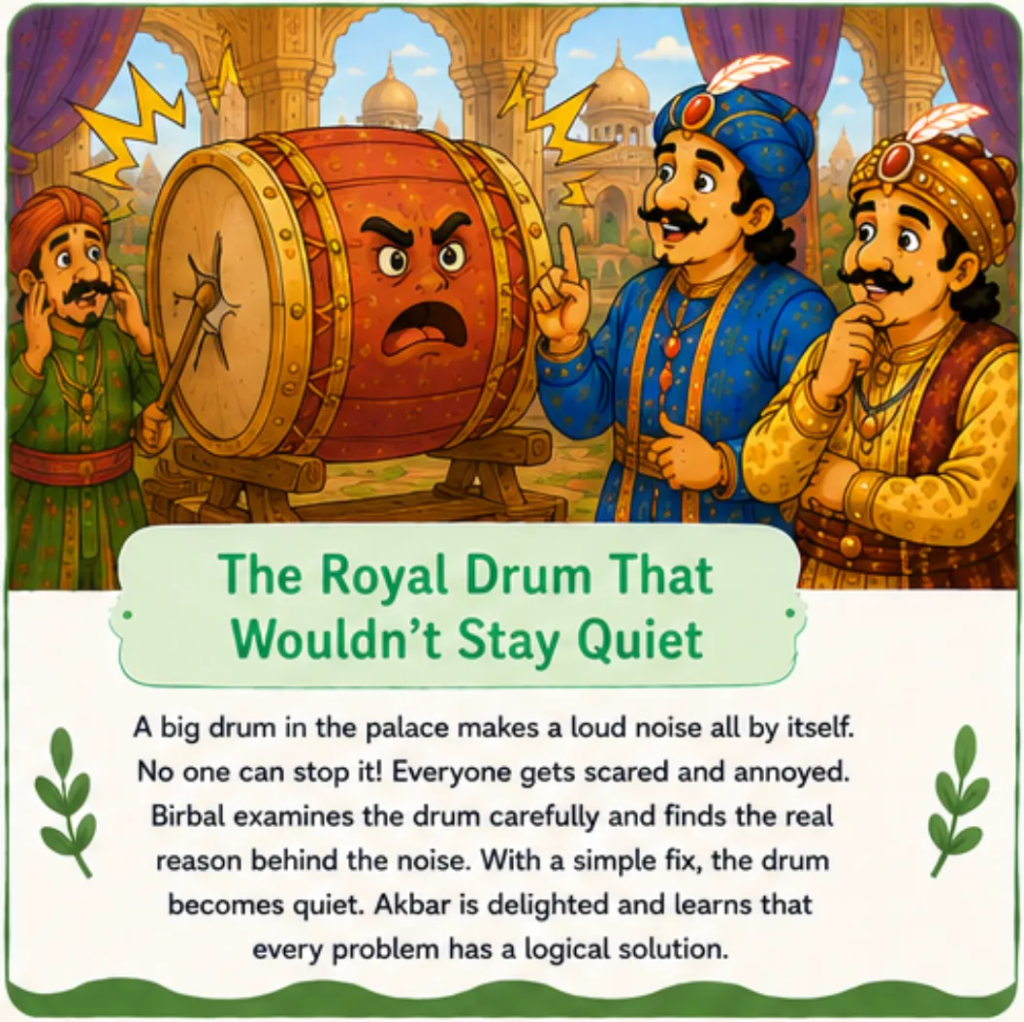
One evening, a large royal drum placed at the palace gate began making loud “Boom! Boom!” sounds all by itself. The guards became frightened, and the ministers whispered that the drum might be enchanted. Soon, curious people gathered outside the palace, wondering what was happening.
Emperor Akbar called Birbal to solve the strange mystery. Instead of believing the rumors, Birbal carefully examined the drum. He noticed that strong gusts of wind were blowing through a small tear in its leather surface. Each time the wind entered, the loose skin vibrated and produced the booming sound.
Birbal asked the palace craftsmen to repair the tear. As soon as they fixed it, the mysterious noise stopped. The guards laughed with relief, and the ministers felt embarrassed for believing the wild stories.
Akbar praised Birbal and said, “A calm mind always finds the truth.”
Moral: Do not believe rumors without checking the facts. Careful observation and logical thinking solve mysteries better than fear.
Akbar’s Lost Slipper Adventure
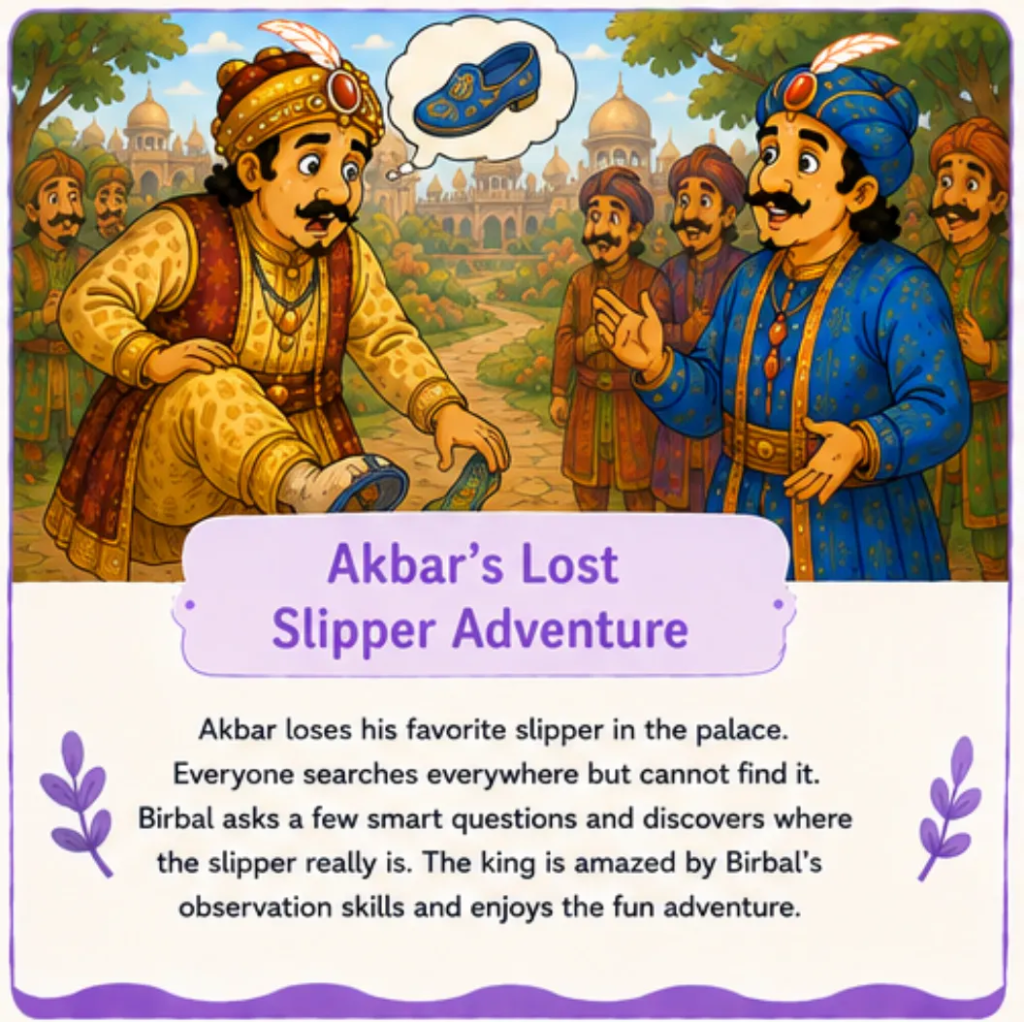
One morning, Emperor Akbar was getting ready for an important meeting when he realized that one of his royal slippers was missing. The palace guards searched every room, the ministers looked under tables, and the servants checked the garden. Soon, everyone was running around in confusion, and the palace looked funnier than ever.
Akbar called Birbal and said, “Can you find my slipper before the meeting begins?”
Birbal calmly walked through the palace instead of rushing. He noticed a trail of tiny wet footprints leading toward the fountain. There he found a playful palace puppy happily chewing on the soft royal slipper.
Everyone burst into laughter. The puppy wagged its tail, thinking it had found a wonderful new toy. Birbal gently took back the slipper and gave the puppy a wooden chew toy instead.
Akbar laughed and thanked Birbal for solving the mystery with patience instead of panic. The meeting started on time, and the puppy became the court’s favorite little prankster.
Moral: Stay calm during problems. Careful observation leads to quick and peaceful solutions.
Birbal’s Flying Hat Mystery
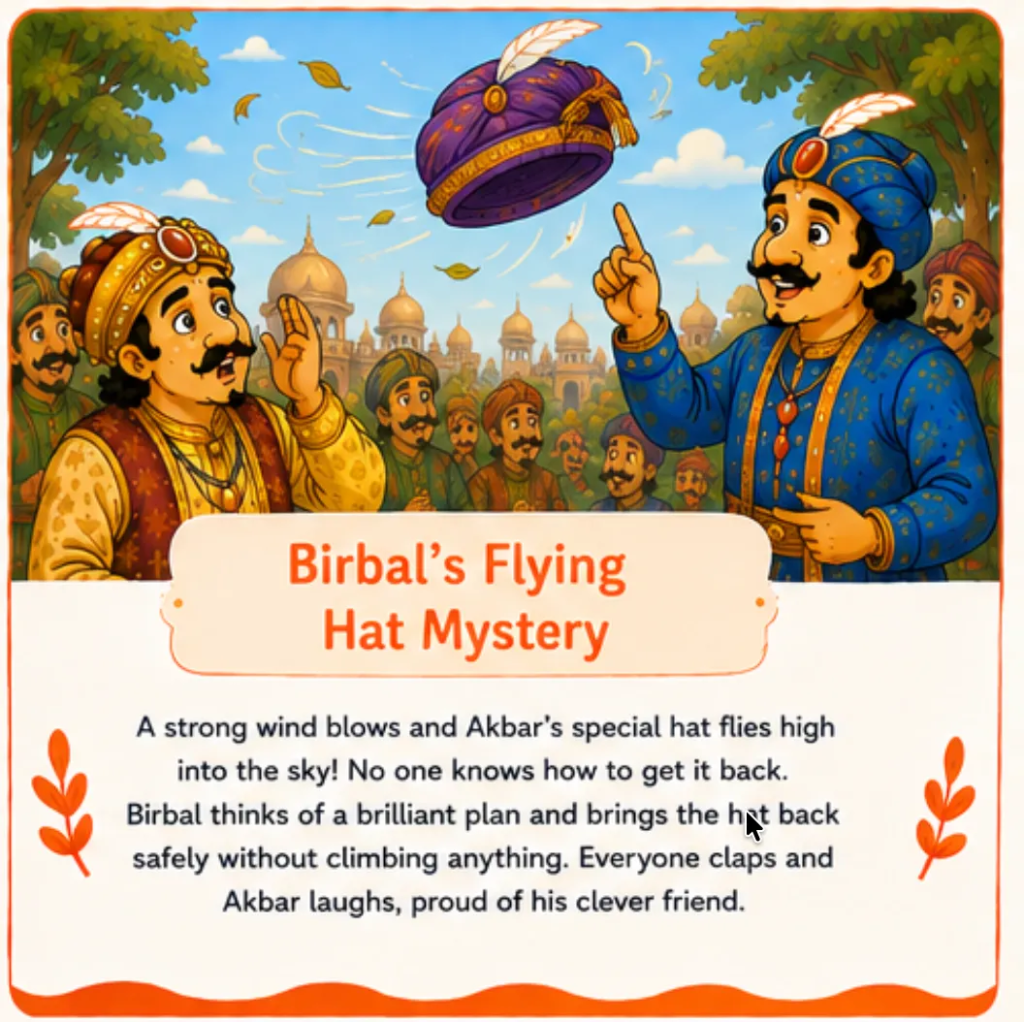
One breezy afternoon, Birbal entered the royal court wearing his favorite hat. Just as Emperor Akbar began speaking, a strong gust of wind rushed through the open windows and carried Birbal’s hat high into the air. It floated across the court and landed on the head of a marble statue. The ministers laughed so hard that some could hardly stand.
One minister joked, “Perhaps the statue has become the new royal advisor!”
Akbar smiled and asked Birbal how he would get the hat down. Instead of climbing or asking the guards to fetch it, Birbal opened all the palace windows on the opposite side. Another gentle breeze swept through the hall, lifting the hat from the statue and carrying it straight into Birbal’s hands.
The court applauded his clever idea. Akbar laughed and said, “You solved the problem by working with nature instead of fighting it.”
Moral: Intelligence means finding simple solutions by understanding the situation.
The Day Everyone Laughed in the Royal Court
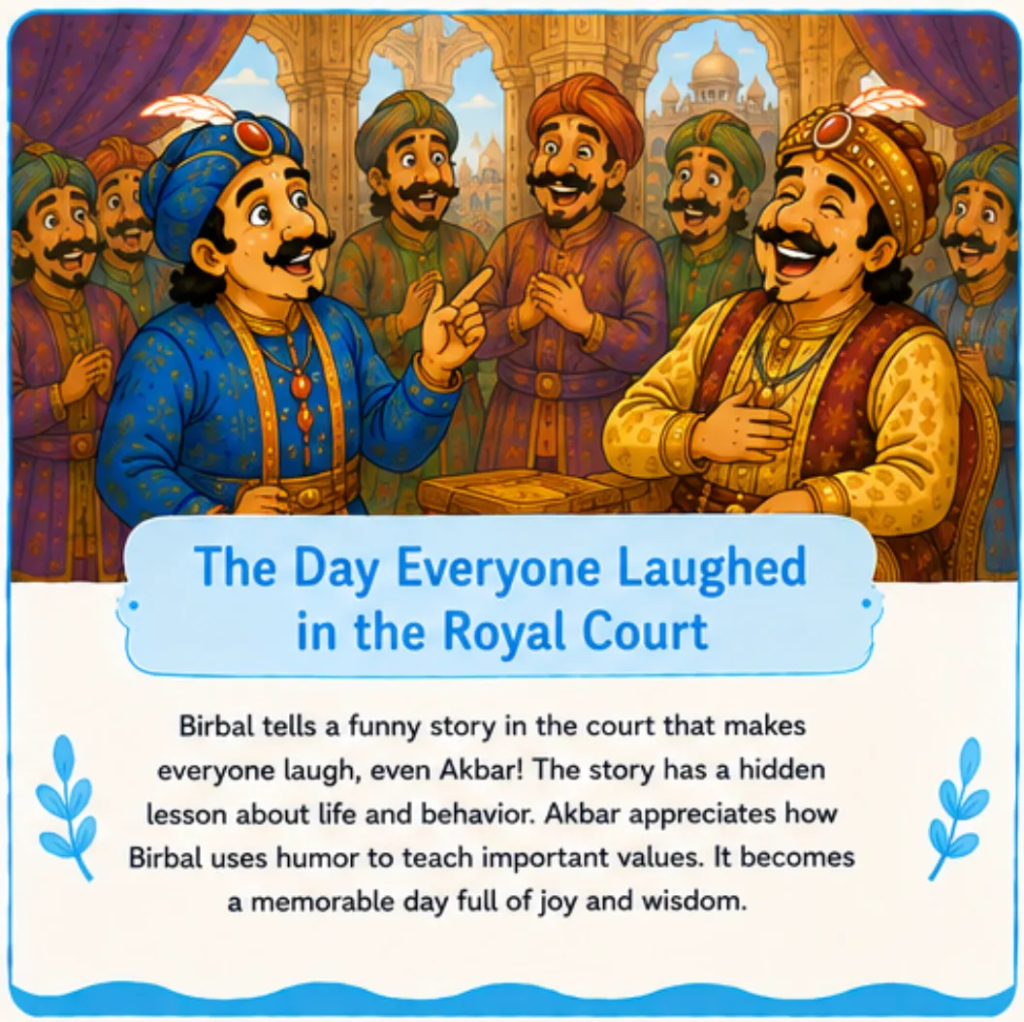
One cheerful morning, Emperor Akbar announced a special challenge. “Today, the person who makes the entire royal court laugh together will receive a bag of gold coins,” he declared.
The ministers took turns telling jokes, acting like animals, and making funny faces. Some people smiled, but no one could make the whole court laugh at once.
Finally, Birbal stepped forward carrying a large covered basket. Everyone watched curiously as he slowly lifted the cloth. Instead of treasure, a tiny goat jumped out, wearing a colorful royal turban. The playful goat began walking proudly around the court, stopping in front of the ministers as if it were giving royal orders.
The sight was so unexpected that Akbar, the ministers, the guards, and even the servants burst into loud laughter. The goat happily bleated and wagged its tail, making everyone laugh even more.
Akbar rewarded Birbal and said, “A joyful heart brings people together better than anything else.”
Moral: Laughter shared with others spreads happiness and strengthens friendships.
Vocabulary that kids can learn from These Stories
| Vocabulary | Meaning |
|---|---|
| Emperor | A king who rules an empire |
| Court | The place where the king meets people |
| Minister | A royal advisor |
| Wise | Very smart and thoughtful |
| Clever | Quick at solving problems |
| Honest | Always telling the truth |
| Kindness | Being caring and helpful |
| Courage | Being brave |
| Patience | Waiting calmly |
| Observation | Looking carefully |
| Mystery | Something difficult to explain |
| Clue | A sign that helps solve a mystery |
| Challenge | A difficult task |
| Reward | A prize for doing something well |
| Adventure | An exciting experience |
| Curious | Wanting to learn or know more |
| Mischievous | Playfully causing trouble |
| Proud | Feeling happy about yourself |
| Boast | To talk too proudly |
| Respect | Treating others politely |
| Laughter | The sound of laughing |
| Cheerful | Happy and joyful |
| Companion | A friend or partner |
| Feast | A large special meal |
| Delicious | Very tasty |
| Spicy | Having a hot flavor |
| Competition | A contest |
| Winner | The person who wins |
| Puzzle | A problem to solve |
| Trick | A clever action to surprise someone |
| Magical | Seeming to have magic |
| Imagination | The ability to create ideas in your mind |
| Gentle | Soft and kind |
| Calm | Peaceful and relaxed |
| Helpful | Ready to help others |
| Loyal | Always faithful and supportive |
| Grateful | Thankful |
| Surprise | Something unexpected |
| Journey | A trip from one place to another |
| Festival | A special celebration |
| Parade | A public celebration with people marching |
| Garden | A place where flowers and plants grow |
| Palace | A large home for a king or queen |
| Crown | The royal headpiece of a king or queen |
| Turban | A cloth wrapped around the head |
| Rooster | An adult male chicken |
| Camel | A desert animal with humps |
| Donkey | An animal used to carry loads |
| Elephant | A very large animal with a trunk |
| Monkey | A playful animal that climbs trees |
Moral Lessons Kids Can Learn from These Akbar and Birbal Funny Stories
Akbar and Birbal stories are not only funny but also teach children important life values. Here are some of the key moral lessons with simple examples.
| Moral Value | What Kids Learn | Example from the Stories |
|---|---|---|
| Honesty | Always tell the truth, even when it is difficult. | Birbal honestly told Akbar that his turban was crooked instead of giving false praise. |
| Kindness | Speak politely and treat everyone with respect. | Birbal taught the talking parrot to say kind words instead of teasing people. |
| Intelligence | Think carefully before acting. | Birbal solved the mystery of the missing mangoes by following clues instead of blaming others. |
| Patience | Stay calm while solving problems. | Birbal patiently watched the sleepy elephant and woke it with sugarcane instead of shouting. |
| Observation | Small details can solve big problems. | Birbal noticed feathers that led to the missing royal pillow. |
| Courage | Have the confidence to speak the truth respectfully. | Birbal politely pointed out Akbar’s crooked turban. |
| Humility | Do not be proud or boastful. | The talking parrot reminded the proud minister not to brag. |
| Teamwork | Working together makes tasks easier. | The guards and Birbal worked together to safely recover the monkey who stole the crown. |
| Respect | Respect people with kind words and actions. | Birbal corrected mistakes without insulting anyone. |
| Problem-Solving | Every problem has a solution if you think calmly. | Birbal discovered why the royal drum made strange sounds by examining it carefully. |
| Don’t Judge Quickly | Learn the truth before blaming others. | Birbal found that monkeys had taken the mangoes instead of accusing innocent people. |
| Creativity | New ideas often solve difficult situations. | Birbal used a shiny bowl to trick the monkey into returning Akbar’s crown. |
| Confidence | Believe in your skills instead of showing off. | Birbal’s simple kite flew the highest because of his skill and patience. |
| Gratitude | Appreciate those who help you. | Akbar thanked Birbal after he solved each funny challenge. |
| Joy and Laughter | Sharing laughter brings people closer. | Birbal’s funny goat made the entire royal court laugh together. |
Conclusion
Akbar Birbal funny stories are more than just entertaining tales—they are timeless stories that inspire children to think wisely, act honestly, and laugh with others. Each story shows that intelligence, patience, kindness, and truth are often the best ways to solve problems. Whether you are a parent, teacher, or young reader, these humorous adventures offer an enjoyable way to learn important life lessons while spending quality time together. Keep exploring these delightful stories and discover how Birbal’s clever ideas continue to bring smiles and wisdom to readers of all ages.
